5 Ways a Strong SDLC Unlocks More Value from AI Coding Tools
Date
June 29th, 2026
Reading Time
7 mins
Introduction
AI coding tools have changed how software teams work. For IT and SaaS companies under pressure to release faster, reduce engineering workload, and shorten development cycles, these tools can create immediate productivity gains. Developers can handle repetitive tasks more quickly, explore solutions faster, and spend more time on higher-value engineering work.
This improvement has shown its effectiveness. Without AI coding tools, many development tasks would take longer, especially when teams need to speed up daily execution or reduce manual work. These tools have become a powerful part of modern software development.
The real opportunity is not just using AI coding tools to accelerate the distribution process, but placing them inside a strong SDLC that turns faster coding into reliable software delivery. When teams have a clear development process, AI speed becomes easier to guide, measure, and turn into real product value. Instead of creating speed in isolation, AI coding tools can work within a structure that connects people, goals, and outcomes.
For decision-makers, the key question is how to make AI coding tools more useful across the software delivery journey. The answer is clear, strong SDLC gives that speed direction, so teams can move faster while staying aligned with business goals and long-term product quality.
What is the Software Development Lifecycle?
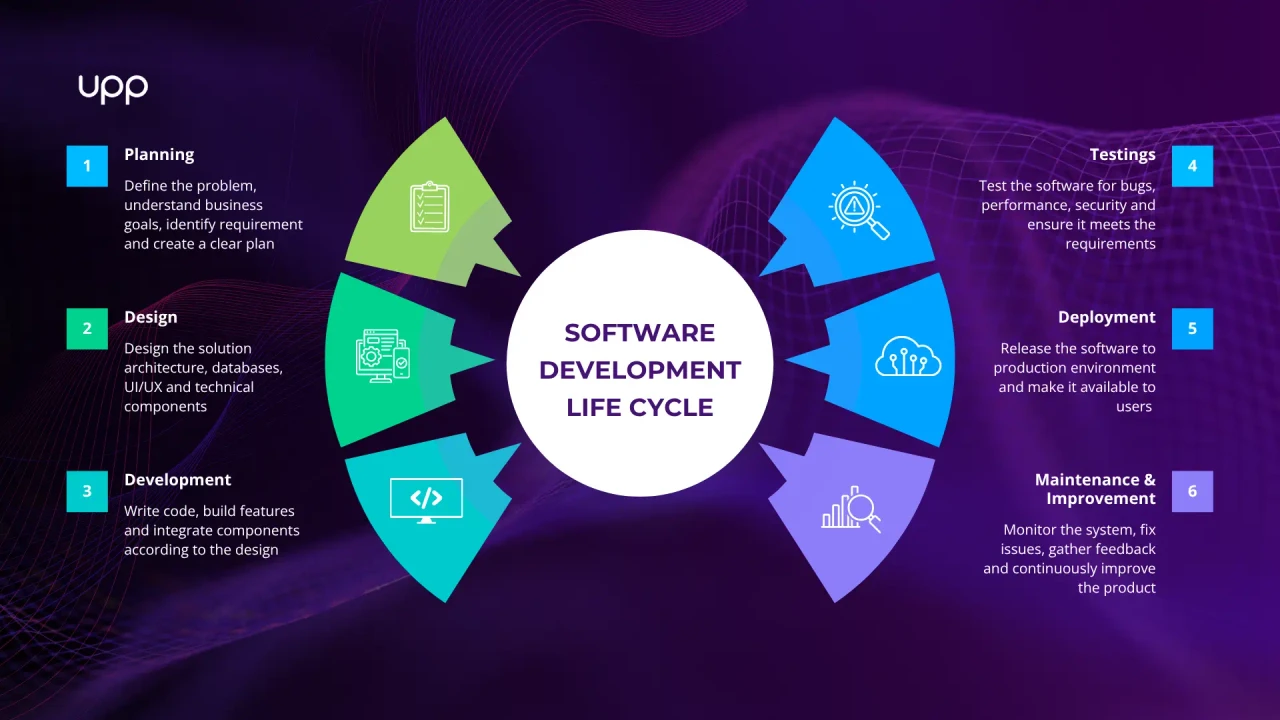
The software development lifecycle is the process that turns a business idea into working software through planning, design, development, testing, deployment, and continuous improvement. It gives software teams a clear path to build products that are useful, secure, scalable, and easier to maintain over time.
In a business context, SDLC is not only about how developers write code. It is also about how product teams define requirements, how architects design the system, how QA checks quality, how DevOps manages releases, and how teams improve the product after launch.
The software development life cycle stages are connected because each stage affects the next one. If requirements are unclear, development becomes harder. If architecture is weak, testing becomes more complex. If testing is incomplete, deployment becomes risky. If monitoring is missing, product issues are discovered too late.
A strong SDLC gives software delivery a clear structure. It helps teams move from idea to release with fewer gaps, fewer surprises, and better control over quality. With this foundation in place, AI coding tools can create greater value by accelerating development while still staying connected to the wider delivery process.
>> Read more: From Drift to Control: Building a Continuous Evaluation Pipeline for AI Agents
The Role of AI Coding Tools Inside the SDLC
Inside SDLC, AI coding tools create the clearest value during the development stage. They help developers write code faster, reduce repetitive tasks, generate common functions, suggest logic, and handle simple fixes more efficiently.
This matters because software development often includes many manual tasks that take time, such as writing repeated API logic, creating form validation, refactoring code, or building standard UI components. With AI coding tools, developers can spend less time on routine work and more time on complex product logic, technical decisions, and user experience.
In this way, AI coding tools become an important productivity layer inside SDLC. They make development faster and less manual, while the wider SDLC process gives that speed clear direction through planning, testing, security, CI/CD, releas e control, and continuous improvement.
Why Faster Coding with AI Still Fails Without Strong SDLC Control?
AI coding tools are most effective when development tasks are already clear, priorities are aligned, and teams understand how each piece of code supports the wider product goal. Their speed gives software teams strong momentum, and a well-structured SDLC helps turn that momentum into controlled, high-quality delivery.
Software delivery is more than writing code quickly. A product moves through many connected decisions before and after development. Teams need to understand the goal, agree on the scope, check technical risks, test the result, release it safely, and continue improving it after launch.
For example, a developer may use an AI tool to build a login feature in a short time. With a strong SDLC, the team can also define user roles, permission rules, security requirements, testing scenarios, and release criteria before the feature reaches users. As a result, fast development becomes part of a safer and more reliable delivery process.
This is where SDLC creates strategic value. It gives teams the structure to connect faster coding with business requirements, testing, security, CI/CD, release control, and post-launch improvement. The following five ways show how a strong SDLC helps companies turn development speed into better software outcomes.
Way 1: SDLC Clarifies Business Requirements Before Development
AI coding tools can generate code quickly, but speed becomes more valuable when the team already understands the business problem. A strong SDLC helps teams define what needs to be built before development starts.
This matters because many software issues begin with unclear requirements. If the team does not fully understand the user need, product priority, or business goal, even well-written code can still solve the wrong problem. AI coding tools may accelerate development, but they still need clear direction from the team.
For example, a SaaS company may want to build a reporting dashboard. AI coding tools can support the creation of the interface, data tables, or basic logic. However, SDLC helps the team answer the more important questions first. Which metrics should be shown? Who needs to use the dashboard? How often should the information be updated? What decision should the dashboard support?
When these questions are answered early, AI coding tools can work with stronger context. Developers are not just generating code faster. They are building toward a clearer business outcome. This is the first way SDLC creates value. It gives AI development direction, so teams can build faster without losing focus on what the product is meant to achieve.
Way 2: SDLC Validates AI-Assisted Code Through Testing
After AI coding tools help teams create code faster, testing inside the SDLC gives that speed a stronger quality layer. It helps teams check whether a feature works correctly, supports the intended user flow, and fits the wider product experience before it reaches real users.
This is important because fast code creation does not always mean the product is ready for release. Teams still need to validate user flows, edge cases, performance, security, and how the new feature connects with other parts of the product. Through testing, SDLC helps turn AI-assisted development into software that is more stable, usable, and reliable.
A practical case is a new subscription feature. AI coding tools may help generate the core logic for plan selection, payment handling, or account updates more quickly. Testing then helps the team confirm what happens when payment fails, when a user changes plans, when an invoice is generated, or when an admin reviews payment history.
In this way, SDLC does not slow down AI-assisted development. It gives teams the testing structure needed to turn faster coding into better product delivery. The result is fewer production bugs, a stronger user experience, and more confidence before every release.
Way 3: SDLC Keeps Project Data Secured During Development
As AI coding tools become part of development work, security needs to remain part of the process from the beginning. A feature can work correctly from a functional point of view but still create risks if data access, user permission, or sensitive information is not handled carefully.
A strong SDLC gives teams a clear way to consider security during development. Instead of treating security as a final review, SDLC makes it part of regular planning, implementation, testing, and maintenance.
For example, a team may build an API that allows users to access account information. AI coding tools can help generate part of the logic, but the team still needs to check who is allowed to access the data, what information can be returned, how unauthorized access is prevented, and whether sensitive details are protected.
This is especially important for SaaS products, enterprise platforms, and systems that manage customer or business data. The faster the team develops, the more important it becomes to maintain clear security practices throughout the process.
In this way, SDLC does not slow AI development down. It makes faster development safer. It gives teams the structure to use AI coding tools confidently while reducing the risk of exposing sensitive information or creating avoidable security issues.
Way 4: SDLC Connects QA with the CI/CD Pipeline for Safer Releases
AI coding tools give development teams more speed during the coding stage. They can help developers create logic, build features, and complete technical tasks faster. To turn that speed into a reliable product release, teams need a clear process that checks quality before the feature reaches users. This is where SDLC, QA, and the CI/CD pipeline work together to make fast development more structured and easier to control.
SDLC defines how a feature should move from development to release, QA checks whether the feature works as expected, and the CI/CD pipeline automates important steps such as building, testing, and preparing the product for deployment. When these parts are connected, AI coding tools can create stronger value because developers can move faster while the release process still protects product quality and user experience.
Take a data export feature as an example. AI coding tools may help developers create the core logic for downloading reports as CSV or PDF files. With a strong SDLC, the team can define what the feature needs to meet before release, such as accurate exported data, correct user permissions, stable performance with large files, and smooth testing in a staging environment. In this process, SDLC sets the release standard, QA validates the feature, and the CI/CD pipeline runs the required checks more efficiently.
Way 5: SDLC Improves Software Quality After Release
Software quality does not stop when a feature is released. After launch, teams still need to monitor performance, review user feedback, fix issues, and improve usability. AI coding tools support this stage by helping developers respond faster to real-world problems, making it easier to adjust features and maintain product stability.
SDLC creates long-term value by turning post-launch feedback into continuous improvement. Instead of treating each release as a one-time task, teams can use SDLC to guide how updates are planned and delivered. AI coding tools enhance this process by accelerating implementation, while SDLC ensures that changes are meaningful, well-tested, and aligned with product goals.
For SaaS products, this combination is especially important. User needs and business priorities can evolve over time, and AI coding tools help teams adapt quickly. At the same time, SDLC helps prioritize improvements, manage risks, and connect each update to the overall product roadmap. Together, they enable teams to move from faster coding to better software over time.
How UPP Helps Businesses Build an AI-Ready SDLC
Before businesses scale AI in software development, they need a clear view of whether their current delivery process is ready to support it. UPP Global Technology JSC helps businesses assess the AI readiness of their software delivery process. Before adding more AI coding tools into daily development, companies need to understand whether their current SDLC is structured enough to support faster execution, better collaboration, and more controlled delivery.
UPP works with businesses to audit their existing SDLC and identify where AI can create practical value across the development process. This includes reviewing how teams define requirements, manage development work, check quality, coordinate CI/CD, operate with DevOps practices, handle releases, and improve products after launch.
The goal is to build an AI-ready SDLC where people, processes, and tools can work together effectively. With this foundation, AI coding tools can support developers more productively, while the wider delivery process remains clear, consistent, and aligned with business goals.
For companies planning to adopt AI in software development, an SDLC audit helps decision-makers understand where they are ready, where risks may appear, and what should be improved first. This creates a clearer roadmap for using AI coding tools in a practical, scalable, and sustainable way.
>> Need a free AI Integration Checklist? Contact UPP and we will send it to you
Conclusion
AI coding tools bring clear value to modern software teams. They reduce repetitive work, speed up development, and allow developers to focus more on complex product thinking and user experience.
A strong SDLC makes that value more practical and reliable. It gives AI development a clear path from idea to delivery, so teams can move faster without losing alignment, control, or long-term product direction.
For companies adopting AI coding tools, the goal is to connect speed with structure. When AI coding tools operate inside a strong SDLC, teams can build software that is not only completed faster but also more stable, scalable, and valuable for long-term business growth.
FAQ:
1. How can a company know its SDLC is not strong enough?
A company may need to review its SDLC when releases are often delayed, bugs appear repeatedly after deployment, requirements change too late, or teams depend too much on manual checks before going live. Another sign is when developers complete tasks quickly, but QA, security review, or release approval still slow everything down.
2. Does improving SDLC make software development slower?
Not necessarily. A stronger SDLC may add clearer steps, but it usually reduces wasted time later. When requirements, testing, security, and release rules are clear, teams spend less time fixing avoidable mistakes, rebuilding features, or handling production issues.
3. What is the biggest mistake companies make when adopting AI coding tools?
The biggest mistake is using AI coding tools without a clear SDLC to guide them. AI coding tools can improve speed and productivity, while a strong SDLC helps teams turn that speed into better planning, stronger quality, and more reliable software delivery.
4. How do SDLC and CI/CD work together?
SDLC defines what needs to be checked before software is released, while the CI/CD pipeline automates build, test, and deployment steps. When both work together, teams can release faster without losing control over quality, security, and product stability.
5. How can companies measure whether their SDLC is improving?
Companies can track release frequency, production bugs, rollback rate, QA cycle time, deployment failure rate, security issues, and time spent on rework. If these numbers improve while the team still delivers features consistently, the SDLC is becoming stronger.
Newsletter
DISCOVER MORE































































![[Recap] UPP Global Technology JSC Establishing Anniversary](/homepage/news-section/new-4.webp)





































LET’S TALK...
Content delivered to your inbox


ENTER YOUR EMAIL
YOU WANT TO...


Hanoi, Vietnam
Web3 Tower, No. 15, Alley 4, Duy Tan, Cau Giay, Hanoi, Vietnam