OpenAI Agents SDK and The Future of Action-Oriented AI in Business
Date
August 28th, 2025
Reading Time
7 mins
What's news
From Conversation to Action
In the last decade, AI in business has primarily been advisory: answering queries, generating reports, or suggesting actions.
But in 2025, with the introduction of OpenAI Agents SDK, we are stepping into a new era AI that doesn’t just recommend, it executes.
In today's blog we see this shift as a defining moment: the rise of Action-Oriented AI. Agents that reason, act, and adapt effectively becoming “digital teammates” in your enterprise.
Automation vs. Autonomy: The Paradigm Shift
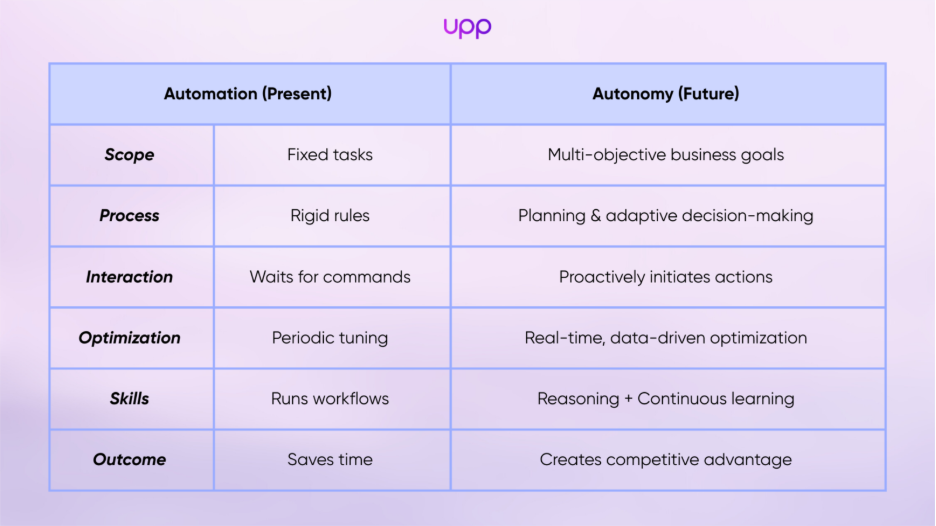
The leap from automation to AI autonomy is more than just technological, it’s transformational.
Automation simply follows predefined instructions. Autonomy, on the other hand, grasps objectives, reasons through complexity, and charts its own path to achieve them.
The OpenAI Agents SDK: A Quick Primer
The OpenAI Agents Software Development Kit (SDK), released in early 2025, is a Python-based framework developed to facilitate the creation of advanced and multi-agent AI systems. It provides a lightweight and production-ready set of primitives for building agentic AI applications. Developed from the experimental “Swarm” project, this framework offers developers a robust platform to design AI agents that can reason, plan, and execute actions to accomplish complex tasks.
OpenAI’s new Agents SDK enables developers to build AI agents with advanced, customizable reasoning abilities. Instead of relying on static instructions, these agents can process information, evaluate options, and make context-aware decisions customized to business needs.
Beyond reasoning, the SDK makes it possible to integrate external tools and APIs, enabling agents to execute real world actions seamlessly across systems. With both short and long-term memory, these agents maintain contextual awareness, allowing them to adapt and improve over time rather than starting from scratch in each interaction.
The framework also supports chaining multiple actions together, enabling the execution of complex workflows that span departments, processes, or entire organizations. And importantly, safety remains a core priority. Developers can embed safeguards such as human-in-the-loop oversight or audit logging to ensure transparency, accountability, and trust.
Use Case: AI-Driven Multi-Channel Marketing
Present-day challenge
Marketing teams today are stretched across LinkedIn, Facebook, TikTok, email, Google Ads, and more. Even with scheduling tools, campaigns remain largely static, lacking adaptive optimization and reacting too slowly to performance data.
With OpenAI Agents SDK (future-ready)
How it works:
-
Trigger: A new campaign is created in CRM (e.g., Salesforce).
-
Agent Planning: AI Agent pulls audience segments, generates channel-specific content.
-
Execution: Agent connects to LinkedIn API, Facebook Ads API, Mailchimp, TikTok Ads, ...
-
Monitoring: Continuously tracks CTR, conversions, sentiment, ...
-
Adaptation: Agent adjusts posting schedule, budget, and messaging.
-
Oversight: Logs all actions into BI dashboard, human can override.
Architecture:
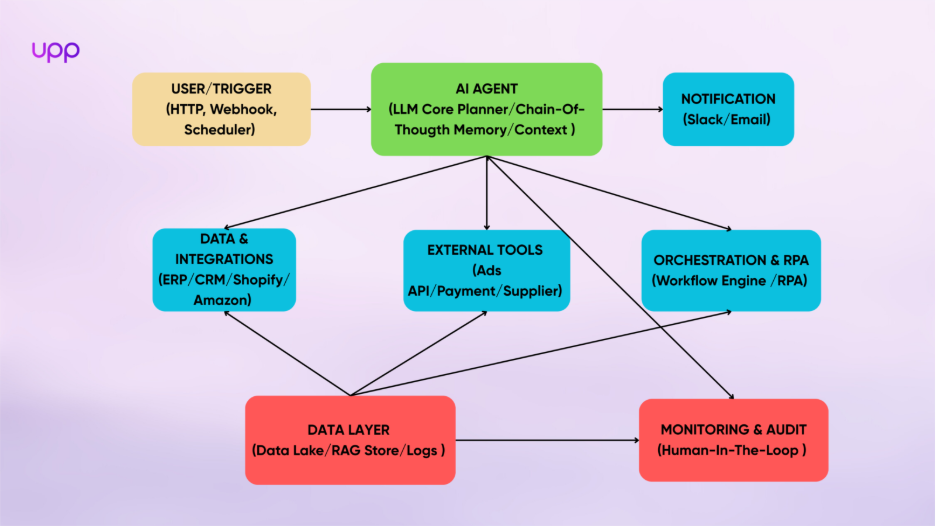
At the center is the Agent Core, powered by the OpenAI Agents SDK, which orchestrates both planning and execution. Surrounding it are the tools - CRM APIs, advertising APIs, email APIs, and other integrations—that enable the agent to act across platforms.
The agent is enhanced with memory, allowing it to store campaign context and audience preferences for smarter, more personalized decisions. Finally, monitoring is built in, with analytics dashboards and audit logs ensuring transparency, performance tracking, and accountability at every step.
Implementation example (pseudo-code):
codeagent = Agent( name="MarketingAgent", tools=[linkedin_post, facebook_ads, tiktok_ads, send_email, fetch_metrics], memory=True, monitoring=True ) agent.run(task="Launch the Just Do It campaign for Nike")
Business Impact
With AI agents, companies can save many hours that are now spent on running campaigns. The return on investment keeps getting better, because the system improves itself without needing many manual changes. This means even small teams can perform as well as, or better than, big marketing departments.
Potential Business Use Cases
Supply Chain Optimization
Present:
Today, RPA scripts create purchase orders when stock goes below a set level. But the system is rigid and cannot react well to market changes or sudden demand shifts.
With OpenAI Agents SDK:
When the ERP system shows a low inventory alert, the AI Agent starts planning. It forecasts demand using past sales, seasonal trends, and even outside data.
Next, the Agent chooses the best supplier through APIs, comparing cost, delivery time, and stock availability. After that, it executes the order automatically.
The Agent then keeps monitoring the process, tracking order fulfillment and logistics status to make sure everything runs smoothly.
Architecture:
ERP → Agent → Supplier APIs → Logistics tracking → Monitoring dashboard.
Business Impact:
With AI Agents, companies can expect big improvements in how they manage their supply chain. Stock outs and overstock, which often cost businesses a lot of money, can be reduced by about 15–25%. This means products are available when customers need them, while storage costs and waste are also kept low.
Supplier negotiations also become more efficient. Instead of staff spending hours comparing offers, the Agent can check price, delivery time, and reliability across many suppliers in seconds. This helps companies choose the best option and often leads to better deals.
Most importantly, the supply chain becomes adaptive. Traditional systems struggle when demand changes suddenly, such as during holiday seasons or unexpected market events. AI Agents can react quickly, adjusting orders and logistics in real time. This gives businesses a supply chain that is more flexible, more resilient, and ready for a volatile market.
Sales CRM Automation
Present:
In many companies today, CRMs send the same automated emails to every new lead. These emails are often generic and not personal. Because of this, many leads lose interest and stop responding. Sales teams then miss good opportunities, and the lead pipeline becomes weak.
With OpenAI Agents SDK:
When a new lead enters the CRM, the AI Agent is triggered. It starts by classifying the lead based on budget, industry, and urgency. After that, the Agent creates a personalized email that matches the lead’s profile and also schedules a follow-up call for the sales team.
The Agent does not stop there. It keeps monitoring the lead’s response rate and activity. If some leads show higher interest, the Agent moves them up in the pipeline. If others become less active, it changes the priority. This way, the sales team focuses time and effort where it matters most.
Architecture:
CRM → Agent → Email API + Calendar API → Sales dashboard.
Business Impact:
-
Leads get a faster and more personal response, which leads to higher conversion rates. Sales reps no longer waste time on repetitive admin tasks, like sending generic emails or updating records.
-
Instead, they can focus their energy on high-value deals and building real relationships with customers. This makes the sales process more efficient and also more human.
Customer Support Enhancement
Present:
Chatbots today can answer simple FAQs, but when a real issue comes up, they usually escalate it to human support. This creates overload for support teams and leaves customers waiting for help.
With OpenAI Agents SDK:
When a new support ticket is created, the AI Agent is triggered. It first understands the customer’s problem and pulls all relevant data, such as order status or account history. After that, the Agent can resolve the case on its own — for example by resetting a password, issuing a refund, or checking shipment status.
If the issue is too complex, the Agent escalates it to a human support rep. This way, simple cases are solved quickly, while human agents can spend more time on the problems that really need their attention.
Architecture:
Ticketing system → Agent → Internal APIs (orders, billing, accounts, ... ) → Resolution log.
Business Impact:
-
40–60% tickets resolved without human touch.
-
Faster response times, happier customers.
-
Support teams scale without adding headcount.
Risks and Governance
-
Over-reliance on autonomous systems → Require strong human oversight.
-
Data security & compliance → Integrations must follow strict governance.
-
Ethical AI use → Transparency in decision-making logic.
At UPP, we emphasize Responsible AI Deployment: integrating monitoring, audit trails, and human-in-the-loop checkpoints.
Final Take: From Assistants to Colleagues
We are at the dawn of AI systems that can own entire business processes.
The OpenAI Agents SDK is not just a toolkit for coders – it’s the foundation for next-generation enterprise operating models.
The question for leaders is no longer “Can AI do this?” but “What processes are we ready to hand over to AI – and how will we govern them?”
At UPP Global Technology JSC, we’re building toward that future – where AI doesn’t just work for you, it works with you.
Newsletter
DISCOVER MORE





















![[Recap] UPP Global Technology JSC Establishing Anniversary](/homepage/news-section/new-4.webp)


















LET’S TALK...
Content delivered to your inbox


ENTER YOUR EMAIL
YOU WANT TO...


Hanoi, Vietnam
Web3 Tower, No. 15, Alley 4, Duy Tan, Cau Giay, Hanoi, Vietnam