Top 10 Mistakes to Avoid When Implementing Salesforce
Date
November 10th, 2025
Reading Time
7 mins
What's news
Salesforce is a cloud-based CRM platform that helps businesses of all sizes manage their sales, marketing, and customer service. It is a powerful tool that can make business operations faster, more connected, and more efficient. However, Salesforce can only bring real results when it is implemented properly. Without careful planning, companies might face many problems that cost both time and money to fix later.
Implementing Salesforce is not always easy. It requires preparation, the right resources, and a clear strategy. Many organizations make similar mistakes during this process. In this article, we will mention ten common mistakes that companies should avoid when implementing Salesforce.
1. Ignoring the Development and Release Process
When implementing Salesforce, many companies only focus on business operations and user needs while overlooking the development and release process. Without an effective CI/CD (Continuous Integration / Continuous Deployment) strategy, development efficiency drops significantly. Teams may experience frequent release errors, inconsistent environments, or even downtime during deployment. These issues not only slow down the project but also increase the cost of fixing bugs later.
UPP's solution:
We help businesses adopt a DevOps-driven release process that ensures stability and transparency. Our approach includes Git-based flow, CI/CD pipelines, sandbox strategy, test automation, and quality gates. This structure minimizes deployment risks, reduces human errors, and speeds up delivery cycles, enabling your Salesforce system to evolve quickly and safely in alignment with business goals.
Take a quick look at our Salesforce-dedicated page: here
2. Overlooking Security and Permission Management
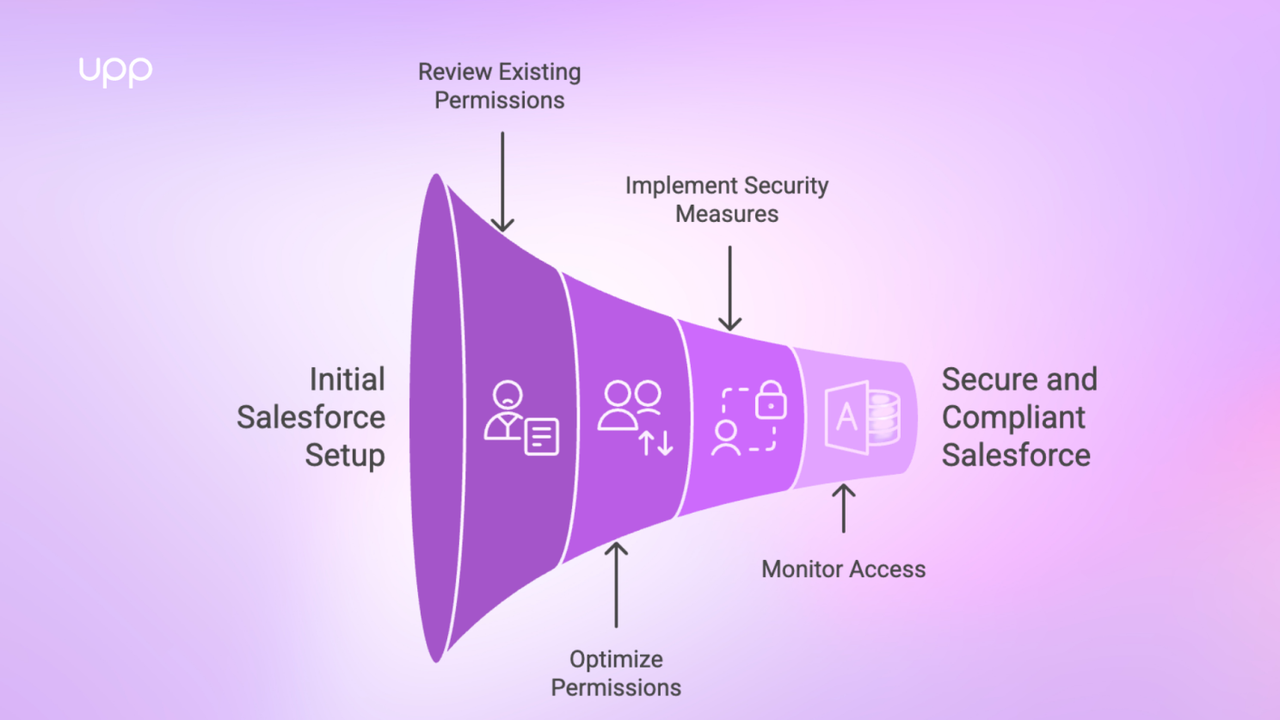
During development or when maintaining and extending a Salesforce system, many teams skip the important step of reviewing existing profiles and permission sets. Instead, they create new permissions or update them directly in production. This practice often leads to permission overlaps, over-privileged access, and potential security violations. Over time, it becomes difficult to control who has access to what, creating serious data governance and compliance risks.
UPP's solution:
UPP maintains a clear compliance and auditing roadmap before starting any task. We regularly review and optimize profiles, permission sets, OWD (Organization-Wide Defaults), sharing rules, and field-level security. We also utilize audit logs and access assessments to ensure that permissions are always properly configured and aligned with your company’s policies. This helps keep your Salesforce environment secure, compliant, and well-controlled.
3. Skipping the Planning Phase
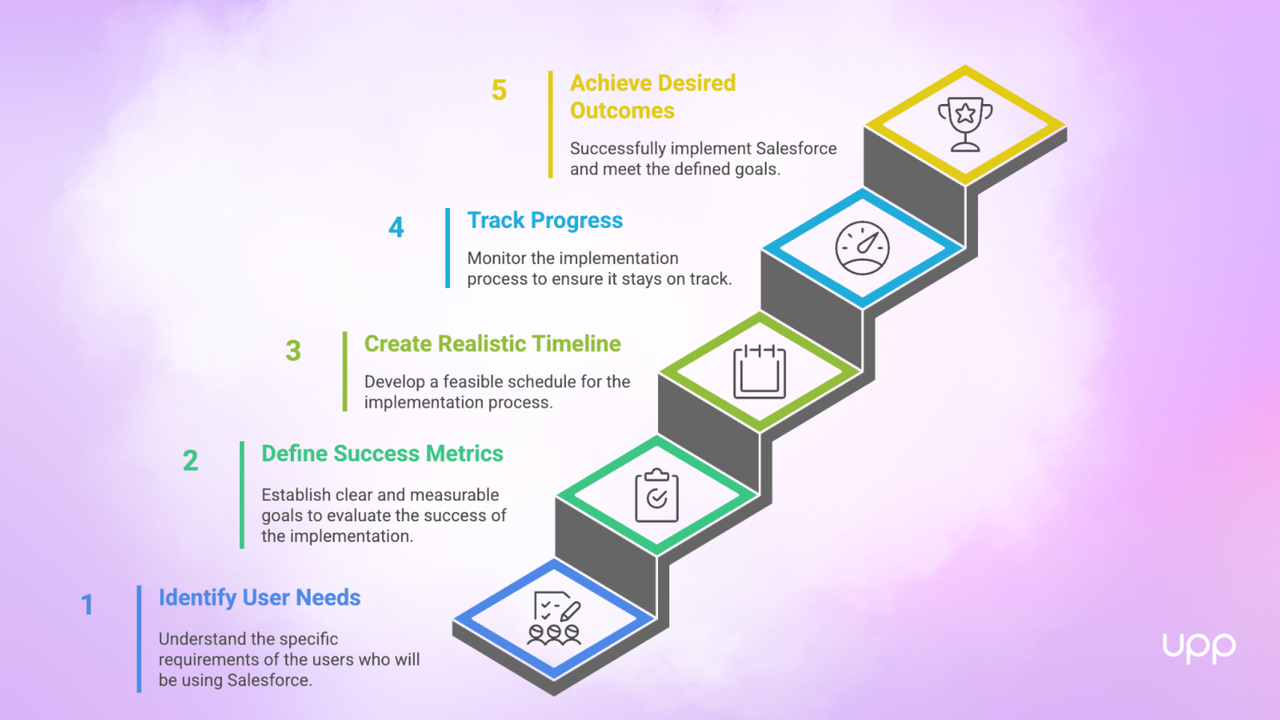
Some companies rush into Salesforce implementation without a clear plan. They believe that once the system is installed, it will automatically improve their business operations. However, without understanding their processes or defining goals, teams often end up confused and waste both time and budget.
A detailed plan helps identify user needs, key success metrics, and a realistic timeline. It also allows management to track progress and make changes when needed. Careful planning at the beginning ensures the whole project runs smoothly and achieves the desired outcomes.
UPP's solution:
We go beyond traditional implementation by offering a flexible collaboration model combined with a clear transformation roadmap and experience mapping for each client’s business. This approach ensures that every Salesforce solution aligns with real operational needs and can be deployed quickly and effectively, delivering tangible business outcomes from day one.
4. Underestimating Platform Limits and Migration Risks
Another common challenge during Salesforce operation or system migration is encountering platform limitations such as REQUEST_LIMIT_EXCEEDED (24-hour API quota) or “Concurrent API” errors, which occur when too many requests run in parallel, for example, during large data sync or integration batches. These limits are built into Salesforce and can cause synchronization failures or system slowdowns if not managed properly. Additionally, record locking is a frequent issue during mass updates or data imports, disrupting critical business processes.
UPP's solution:
UPP helps clients anticipate and handle these platform constraints effectively. Our experts design optimized integration strategies, schedule API calls intelligently, and implement queueing or batch processing mechanisms to prevent overload. During data migration, we ensure careful sequencing and locking management to minimize conflicts. This ensures smooth system operation and reliable data synchronization without affecting daily business performance.
5. Failing to Fully Consider the Data
When organizations move to Salesforce, they often focus too much on new tools and features and forget about their existing data. Data is the foundation of every CRM system. Without clean, accurate, and complete data, Salesforce will not perform as expected.
Before implementation, take time to check your data carefully. Remove duplicates, fix errors, and organize everything properly. Make sure the data migration process is clear and smooth. When your data is well-prepared, your Salesforce system will run more efficiently, and your reports will be much more reliable.
Read more: Optimizing Data Pipelines in Salesforce Data Cloud
6. Absence of a Post-Implementation Plan
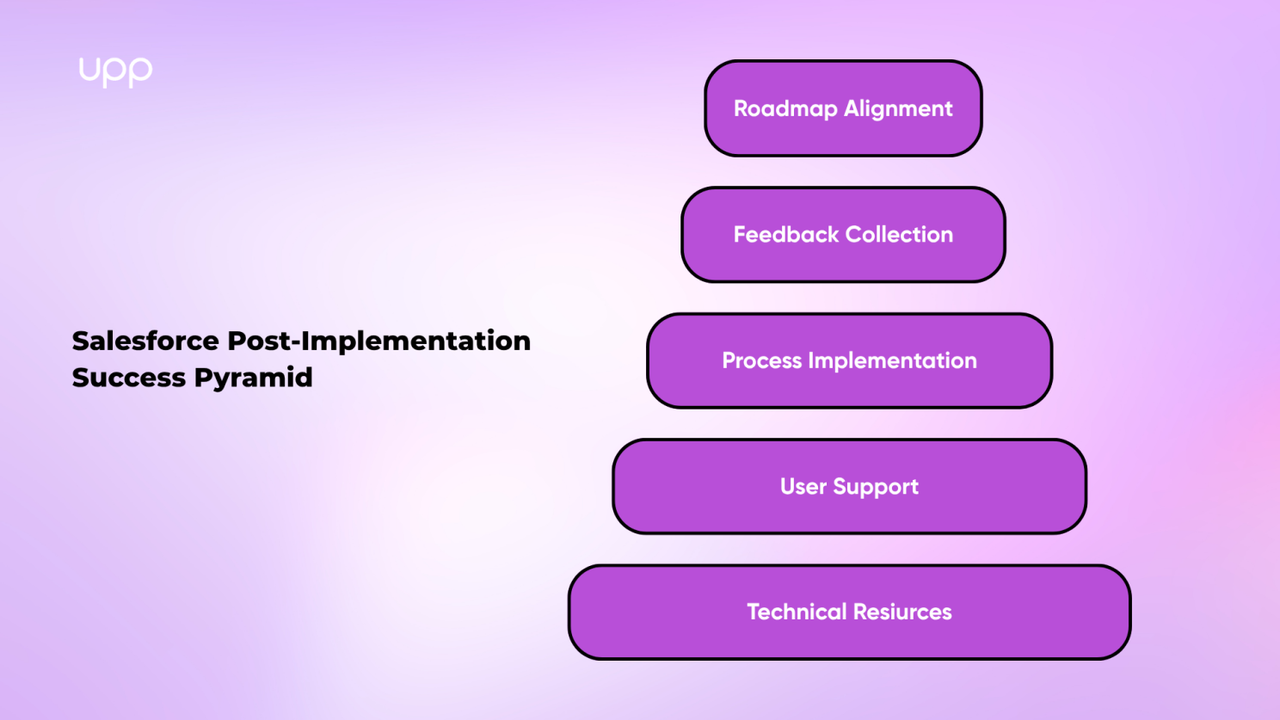
One of the most underrated aspects of Salesforce’s success is post-implementation. Many people believe that once Salesforce is installed, it will take off and prosper on its own. However, upon implementation, a project leader or administrator must continue to monitor and ensure the following:
- Technical resources must be present
- Users must be given support with training and assistance
- New software processes are clearly identified and implemented
- Users can give feedback about the new improvements
- Salesforce roadmap must be in place
Having a post-implementation plan ensures that the system continues to grow and adapt to your company’s needs. It helps maintain user engagement, improves productivity, and ensures long-term success with Salesforce.
7. Lack of Training
Training is one of the most important parts of Salesforce implementation, but it is also the one most often forgotten. Salesforce offers many strong features, but these tools are useless if employees don’t know how to use them.
Before launching Salesforce, make sure your team understands how the system works and how it supports their daily work. Training should include key features, third-party applications, and best practices for using the system efficiently. When users feel confident and comfortable with Salesforce, they will be more productive, and your organization will get more value from the platform.
8. Choosing the Wrong Implementation Partner
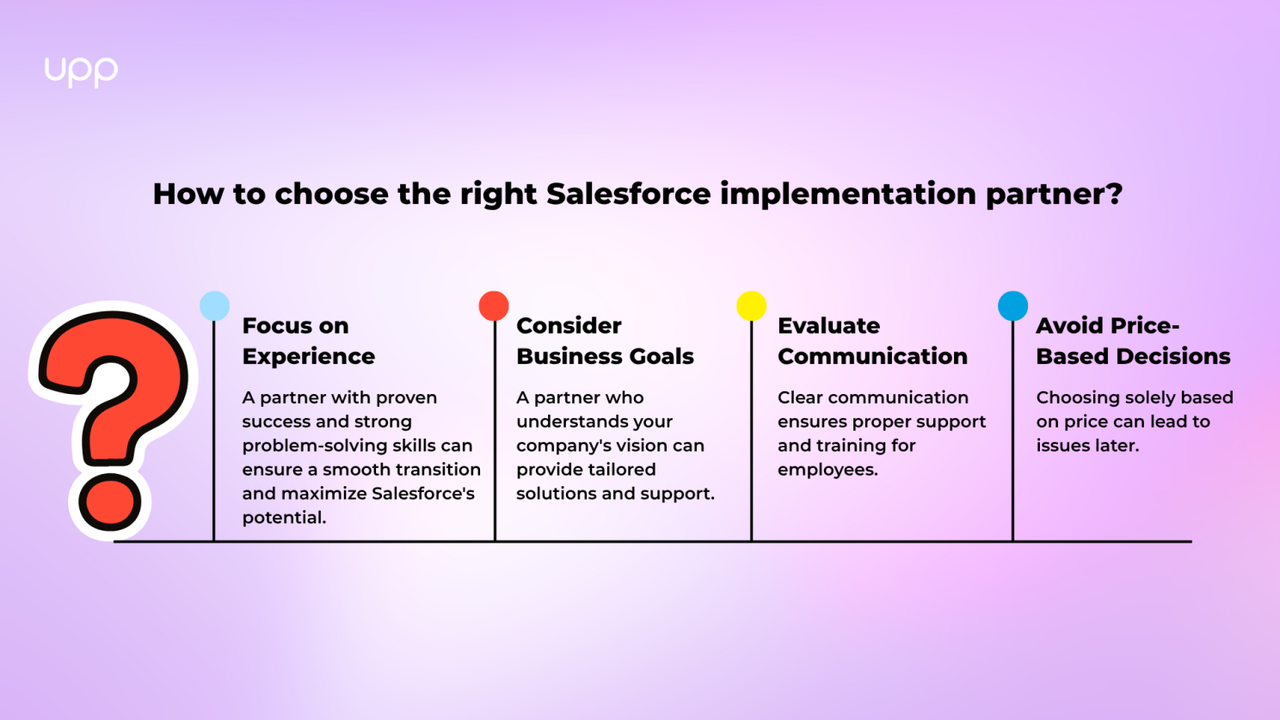
Selecting the right partner for your Salesforce project is one of the most important decisions. A good partner should understand your business goals, communicate clearly, and have real experience with Salesforce projects. If the partner lacks experience or doesn’t match your company’s needs, your employees may not receive proper support or training.
Don’t choose based only on price; sometimes cheaper partners bring more trouble later. Instead, look for a team with proven success, strong problem-solving skills, and a clear understanding of your company’s vision. The right implementation partner can make the transition smooth and help your team use Salesforce to its full potential.
With over 100 Salesforce certifications across key roles, UPP brings deep expertise in Salesforce solutions that empower businesses to streamline operations, enhance customer engagement, and accelerate growth through Salesforce's powerful automation capabilities.
Read more: Top Leading Salesforce Development Companies in Vietnam 2025
9. Assuming Salesforce is “Just a CRM”
Many new users think Salesforce is only a tool to store contacts and accounts. This belief limits how much value they can get from the system. Salesforce is not only a database but also a platform that helps businesses automate workflows, analyze data, and connect different departments in one place.
When companies treat Salesforce as a simple When companies treat Salesforce as a simple CRM, they miss opportunities to use advanced features such as automation, dashboards, and integrations. As a result, employees keep doing manual work and the system does not deliver the expected return on investment.CRM, they miss opportunities to use advanced features such as automation, dashboards, and integrations. As a result, employees keep doing manual work and the system does not deliver the expected return on investment.
10. Buying Salesforce Licenses Without Expert Advice
Buying Salesforce licenses without expert advice is one of the most common and costly mistakes organizations make. Many companies purchase too many or the wrong types of licenses because they don’t fully understand their real usage needs. Salesforce offers a wide range of license types, each with different access levels and pricing models. Without proper consultation, businesses often end up paying for features they never use or lack access to critical tools they actually need.
UPP's solution:
UPP helps clients analyze business requirements, user roles, and future scalability before making any licensing decisions. Our team provides detailed guidance on license optimization, ensuring you only pay for what brings value to your operations. By matching the right licenses to the right users, we help reduce unnecessary expenses while maintaining flexibility for future growth. This approach maximizes your return on investment and prevents costly reconfiguration later.
Conclusion
Salesforce can transform the way your company operates, helping you improve customer experience, streamline operations, and boost sales. But to unlock its full potential, careful preparation and smart execution are necessary.
By avoiding these five mistakes, choosing the wrong partner, ignoring costs, neglecting data, skipping post-implementation planning, and forgetting about training, your business can achieve long-term success and make the most of Salesforce’s powerful tools.
To implement it, UPP Global Technology JSC can help you. As a Salesforce Ridge Partner, we keep pace with Salesforce best practices and consistently deliver high-quality, up-to-date solutions to our clients. With years of experience collaborating with clients across diverse markets, including the United States, Australia, Singapore, Japan, and South Korea, our team brings deep insight into global business practices and technical expectations. This enables us to tailor Salesforce implementations that align with the unique demands of each market, ensuring optimal client satisfaction.
Newsletter
DISCOVER MORE














































































![[Recap] UPP Global Technology JSC Establishing Anniversary](/homepage/news-section/new-4.webp)















































LET’S TALK...
Content delivered to your inbox


ENTER YOUR EMAIL
YOU WANT TO...


Hanoi, Vietnam
Web3 Tower, No. 15, Alley 4, Duy Tan, Cau Giay, Hanoi, Vietnam