Building AI Agents for Intelligent Task Automation in Business (Part 1)
Date
April 2nd, 2025
Reading Time
7 mins
Introduction
AI agents powered by large language models (LLMs) are emerging as powerful solutions for automating complex business tasks. Unlike traditional software with fixed workflows, an AI agent can reason, plan, and act dynamically using natural language understanding. This enables automation of tasks in domains like operations, customer support, sales outreach, finance workflows, and more. In this post, we dive deep into how to build such AI agents for business automation – covering their architecture, algorithms, code examples, and deployment considerations.
Key Takeaways
1.AI Agents for Business Automation
- AI agents powered by Large Language Models (LLMs) can dynamically reason, plan, and act, making them more flexible than traditional automation tools.
- They are used in operations, customer support, sales, and finance to streamline workflows and reduce manual effort.
2. Use Cases
- Operations: AI agents automate multi-step processes like order fulfillment and employee onboarding.
- Customer Support: They provide intelligent responses, integrate with ticketing systems, and take actions beyond simple chatbot functions.
- Sales & CRM: AI agents research leads, personalize outreach, update CRM data, and schedule follow-ups.
- Finance & Reporting: They automate financial workflows, retrieve data, and generate reports for quick insights.
3. AI Agent Architecture
- LLM as the Brain: The AI agent’s core reasoning engine processes user inputs and determines the next action.
- Tools & Actions: Agents interact with APIs and external tools to retrieve data, perform calculations, or execute operations.
- Memory Systems: Short-term memory retains context within conversations, while long-term memory (e.g., vector databases) stores past knowledge.
- Planning & Control Flow: AI agents decide their next steps using structured reasoning, either through implicit prompting (ReAct) or explicit planning (Plan-and-Execute).
4. Control Flow Strategies
- ReAct (Reasoning + Acting): AI agents think, act, observe results, and refine their approach iteratively.
- Plan-and-Execute: The agent first formulates a high-level plan, then executes tasks step by step, reducing redundant LLM calls and improving efficiency.
5. Next Steps
- The next part (Part 2) will cover hands-on implementation using LangGraph, demonstrating how to build, deploy, and optimize AI agents for real-world business applications.
Use Cases: Business Automation with AI Agents
AI agents can transform many business functions by handling tasks intelligently and autonomously. They can take over repetitive or complex processes, allowing businesses to operate more efficiently.
One key area is operations and workflow automation. AI agents can manage multi-step processes such as order fulfillment or employee onboarding. They interact with APIs, update databases, and send notifications to different systems. For example, if a company needs to schedule maintenance for a machine, an AI agent can understand the request and execute each step needed to complete the task.
Another important use case is customer support. AI agents act as intelligent assistants that use knowledge bases to answer frequently asked questions, connect with ticketing systems, and even diagnose problems using automated tools. Unlike basic chatbots, they can ask follow-up questions and take additional actions to fully resolve customer inquiries.
In sales and customer relationship management (CRM), AI agents help sales teams by researching potential customers, drafting personalized emails, updating CRM systems, and scheduling follow-ups. These agents act as virtual sales assistants, handling time-consuming tasks so human representatives can focus on closing deals.
AI agents are also useful in finance and reporting. They can automate financial workflows, such as generating reports. For instance, an AI agent can retrieve data from accounting databases, perform calculations, and compile financial summaries. This allows businesses to get insights quickly without manual effort.
All these use cases involve multi-step tasks where AI agents must plan their actions, use different tools and APIs, and adjust based on results. Next, we will explore the architecture that enables these intelligent processes.
AI Agent Architecture: Core Components and Design
Modern AI agents are built from several core components working in unison to perceive, reason, and act. At a high level, you can think of the LLM as the “brain” of the agent, supported by modules for tools, memory, and planning. An effective architecture ensures seamless flow between user inputs, the LLM’s reasoning, external tool calls, and results aggregation.
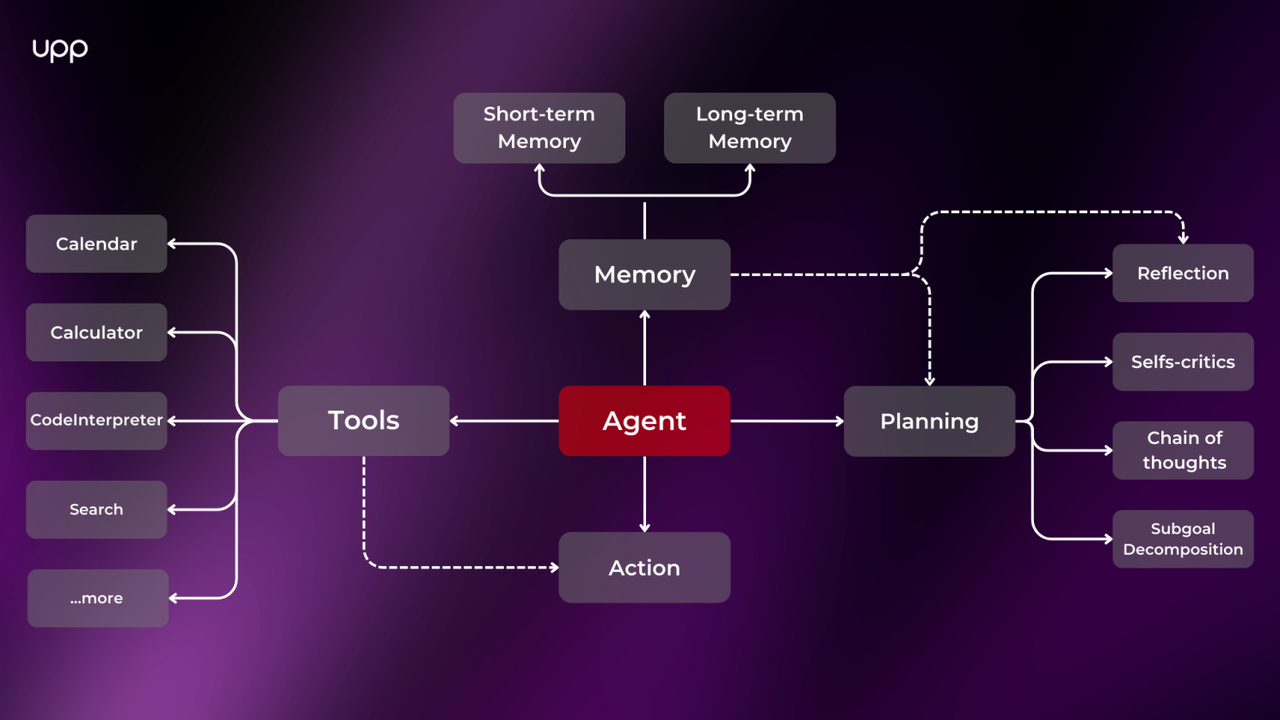
Let’s break down the key components depicted above:
-
LLM (Agent’s Brain): The large language model (e.g. GPT-4o, Deepseek V3,…) is the core reasoning engine. It processes the user’s instructions and decides what to do next. By itself, an LLM just generates text, but as an “agent brain” it can be prompted to choose actions or answers based on context. The LLM’s output can be interpreted either as a direct answer or as a command for some tool.
-
**Tools and Actions:**Tools are external functions or APIs the agent can invoke to interact with the world. These could be a web search, database query, calculator, email sender, code executor, etc. The agent uses tools to gather information or perform operations that are beyond its internal knowledge. Each tool typically has a name, a description, and a function that the agent can call. Tools extend the agent’s capabilities – for example, accessing real-time data or performing computations. The architecture allows the LLM to output an “Action” specifying a tool and its input, which the agent’s executor then calls.
-
Memory Systems: Agents need memory to maintain context and learn from previous interactions. There are two main types: short-term memory and long-term memory. Short-term memory is the conversation or task history the agent keeps in the prompt (similar to an ongoing context window). Long-term memory is typically an external knowledge store (like a vector database or key-value store) that the agent can consult for facts or past events. By design, LLMs do not persist memory between calls, so we must explicitly manage memory. A common approach is Retrieval-Augmented Generation(RAG) – storing documents or prior knowledge as embeddings in a vector database and retrieving relevant pieces when needed. This allows an agent to recall company policies, customer profiles, or any reference data on-the-fly. Memory components ensure the agent’s decisions are informed by context (recent conversation) and knowledge base (enterprise data).
-
Planning & Control Flow: The agent needs a control mechanism to decide which action to take when. A planning module or logic manages this agent loop. It might be implicit (emergent from the LLM prompt, as in ReAct agents) or explicit (a separate planner that breaks tasks into sub-tasks). Planning may involve reasoning about subgoals, doing self-reflection on outcomes, and adjusting the strategy. For instance, the agent might plan to “first search for info, then calculate, then answer.” We’ll discuss specific planning techniques like ReAct, chain-of-thought, and others in the next section.
All these components communicate in a loop: The user gives an input, the LLM decides if it’s final answer or an action, tools execute and return results, memory updates with new observations, and the LLM is invoked again with updated context. This continues until a final answer or outcome is produced.
Agent Control Flow: From Reasoning to Action
A defining feature of AI agents is their iterative thought-action loop. Unlike a fixed script, the agent dynamically decides each step based on current information. Let’s explore how this control flow works and the algorithms enabling it:
ReAct: The Thought-Action-Observation Loop
One popular approach is the ReAct framework (Reasoning + Acting), where the LLM interleaves reasoning steps (“Thought”) with actions and observations. In each cycle, the agent does the following:
-
Thought: The LLM “thinks” about the problem and decides an action. This is usually a natural language string describing its reasoning or next step (e.g. “I should search for X to get more info”).
-
**Action:**Based on that thought, the agent outputs an action directive, typically calling a tool. For example: Action: Search["current weather in London"]. The agent framework parses this and invokes the specified tool (in this case, a search API).
-
**Observation:**The result from the tool is returned to the agent. This becomes an observation (e.g. the search results text). The agent incorporates this into its context.
-
**Next Thought:**Given the new information, the LLM produces the next thought, and the cycle repeats... until the agent decides to finish with an answer rather than another action.
This loop continues until a termination condition is met (often an explicit Finish action or the agent producing an answer). The ReAct paradigm effectively lets the LLM plan and adjust on the fly, using external information to inform its reasoning. It combines _chain-of-thought_style reasoning with real-time tool use, enabling dynamic problem solving beyond the LLM’s static knowledge.
For example, imagine a support agent tasked with answering _“What’s the weather in London and schedule a meeting if it’s sunny.”_A ReAct agent might internally generate a sequence like:
-
Thought: “The user is asking for London weather and a meeting schedule. I should check the weather first.”
-
Action: WeatherAPI["London"] → (Observation: “It’s sunny and 20°C in London”).
-
Thought: “It’s sunny. Next, I need to schedule a meeting.”
-
Action: CalendarAPI["Schedule meeting with team on next sunny day in London"] → (Observation: “Meeting scheduled for tomorrow 10am.”).
-
Thought: “I have the info and the meeting is set, I can now answer.”
-
Action: Finish["The weather in London is sunny, 20°C. I have scheduled a meeting for tomorrow at 10 AM."]
This interleaving of reasoning and acting is precisely how ReAct agents operate. Research has shown ReAct to be effective for complex question answering and decision-making tasks. The agent’s chain-of-thought guides which tool to use next, while each tool’s feedback informs subsequent reasoning, creating a powerful feedback loop.
Chain-of-Thought (CoT) and Advanced Planning
Underpinning approaches like ReAct is the concept of Chain-of-Thought prompting, where the model is encouraged to think step-by-step. CoT alone involves the LLM generating intermediate reasoning steps (usually hidden from the user) before the final answer. It improves performance on tasks requiring multi-step reasoning (math, logical inference, etc.) by breaking them down into smaller steps. For agents, CoT can be incorporated into prompts to get the LLM to outline a plan or reflect on results.
More advanced planning algorithms extend these ideas. For example:
-
**Tree of Thoughts:**Instead of a linear chain, the LLM explores a tree of possible actions and consequences, backtracking as needed to find the best solution (this can increase robustness for very complex tasks).
-
**PDDL Planning:**For certain structured problems, one can convert the task into a formal planning problem. PDDL (Planning Domain Definition Language) is a classical AI planning language. Some recent approaches use LLMs to translate a natural language goal into a PDDL problem, solve it with a symbolic planner, then have the agent execute that plan. This hybrid of symbolic AI and LLMs can bring “razor-sharp” logical reasoning to the agent for tasks like scheduling or logistics that benefit from explicit optimal planning.
-
**Self-Reflection and Correction:**Agents can be prompted to reflect on errors or quality of their output (e.g., using a “critic” prompt or by asking the LLM to verify the correctness of a solution). This is a meta-cognitive step that helps catch mistakes. A planning module might, for instance, ask the LLM: “Did the last action help? If not, consider a different approach.” This idea was inspired by human-like self-critique and is used in frameworks like AutoGPT and others to improve reliability.
Plan-and-Execute Paradigm
While ReAct agents plan one step at a time, an alternative is the Plan-and-Execute approach. Here, the agent first formulates an overall plan for the task (possibly using a stronger LLM or a specific prompt for planning), then executes each step of that plan. This can be more efficient for long, multi-step problems. For instance, if the task is to do a research report, a planning phase might output a list of steps: _“1. Gather data A; 2. Analyze data; 3. Draft report; 4. Review and finalize.”_After this, each step is carried out, possibly by smaller agents or function calls, without involving the main LLM for every tiny action. The agent may re-plan if an execution step yields unexpected results.
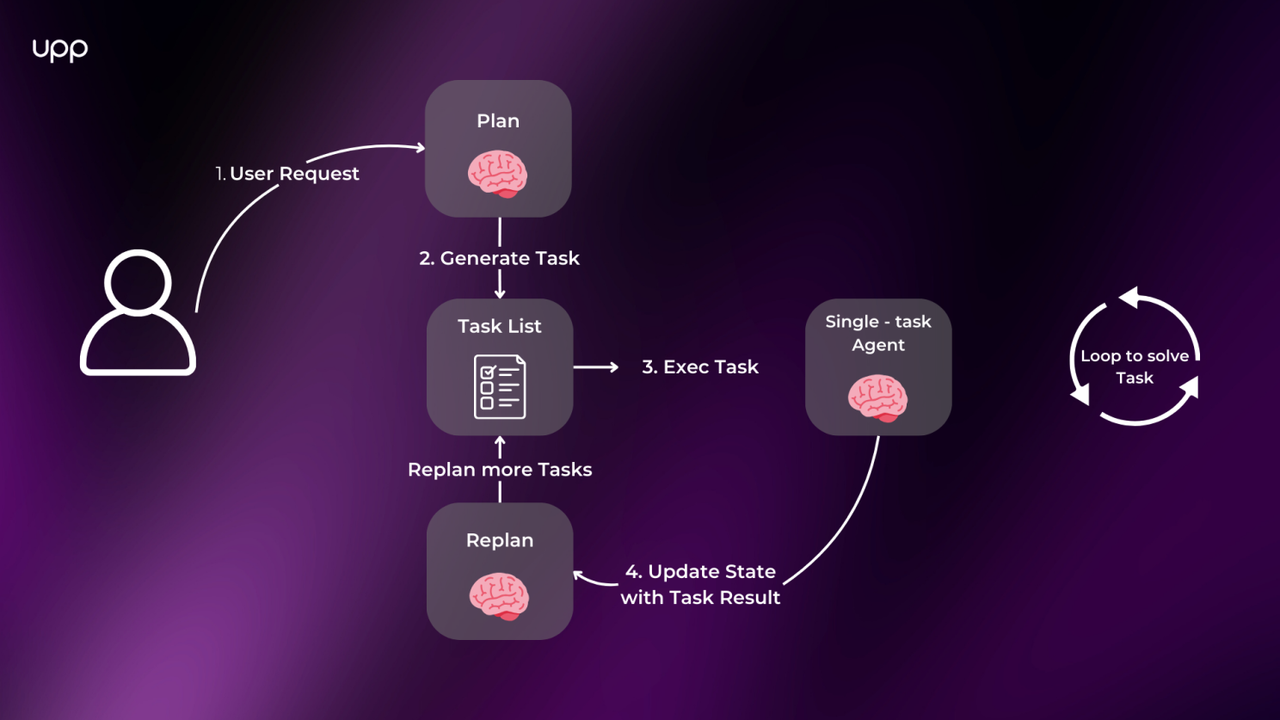
The Plan-and-Execute design (illustrated in Figure 2) often reduces the number of expensive LLM calls by handling sub-tasks in a more linear or specialized manner. It’s useful in business workflows where the task can be decomposed(e.g., data extraction → transformation → reporting). The initial planner ensures a coherent global strategy, while the executors handle details. Recent innovations like ReWOO (Reasoning Without Observations) and LLM+P (LLM with planning) further improve this by allowing the plan to use variables and handle dependencies between sub-tasks, but the core idea remains: explicitly think through the whole problem, then act.
Now that we’ve covered the conceptual foundations, let’s get hands-on with LangGraph– an implementation framework that makes it easier to build these kinds of agent workflows.
Conclusion
To wrap up Part 1, we have explored the fundamental role of AI agents in business automation, highlighting key use cases such as operations, customer support, sales, and finance. These agents go beyond simple automation by reasoning, planning, and executing tasks dynamically, making them more flexible and efficient than traditional rule-based systems. We also examined the architecture behind AI agents, detailing core components like LLMs, tools, memory systems, and planning modules. These elements work together to enable AI agents to interact with external systems, retrieve relevant information, and make decisions in real time. Additionally, we discussed different control flow strategies, including ReAct and Plan-and-Execute, which allow AI agents to handle complex, multi-step tasks effectively. With these foundational concepts in place, the next step is to delve into the practical implementation of AI agents. In Part 2, we will explore hands-on techniques for building these intelligent systems using frameworks like LangGraph, demonstrating how to design, deploy, and optimize AI agents for real-world business applications.
Newsletter
DISCOVER MORE















































![[Recap] UPP Global Technology JSC Establishing Anniversary](/homepage/news-section/new-4.webp)

























LET’S TALK...
Content delivered to your inbox


ENTER YOUR EMAIL
YOU WANT TO...


Hanoi, Vietnam
Web3 Tower, No. 15, Alley 4, Duy Tan, Cau Giay, Hanoi, Vietnam