CDP vs MDM: Why the Difference Matters and Where Data 360 Fits
Date
April 8th, 2026
Reading Time
7 mins
What's news
Abstract
As Data 360 continues to expand beyond its origins as a customer data platform, many organizations are starting to question whether it can replace Master Data Management (MDM). While both approaches deal with customer data and identity, they are built for fundamentally different purposes.
This article clarifies how Data 360 and MDM differ in design and intent, why confusing the two creates risk, and how they should be positioned together to support both data trust and business agility.
When Platform Evolution Creates Confusion
A common question in many data initiatives is whether Data 360 can take on the responsibilities of an MDM system.
This question reflects how far Data 360 has come. What started as a platform to unify customer profiles for marketing has grown into a central layer that connects data across sales, service, and customer engagement functions. With capabilities such as data unification and identity resolution, it can appear similar to MDM at first glance.
However, similarity in function does not mean equivalence in role. Treating Data 360 as an MDM often leads to architectural gaps that only become visible at scale, especially when data accuracy, accountability, and traceability are required.
Two Different Foundations: Data Control vs. Data Usage
The most effective way to separate the two is by looking at the problem each one is designed to solve.
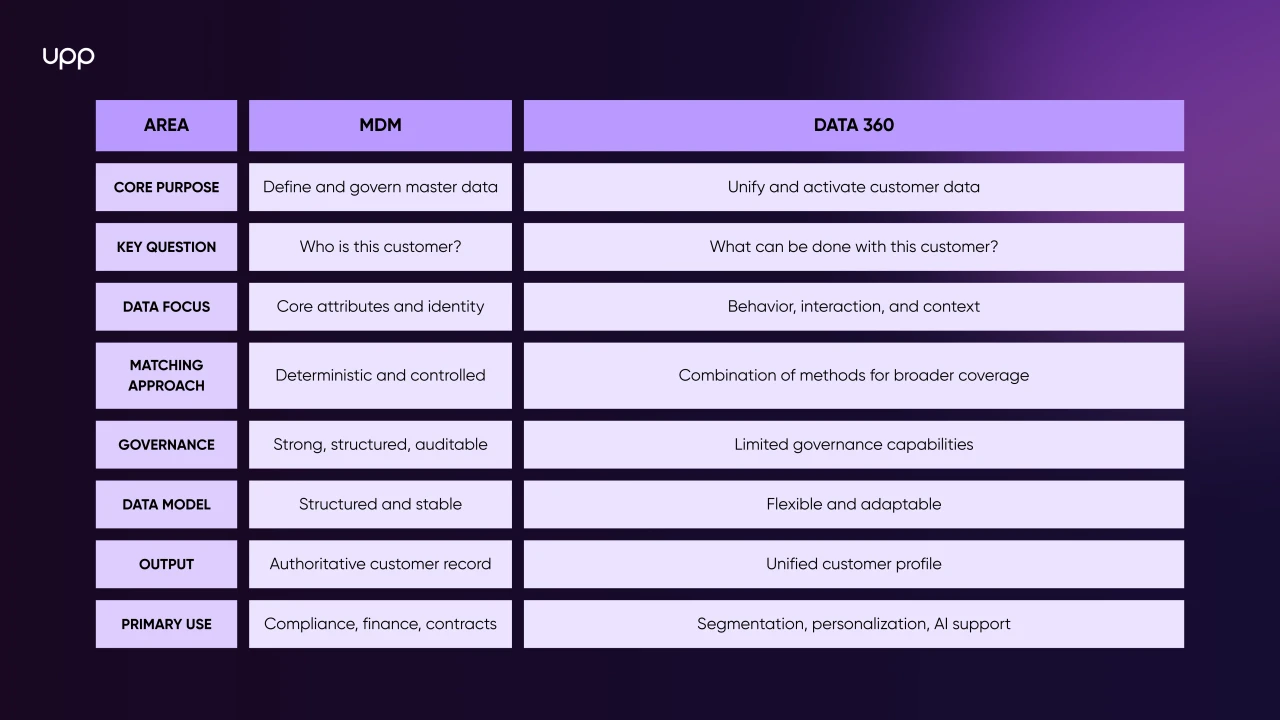
MDM answers a question of identity: Who exactly is this customer?
It is built to create trusted, governed, and standardized data. This includes managing survivorship rules, enforcing stewardship, and ensuring that records are auditable and consistent across systems. Its role is to define the official version of a customer or account, especially in contexts where accuracy has legal, financial, or contractual impact. Data 360 addresses a different need: What should be done with this customer?
It focuses on bringing together customer signals quickly so that organizations can segment audiences, personalize interactions, and support downstream processes, including AI use cases. The result is a unified profile designed for use, not a legally defensible record.
For this reason, even in its more advanced form, Data 360 remains aligned with the CDP category.
Read more: Optimizing Data Pipelines in Salesforce Data Cloud
What Happens When Roles Are Blurred
Challenges begin when Data 360 is expected to function as a system of record.
Governance gaps emerge
MDM systems are designed with formal governance in mind, including clear ownership, approval processes, and audit trails. Data 360 does not operate as a centralized environment for governing enterprise-wide customer data.
This becomes critical when identity decisions carry legal or financial implications. In such cases, deterministic matching, traceability, and clear data lineage are essential. Data 360’s identity resolution is valuable, but it is optimized for activation scenarios rather than strict governance.
Data quality issues shift downstream
Once Data 360 is treated as a substitute for MDM, upstream data issues, such as duplication, source conflicts, and ownership disputes are often pushed into it.
As a result, the platform begins to absorb responsibilities it was not designed for. Instead of enabling business use, it becomes a workaround for unresolved governance challenges, which can slow down operations and reduce overall control.
Trust begins to erode
When a unified profile is assumed to be the official version of a customer, it may be used beyond its intended scope.
While flexible matching methods can support customer engagement, they do not provide the level of certainty required for financial records or legal processes. Once trust in data is questioned, it affects every system that depends on it.
Identity Resolution: Same Concept, Different Intent
Part of the confusion comes from the fact that both CDPs and MDM systems refer to identity resolution and a “complete customer view.”
However, the intent behind these concepts differs.
In Data 360, identity resolution is used to assemble an actionable view by connecting behavioral, interaction, and channel data. The goal is to enable a more complete understanding of the customer across touchpoints.
In MDM, identity resolution is focused on establishing and maintaining the official identity of a customer across systems. The emphasis is on accuracy, consistency, and long-term data quality.
A useful way to frame this is:
-
MDM defines the official truth
-
Data 360 provides the best available unified view for use
While there is overlap, these roles are not interchangeable.
Flexible vs. Controlled Data Models
Another important distinction lies in how each system handles data structure.
Data 360 is designed to work with a wide range of data types, including high-volume and fast-changing inputs such as interactions, transactions, and engagement data. Its flexibility allows organizations to integrate and use diverse data sources efficiently.
MDM, by contrast, is intentionally more structured. Its data models are tightly controlled, with strict change management processes in place. This structure is what enables it to manage critical business entities and maintain consistency over time.
Data 360 can consume and build on data that has already been standardized in MDM, but it should not be the system where master data is defined and governed.
A Side-by-Side View
Why Structure and Flexibility Must Coexist
Another key difference lies in how each system handles data structure.
Data 360 is designed to work with high volumes of changing data. It supports a wide range of inputs, making it well suited for environments where customer interactions are constantly evolving. MDM, by contrast, focuses on stability. Its structure is carefully managed to ensure that critical business data remains consistent over time. Both approaches are necessary.
Without structure, data cannot be trusted. Without flexibility, it cannot be fully used.
A Practical Architecture Approach
In a well-defined data architecture, Data 360 and MDM operate together with clear responsibilities.
Data typically flows from operational systems such as CRM and ERP into MDM, where core customer data is standardized and governed. Data 360 then builds on this foundation, combining it with additional context to create a broader view that can be used across business functions.
This layered approach ensures that:
-
Core data remains accurate and consistent
-
Additional context can be applied without compromising integrity
-
Different teams can use data confidently for their specific needs
Rather than competing, the two systems strengthen each other.
Conclusion
As organizations scale and place greater reliance on data, clarity in system roles becomes critical. Misinterpreting Data 360 as a replacement for MDM often leads to gaps in governance, reduced trust in data, and unnecessary complexity across systems. While Data 360 has evolved into a powerful platform for unifying and extending customer data, it does not eliminate the need for a controlled and authoritative source of truth. The most effective approach is to clearly separate responsibilities: MDM ensures accuracy, consistency, and accountability for core customer data, while Data 360 expands that foundation with broader context to support business use. When these roles are properly defined, organizations can maintain strong data integrity while still enabling flexible and scalable use of customer data across functions.
Newsletter
DISCOVER MORE















































































![[Recap] UPP Global Technology JSC Establishing Anniversary](/homepage/news-section/new-4.webp)















































LET’S TALK...
Content delivered to your inbox


ENTER YOUR EMAIL
YOU WANT TO...


Hanoi, Vietnam
Web3 Tower, No. 15, Alley 4, Duy Tan, Cau Giay, Hanoi, Vietnam