RAG - The Hottest 3 Letters in Generative AI (Part 1)
Date
October 18th, 2024
Reading Time
10 mins
Tags cloud
What's news
Retrieval-Augmented Generation (RAG) enhances large language models (LLMs) by integrating real-time, domain-specific data, addressing the limitations of static training. This method allows organizations to generate accurate, context-relevant responses without the costly retraining of models. RAG is applicable in various areas, including customer support chatbots, search augmentation, and internal knowledge engines, improving operational efficiency and reducing inaccuracies. By leveraging RAG, businesses can swiftly adapt to changing information, ensuring their AI solutions remain effective and relevant in a dynamic environment.
What is RAG?
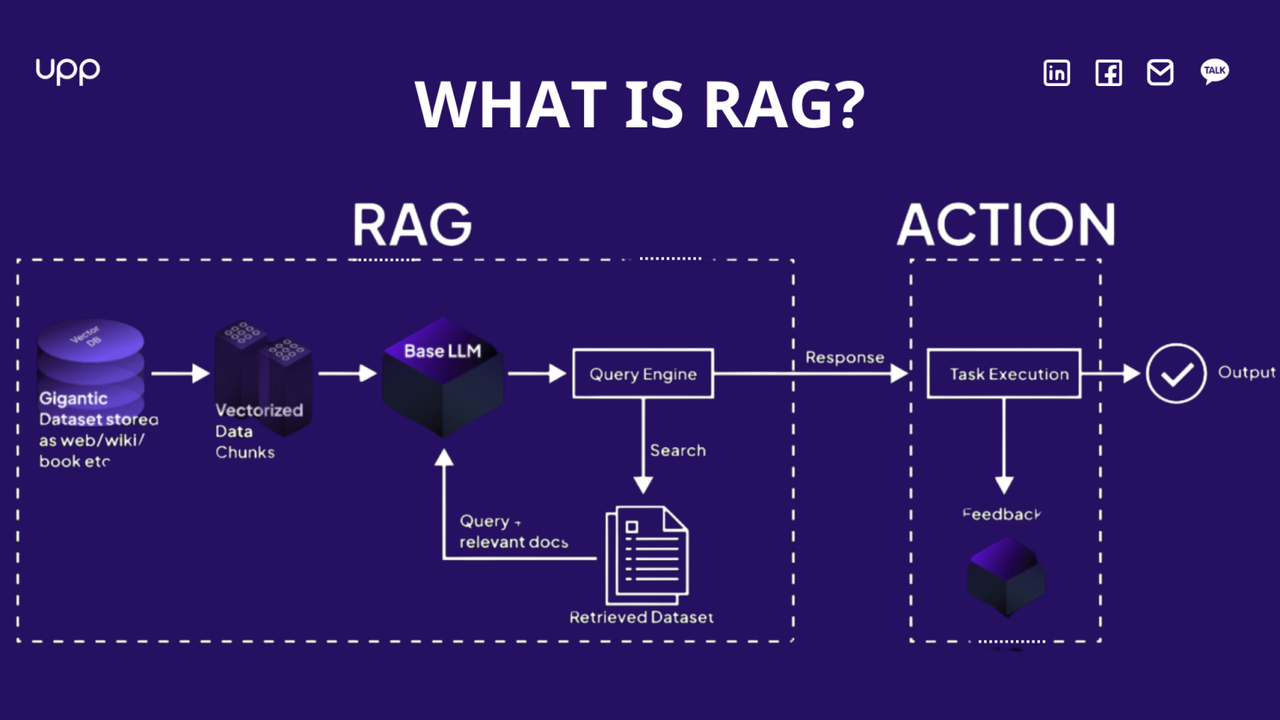
Retrieval-Augmented Generation (RAG) is a method that boosts the performance of large language models (LLMs) by using specific data. It works by finding relevant documents or information for a question or task, then giving that context to the LLM. RAG has been effective in support chatbots and Q&A systems, especially when they need to stay updated or provide specialized knowledge.
What can RAG do?
Retrieval-Augmented Generation (RAG) solves key challenges with large language models (LLMs). We can know more through these two problems:
Problem 1: LLMs don’t have access to your specific data
LLMs are trained on massive public datasets, allowing them to generate and understand content on a wide variety of topics. However, while this broad training gives them versatility, it also limits their ability to handle specific, up to date, or domain specific data. Once an LLM is trained, it cannot access or learn from new information beyond its original training data.
This limitation means that LLMs can become static, unable to keep pace with rapidly changing information. As a result, when asked about topics or data that fall outside their training, LLMs may produce inaccurate or outdated responses. In some cases, they may even "hallucinate" answers, generating content that sounds plausible but is incorrect or entirely wrong. This poses a significant challenge for organizations that need AI solutions to provide accurate, current, and context specific answers based on their unique data. Without a way to integrate real time information, LLMs risk becoming less effective over time.
Problem 2: AI applications need custom data to be effective
For LLMs to provide relevant, specific responses, they need to understand an organization’s unique domain and use its data, rather than offering generic answers. Can be mentioned as when companies build customer support bots, those bots need to provide company specific responses to customer questions. Similarly, internal Q&A bots must answer employee questions based on internal data, like HR or company policies.
The challenge is that retraining LLMs with custom data to fit a company’s specific needs can be costly and time consuming. Without using the right data, AI solutions may give irrelevant or inaccurate answers. So, how can companies build these AI solutions using their own data without going through the expensive and complex process of retraining the models? Solving this issue is key to making AI applications more useful and effective for organizations.
Solution: Retrieval Augmentation is the New Industry Standard
A straightforward and commonly used method for integrating custom data into large language models (LLMs) is called retrieval-augmented generation (RAG). This technique allows you to include your own data directly in the query you send to the LLM. Instead of relying only on the model’s training data, RAG retrieves relevant information in real time. This helps to enhance the model’s responses with the most up-to-date and specific context.
By using RAG, organizations can deploy any LLM and improve its capabilities by providing a small amount of their own data. This means the model can deliver results that are more relevant to their needs. Plus, RAG eliminates the need for expensive and time-consuming processes like fine-tuning or retraining the model, making it a more efficient and flexible option for companies looking to use AI in specific domains.
Some use cases for RAG
Exploring the Versatility of Retrieval-Augmented Generation (RAG)
Retrieval Augmented Generation (RAG) is revolutionizing how businesses access and utilize information. Now we will discover some potential use cases.
Question and Answer Chatbots
Integrating large language models (LLMs) with chatbots enables companies to deliver accurate and relevant answers drawn from their documents and knowledge bases. This automation enhances customer support by swiftly addressing inquiries and resolving issues, ultimately resulting in greater customer satisfaction.
Search Augmentation
LLMs can improve search engines by generating answers that enhance traditional search results. This helps users find the information they need more easily, whether for specific projects or general inquiries. As a result, it streamlines their workflow and boosts productivity.
Knowledge Engines for Internal Data
RAG (Retrieval-Augmented Generation) allows employees to easily access insights from company data, including HR policies and compliance documents, by simply asking questions. This direct access promotes a more informed workforce, leading to improved compliance and enhanced employee engagement.
Benefits of Retrieval-Augmented Generation (RAG)
Up to Date and Accurate Responses
RAG (Retrieval-Augmented Generation) is highly effective at providing specialized, domain specific responses, which is crucial for organizations operating in niche areas. By utilizing proprietary or specialized datasets, RAG delivers insights tailored to the organization’s specific needs, ensuring that users receive accurate and relevant information.
For instance, HR employees can quickly access company-specific policies and benefits details, which fosters trust and engagement by offering precise and helpful answers. In technical fields, professionals can easily find project-specific data, promoting collaboration and innovation.
This contextual relevance also enhances efficiency by reducing the time employees spend searching for information, allowing them to focus on using it effectively. As a result, this boost in productivity leads to improved customer service, as support staff equipped with domain-specific knowledge can resolve issues more effectively, ultimately contributing to organizational success.
Reduced Inaccuracies and Hallucinations
RAG (Retrieval-Augmented Generation) effectively minimizes inaccuracies and hallucinations often found in large language models (LLMs). Hallucinations occur when these models produce incorrect information, which can lead to misinformation and undermine trust. By grounding the LLM's output in relevant external knowledge, RAG improves the reliability of the information provided.
Furthermore, RAG can include information from original sources in its responses, making it easy for users to verify the information. This feature is especially valuable in industries like legal and healthcare, where accuracy is critical. By promoting transparency and accountability, RAG allows users to cross reference information, boosting their confidence in the responses they receive.
Reducing inaccuracies not only benefits users but also enhances overall organizational effectiveness. With reliable data, teams can make informed decisions, leading to better strategic planning and execution. In highly regulated industries, RAG helps organizations maintain compliance by providing accurate and verifiable information, thus minimizing the risks associated with misinformation.
Domain-Specific and Relevant Responses
RAG (Retrieval-Augmented Generation) useful for generating domain-specific responses, which is essential for organizations in specialized fields. By leveraging proprietary or specialized datasets, RAG offers insights that are highly relevant to the organization’s context, ensuring users receive accurate information tailored to their needs.
For example, HR employees can quickly access company-specific policies or benefits information, fostering trust and engagement among staff. In technical fields, professionals can find nuanced information relevant to their projects, which enhances collaboration and innovation.
Additionally, providing contextually relevant responses boosts operational efficiency. Employees spend less time searching for information and more time applying it, which increases productivity. This efficiency leads to improved customer service, as representatives equipped with domain-specific knowledge can resolve issues more effectively, ultimately driving overall organizational success.
Efficiency and Cost-Effectiveness
Implementing Retrieval-Augmented Generation (RAG) is simple and cost-effective compared to traditional methods for customizing large language models (LLMs) with specialized data. Organizations can adopt RAG solutions without needing extensive model changes or hefty infrastructure investments. This makes it a viable option for businesses of all sizes, including startups.
The affordability of RAG is especially advantageous in environments where data is constantly changing. Traditional retraining methods can be both time-consuming and expensive. In contrast, RAG helps organizations keep their LLMs relevant by linking them to external data sources. This connection allows for quick adaptations without the high costs associated with retraining.
Moreover, effective RAG implementation can lead to substantial long-term savings. By minimizing the time spent on information retrieval and boosting response accuracy, employees can focus on higher value tasks that contribute to business growth. RAG not only streamlines operations but also improves overall organizational efficiency, enabling better resource allocation and maximizing return on investment.
Conclusion
In conclusion, Retrieval Augmented Generation (RAG) significantly enhances the capabilities of large language models (LLMs) by integrating real time, domain specific data, which addresses key limitations such as outdated information and inaccuracies. This approach not only improves response accuracy and relevance but also fosters knowledge sharing within organizations, ultimately enhancing customer interactions. RAG's straightforward and cost effective implementation allows businesses to leverage AI efficiently without the need for complex retraining, positioning them for success in an increasingly fast paced environment.
Tags cloud
Newsletter
DISCOVER MORE



























![[Recap] UPP Global Technology JSC Establishing Anniversary](/homepage/news-section/new-4.webp)























LET’S TALK...
Content delivered to your inbox


ENTER YOUR EMAIL
YOU WANT TO...


Hanoi, Vietnam
Web3 Tower, No. 15, Alley 4, Duy Tan, Cau Giay, Hanoi, Vietnam