Multi-Agent Orchestration: How AI Agents Communicate, Coordinate, and Work Together (Part 2)
Date
November 5th, 2026
Reading Time
8 mins
Introduction
As agentic AI moves into enterprise workflows, the challenge is no longer just building smart agents, it is making them work together reliably.
A single AI agent can reason, use tools, and take action, but complex business processes often span multiple systems, data sources, and decisions. A multi-agent system solves this by assigning specialized agents to different tasks. But for the system to work, it must coordinate who acts, when, with what information, and how results move forward.
That coordination layer is multi-agent orchestration.
In Part 1 of this series, we introduced the fundamentals of a multi-agent system (MAS), including its components, benefits, use cases, and challenges. We also looked at how specialized agents can divide responsibilities and work toward a shared objective.
>> Read more: Multi-Agent System: How AI Agents Collaborate to Solve Problems (Part 1)
In this article, we move to the technical layer: how agents are coordinated, how they communicate, and how technologies such as MCP (Model Context Protocol) and A2A (Agent2Agent) connect agents with tools, data, and other agents.
What Is Multi-Agent Orchestration?
Multi-agent orchestration is the process of coordinating multiple AI agents so that they can work toward a shared objective. Rather than allowing every agent to operate independently, an orchestration layer determines which agent should handle each task, how tasks should be sequenced or executed in parallel, what information should be passed between agents, and how individual outputs should be combined.
The orchestrator can take different forms depending on the architecture. It may be a dedicated AI agent, a deterministic workflow engine, a rule-based router, or a hybrid system that combines software logic with AI reasoning. A common pattern is a primary agent that acts as the main interface and delegates specialized work to secondary agents.
For example, consider a business research workflow. A primary agent could receive a request to analyze a market, then assign source collection to a research agent, quantitative analysis to a data agent, and validation to a review agent. Once those tasks are completed, the orchestrator can combine the outputs into a final result.
The objective is not simply to add more agents. The architecture needs to ensure that each agent has a clear responsibility and that the overall workflow remains predictable and manageable.
How Multi-Agent Orchestration Works
A multi-agent workflow typically begins with a high-level request and passes through several stages as the system determines what needs to be done, assigns work to the appropriate agents, and combines their outputs.
1. Receive the Task
The workflow starts when the system receives a request from a user, application, or business process. At this stage, the system identifies the overall objective that needs to be accomplished.
2. Plan and Decompose the Task
The orchestrator analyzes the request and breaks it down into smaller, more manageable subtasks. For example, a market analysis request could be divided into market research, competitor analysis, and customer data analysis. This allows different agents to focus on specific parts of the overall task.
3. Select and Delegate to Agents
The orchestrator determines which agents are best suited to handle each subtask and assigns the work accordingly. Agent selection can be based on factors such as the agent's capabilities, available tools, access to specific data, or defined role within the workflow.
4. Execute and Coordinate
The assigned agents perform their tasks using their respective tools, data, and context. Depending on the dependencies between tasks, agents may work sequentially or in parallel. The orchestration layer coordinates these activities and manages the flow of information between agents as the workflow progresses.
5. Aggregate and Synthesize Results
Once the individual tasks are completed, their outputs are returned to the orchestration layer. The orchestrator then combines and, where necessary, evaluates these outputs to produce a coherent final result that addresses the original request.
This five-stage structure gives readers a clear picture of how orchestration connects multiple specialized agents into a single workflow, while leaving room to discuss different orchestration patterns in the following section.
Multi-Agent Architecture Patterns
There is no single architecture that fits every multi-agent application. The appropriate design depends on the workflow, the level of autonomy required, and how agents need to interact.
1. Centralized Orchestration
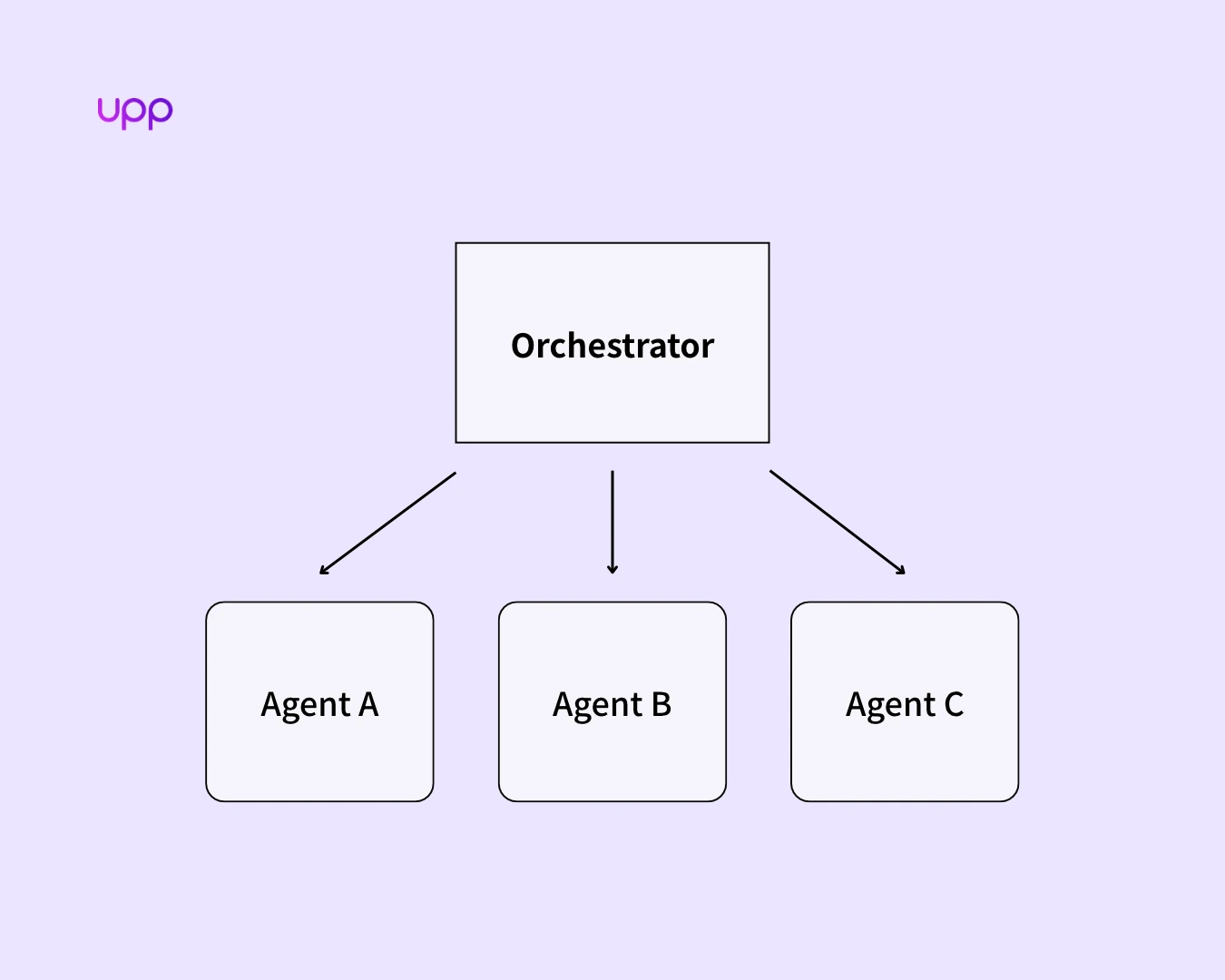
In a centralized architecture, one orchestrator manages the overall workflow. It receives the request, determines which agents should be involved, assigns tasks, and combines their results.
This approach provides a clear control point for monitoring and governance. It can be particularly useful when the workflow follows defined business rules and requires predictable execution.
A primary-agent pattern is one example. The main agent interacts with the user while delegating specialized tasks to secondary agents. This model is also reflected in enterprise platforms such as Salesforce’s Agentforce.
2. Hierarchical Orchestration
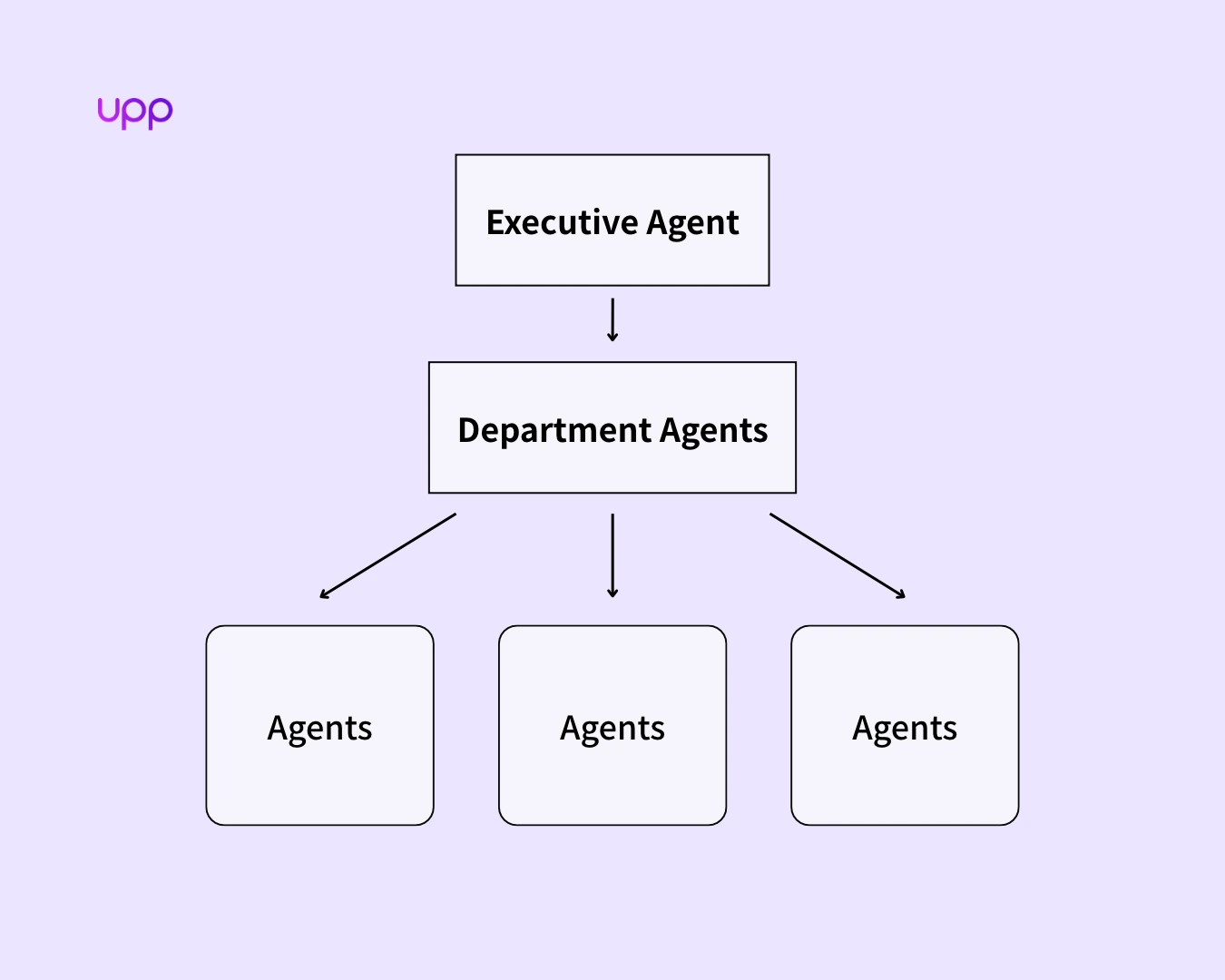
A hierarchical architecture introduces multiple levels of coordination. A higher-level agent or orchestrator manages broader objectives, while subordinate agents or sub-orchestrators handle specific areas of work.
For example, a business-analysis workflow could have a main coordinator overseeing separate research, financial analysis, and reporting groups. Each group could then coordinate its own specialized agents.
This structure can help organize larger workflows, but it also introduces additional coordination layers that need to be monitored.
3. Peer-to-Peer Collaboration
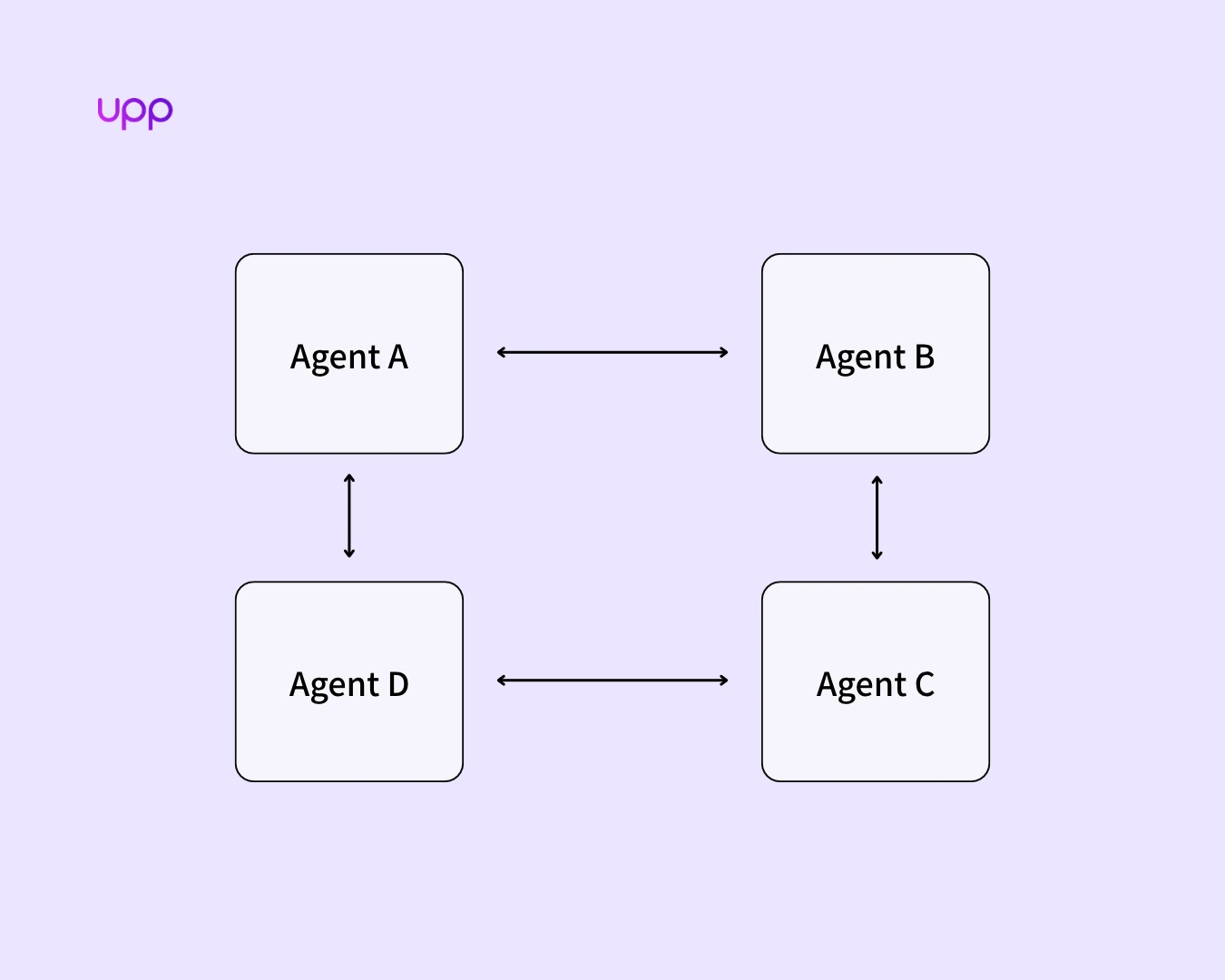
In a peer-to-peer model, agents can communicate more directly with one another rather than relying entirely on a central orchestrator. An agent can discover another agent's capabilities and delegate a task when appropriate.
This approach can support more dynamic collaboration, particularly when agents are developed independently or operate across different systems. However, it also makes communication, governance, and observability more important.
4. Hybrid Architecture
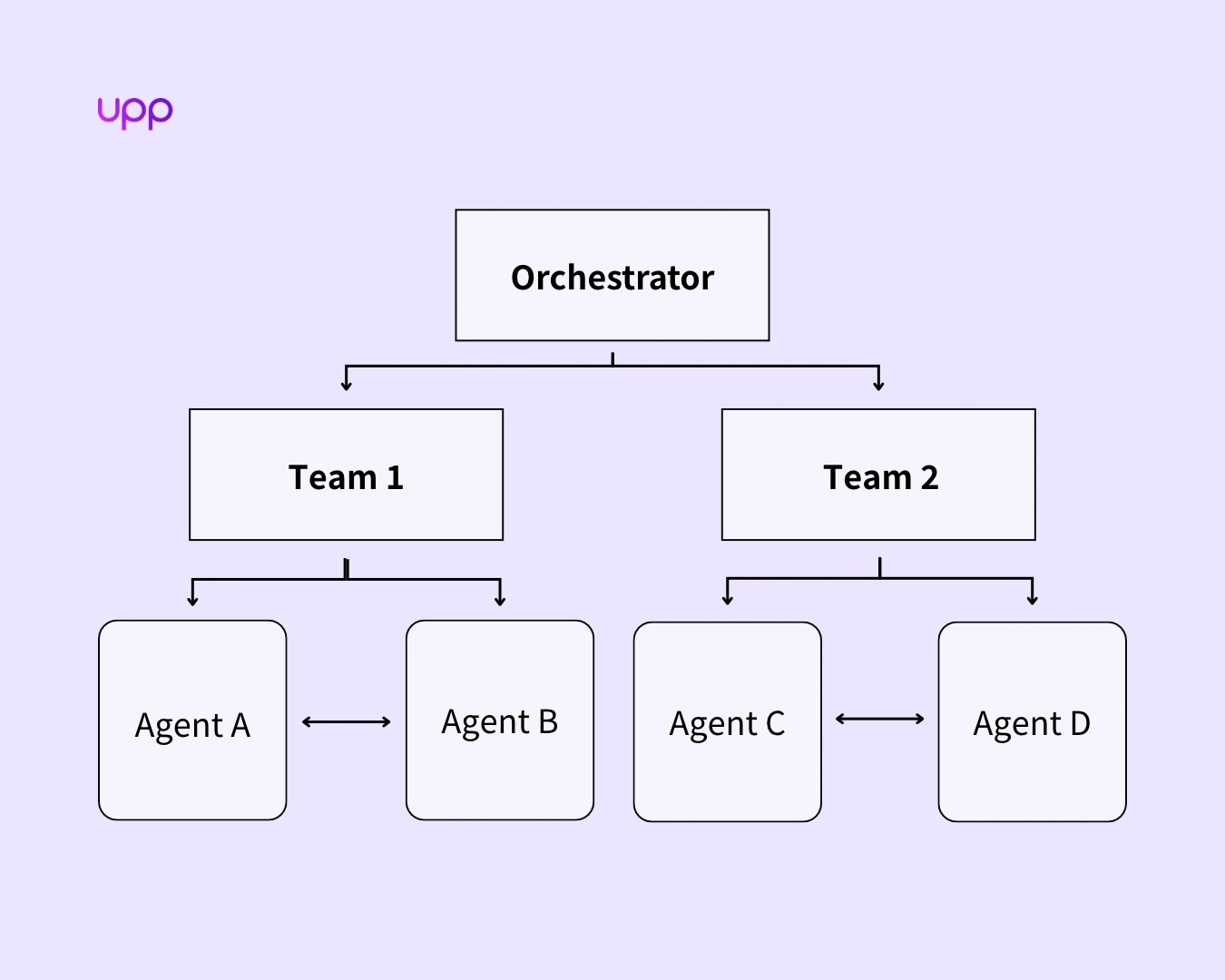
Many enterprise systems may combine several patterns in their multi-agent architecture. The top-level system may use centralized orchestration, while individual teams of agents use parallel or peer-to-peer collaboration.
This hybrid model reflects a broader principle in enterprise AI: AI reasoning can handle ambiguous or specialized tasks, while conventional software can enforce business rules, permissions, and predictable execution.
How Agent Workflows Are Executed
Another useful way to understand multi-agent architectures is to look at when agents are activated and how their work is arranged over time. Architecture partterns describes how agents are organized. Execution patterns describe when their tasks run and whether work happens. In practice, orchestration often follows one of three execution patterns: sequential, parallel, or event-driven.
Sequential
In sequential orchestration, agents work in a fixed order, where each step depends on the output of the previous one. This pattern is useful when a workflow has clear dependencies and the result of one agent becomes the input for the next agent.
- Research → Analyze → Review → Publish
This approach is predictable and easy to monitor, but it can be slower because each step must wait for the previous one to finish.
Parallel
In parallel orchestration, multiple agents work at the same time on tasks that do not strongly depend on one another. This pattern is useful when the workflow can be divided into independent workstreams and the system needs to reduce overall execution time.
- Research + Data Analysis + Competitor Analysis → Synthesis
Parallel execution can improve speed, but it requires clear output formats and a strong synthesis step to avoid fragmented or inconsistent results.
Event-driven
In event-driven orchestration, agents are activated by a specific event rather than by a fixed sequence or direct user request. The event could be a new customer ticket, a database update, a system alert, or a change in business status.
- New customer ticket → Classification → Specialist Agent → Action → Monitoring
This model is particularly relevant to enterprise automation because workflows can run continuously in response to real business activity, rather than only when a user manually starts them.
Research published in 2026 on event-driven multi-agent orchestration found that scaling the number of agents can create new coordination problems, with agent discovery noise becoming a significant bottleneck in the researchers' enterprise-scale experiments.
The implication is important: adding more agents does not automatically make an architecture better. The coordination mechanism must scale with the number of agents and interactions.
How AI Agents Exchange Information
For multiple agents to collaborate, they need a reliable way to exchange information. Communication can be relatively simple, such as passing a structured output from one task to the next, or more dynamic, allowing agents to discover capabilities and collaborate across systems.
The communication format becomes increasingly important as systems grow. If every agent passes loosely formatted natural-language output to every other agent, the workflow can become difficult to control. Therefore, structured communication is particularly important in enterprise environments. Structured communication makes it easier to validate inputs, trace execution, retry failed tasks, and maintain consistent interfaces.
This is one reason why interoperability protocols are becoming increasingly relevant.
The Latest Standard Protocol Landscape
As AI agents become increasingly connected to enterprise tools, data sources, and other agents, interoperability becomes an important architectural consideration.
Two protocols are particularly relevant to the current agentic AI ecosystem:
- Model Context Protocol (MCP): focused on connecting AI applications and agents with tools and data.
- Agent2Agent (A2A): focused on communication and collaboration between independent AI agents.
These protocols address different communication problems and should not be treated as competing versions of the same standard. An enterprise workflow may use both within the same architecture. For example, one agent could communicate with another specialized agent through A2A and then use MCP to access a CRM or database.
Model Context Protocol (MCP)
The Model Context Protocol (MCP) was introduced by Anthropic in 2024 as an open standard for connecting AI applications with external data sources and tools.
Rather than requiring a separate custom integration for every system, MCP provides a standardized way for AI applications to interact with external capabilities. An MCP server can expose tools, resources, and prompts, while an AI application acting as an MCP client can connect to those capabilities through the protocol.
MCP becomes particularly relevant when individual agents need access to different enterprise resources. The agents can remain specialized while their connections to external resources follow a common interface. This separation can also help organizations manage permissions and control which systems each agent can access.
Agent2Agent (A2A)
Agent2Agent (A2A) addresses a different layer of communication. Rather than standardizing how an agent accesses a tool, A2A is designed to enable independent AI agents to discover capabilities, communicate, delegate tasks, and exchange results.
The protocol includes concepts such as agent discovery, capabilities, tasks, messages, artifacts, streaming, and long-running interactions. An agent can publish an Agent Card describing its capabilities so that another agent can understand what it can do before delegating work.
This becomes particularly relevant when agents are developed or operated independently. Instead of requiring every agent to understand the internal implementation of another system, standardized communication can provide a common way to interact.
How MCP and A2A Work Together
MCP and A2A can be understood as complementary layers in a multi-agent architecture.
Consider a travel-planning workflow. A travel agent communicates with a hotel agent through A2A to request accommodation options. The hotel agent then uses MCP to connect to a booking system and retrieve available information.
In this example:
- A2A → connects agents with other agents
- MCP → connects agents with tools and data
This distinction is useful because enterprise AI workflows increasingly involve all three elements: agents, external systems, and data. A single agent may need to collaborate with another agent while also accessing several enterprise applications.
Real-World Multi-Agent Frameworks and Platforms
The growing agent ecosystem includes frameworks, protocols, models, runtimes, and enterprise platforms. These technologies should not be treated as interchangeable.
CrewAI
CrewAI is an open-source framework specifically designed for building multi-agent systems.
Its documentation describes two major abstractions:
- Crews, which focus on autonomous collaboration between specialized agents
- Flows, which provide more structured workflow control, including state management, conditional logic, and event-driven execution
CrewAI also currently highlights first-class MCP support and A2A connectivity, making it a useful practical example of how agent orchestration and interoperability protocols can exist at different architectural layers.
For production environments, CrewAI also provides a platform for deploying, monitoring, and scaling agent workflows.
Claude and MCP
Claude is an AI model ecosystem rather than an orchestration protocol.
Its relevance to this architecture comes partly from Anthropic's development and adoption of MCP. Anthropic's current documentation describes MCP support across products including Claude Code, Claude.ai, Claude Desktop, and the Messages API.
This illustrates how an AI model or application can use a standardized protocol to access capabilities outside the model itself.
OpenClaw
OpenClaw provides another practical example of multi-agent runtime architecture.
Its current documentation describes running multiple isolated agents within a single Gateway, with separate workspaces, state directories, authentication profiles, and session histories. Incoming messages can be routed to the appropriate agent through configurable bindings.
OpenClaw also supports explicit agent-to-agent access controls, allowing organizations to control which agents can interact with one another.
This is useful for understanding a different aspect of multi-agent architecture: agent isolation and routing, rather than simply task delegation.
>> Read more: OpenClaw: From Chatbot to Operator Agentic System
Salesforce Agentforce
Salesforce provides a more enterprise-oriented example through Agentforce multi-agent orchestration.
Salesforce describes a primary agent that acts as the single point of contact, analyzes the user's request, and routes tasks to specialized secondary agents. Those agents can use specialized data and actions before returning results to the primary agent.
Agentforce also documents A2A support for connecting its agents with third-party agents, demonstrating how an enterprise agent platform can participate in a broader multi-agent ecosystem rather than operating entirely within one platform.
The Future of Multi-Agent AI
The development of multi-agent AI is moving beyond isolated AI assistants toward interconnected systems in which agents can access enterprise resources, collaborate with other agents, and execute multi-step workflows.
Protocols such as MCP and A2A are important to this transition because they address interoperability at different levels. MCP provides a standardized interface for connecting AI applications with tools and resources, while A2A provides a standardized mechanism for agents to discover and collaborate with other agents.
The emergence of real frameworks and platforms also shows that multi-agent architecture is no longer limited to research concepts. CrewAI provides an open-source framework for agent teams and structured flows; OpenClaw provides multi-agent routing and isolation; and enterprise platforms such as Agentforce are incorporating multi-agent orchestration into business applications.
At the same time, the increasing number of agents introduces a new engineering challenge: coordination itself becomes a system that needs to be designed, monitored, secured, and optimized.
The future of multi-agent AI is therefore unlikely to be defined simply by creating more autonomous agents. The more important question is how reliably those agents can operate together within real business environments.
Looking for similar AI solutions?
UPP Global Technology JSC is an AI Integration Partner, supporting businesses throughout the end-to-end AI lifecycle, from strategy and development to integration and continuous improvement. UPP’s AI-Native Delivery approach, built on MASS (Multi-Agent Software Studio), enables businesses to develop and deploy AI solutions with greater speed, efficiency, and scalability.
FAQs
What is multi-agent orchestration?
Multi-agent orchestration is the process of coordinating multiple AI agents so they can divide tasks, communicate, manage dependencies, execute workflows, validate results, and work toward a shared objective.
What is the difference between a multi-agent system and multi-agent orchestration?
A multi-agent system is the broader architecture containing multiple AI agents. Multi-agent orchestration refers to the coordination layer that determines how those agents interact and how their work is managed.
What is MCP in AI?
MCP, or Model Context Protocol, is an open protocol that standardizes how AI applications connect to external tools, resources, and contextual information.
What is A2A in AI?
A2A, or Agent2Agent, is an open protocol designed to enable independent AI agents to discover capabilities, communicate, delegate tasks, and exchange results.
What is the difference between MCP and A2A?
The simplest distinction is that MCP connects AI applications or agents with tools and data, while A2A connects independent agents with other agents. They can be used together within the same multi-agent architecture.
Can multiple AI agents use different AI models?
Yes. A multi-agent architecture can assign different models to different agents depending on their requirements. For example, one agent may use a model optimized for reasoning, while another may use a faster or lower-cost model for classification or routine tasks.
Are multi-agent systems better than single-agent systems?
Not necessarily. Multi-agent systems are useful when a workflow contains distinct responsibilities, specialized tools, or tasks that benefit from parallel execution or independent validation. For simpler workflows, a single-agent architecture may involve less coordination overhead.
Newsletter
DISCOVER MORE






LET’S TALK...
Content delivered to your inbox


ENTER YOUR EMAIL
YOU WANT TO...


Hanoi, Vietnam
Web3 Tower, No. 15, Alley 4, Duy Tan, Cau Giay, Hanoi, Vietnam