Healthcare AI Integration: How Can AI Move from Pilot to Clinical Workflow?
Date
October 19th, 2026
Reading Time
5 mins
Tags cloud
What's news
Key Takeaways:
-
Healthcare AI creates more value when clinical data, AI capabilities and existing workflows are connected as one operating process rather than deployed as separate tools.
-
Reliable AI workflows depend on access to the right clinical context, not just model accuracy. Clinical data integration and interoperability are therefore part of the foundation.
-
AI insights become useful when they move into the systems and review steps healthcare teams already use, with clear handoffs between automation and human decision-making.
-
Governance should be built into the workflow itself, with different levels of review and escalation depending on the risk of the AI-supported task.
Introduction
Healthcare organisations are seeing clear potential from AI, but turning that potential into everyday clinical value remains an integration challenge.
Deloitte's 2026 Global Health Care Outlook found that 64% of surveyed health-system executives expect AI to reduce costs through workflow standardisation and automation. More than half also expect significant value from operational efficiency and administrative tasks that support clinical workflows.
Yet moving AI into real healthcare operations is still difficult. Microsoft and The Health Management Academy reported in 2026 that 43% of surveyed healthcare organisations were piloting or testing agentic AI, while only 3% had deployed agents in live workflows.
That gap explains why healthcare AI value does not come from model output alone. For healthcare AI consulting, the challenge is therefore less about adding another model and more about connecting clinical data, AI, systems and workflows into a reliable operating environment.
1. Why Healthcare AI Pilots Fail to Deliver Clinical Value
AI can already support several parts of healthcare delivery and operations. Predictive analytics can identify patterns that deserve attention. Medical document intelligence can extract information from referrals or clinical notes. Generative AI can help clinicians and administrative teams work with complex information more efficiently.
But those capabilities create limited value when they sit outside the systems people already use. A prediction still needs to reach the appropriate team. Extracted information needs somewhere to go. A recommendation needs to appear at the right point in the workflow rather than inside another disconnected AI interface.
This is where healthcare AI integration becomes important. The value comes from connecting clinical data, AI capabilities and the systems where healthcare work already happens.
For healthcare organisations, this means AI needs to fit the way clinical work already happens rather than create another disconnected process. That is why a clear integration workflow is needed to move from clinical data to AI insights, then into the right healthcare process with the appropriate governance and human oversight around it.
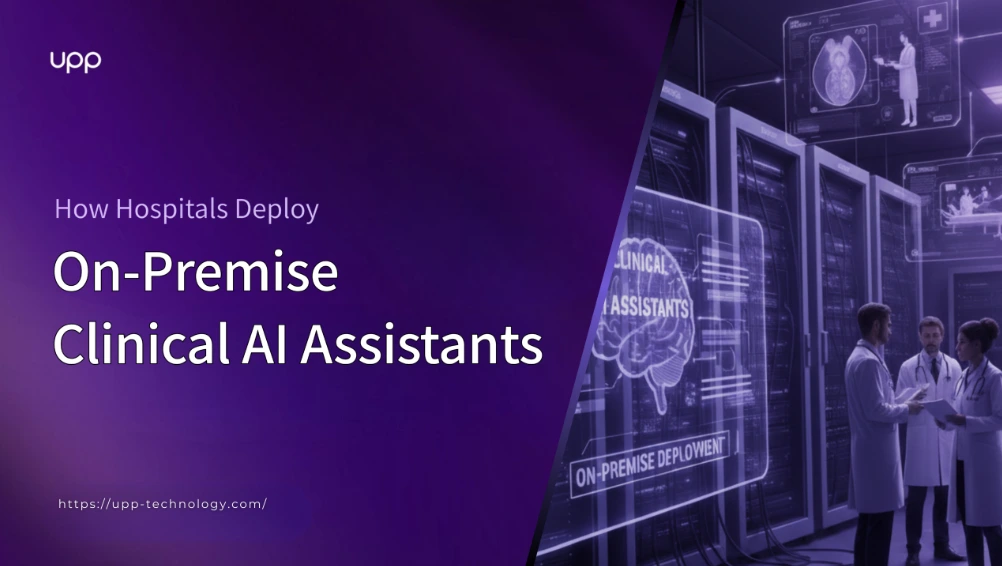
>> Read more: How Hospitals Deploy On-Premise Clinical AI Assistants
2. What Healthcare AI Integration Requires
Healthcare AI integration can be understood as a connected journey:
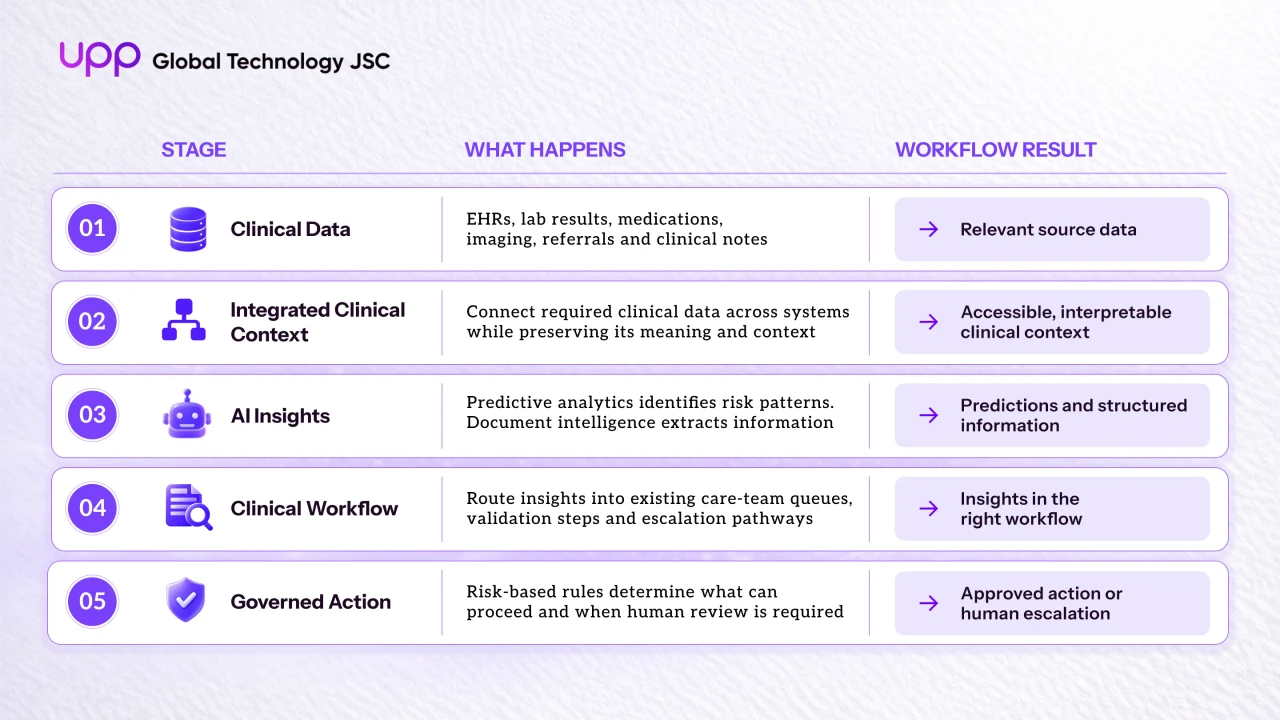
Each stage solves a different part of the integration problem.
Clinical data first needs to be accessible and understandable across systems. AI can then turn that information into predictions, extracted information or other insights. Those outputs need to enter the appropriate workflow, while governance determines how they can be used and where human intervention remains necessary.
These stages work best when they are designed together. If one layer is missing, the burden often moves back to the user through manual checking, duplicate data entry or extra handoffs.
2.1. Clinical Data Integration and EHR Interoperability
Healthcare information is rarely contained in one system. A single care journey may involve EHR data, laboratory results, medication records, imaging systems, referrals, clinical notes and other digital health applications.
Clinical data integration connects the information required by a particular AI use case. The aim is not to collect every available dataset. It is to make the relevant information accessible, consistent and usable at the point where the AI workflow needs it.
EHR interoperability supports the same goal from another angle. When clinical information moves between applications, its meaning needs to remain clear. A diagnosis, observation or medication entry is only useful to another system when its structure and context can still be interpreted correctly.
For AI workflow automation, the integration layer must do more than transfer data. It needs to preserve clinical context so AI can interpret information accurately. Rather than replacing existing healthcare systems, organisations can connect them through reliable data pathways tailored to each use case. For example, referral processing and patient risk analysis require different data sources, so integration should follow the workflow's needs.
2.2. Predictive Analytics and Medical Document Intelligence
Once the necessary clinical information is connected and interpretable, AI can begin turning that information into something useful for the workflow.
Predictive analytics and machine learning can identify patterns in structured data, such as changes in patient risk, demand or other conditions that may require attention. The purpose is not to replace clinical judgement, but to help teams recognise information that might otherwise take more time to find.
Medical document intelligence addresses information that is harder for traditional systems to use directly. Referrals, clinical notes, reports and PDFs often contain important context in free text. AI can identify relevant information in those documents and convert selected parts into structured data for further processing or review.
At this point, the workflow has moved from clinical context to AI insights. The next challenge is making sure that insight reaches the process where it can actually be used. That is where workflow integration becomes the next step.
2.3. Integrating AI into Clinical Workflows
Once AI produces a prediction, extracted information or recommendation, that output needs to enter the clinical process in a way that fits how teams already work.
Clinical workflow integration connects AI with the systems, queues and review steps that clinicians or operational teams already use. A patient risk signal might be routed to the appropriate care team, while information extracted from a referral could move into a validation step before being added to the patient record. The aim is to avoid creating another separate tool that users need to monitor manually.
The workflow should also define what happens after AI contributes its output. Some steps can move forward automatically, while others may require review, approval or escalation depending on the level of clinical risk. Designing these handoffs clearly helps AI support the process without disrupting accountability or clinical judgement.
In practice, this means mapping the current workflow first, then deciding where AI can remove repetitive work, where it should support a decision and where a person still needs to take over. This keeps healthcare AI workflow automation tied to real operational needs rather than forcing teams to adapt around the technology.
2.4. Clinical Governance and Human Oversight
As AI becomes part of clinical workflows, clinical governance determines where automation can proceed and where people need to remain responsible.
Different AI applications need different boundaries. A document-processing system does not carry the same consequences as a system supporting a treatment-related decision. The level of human review should reflect that difference.
Human oversight works best when it is part of the workflow rather than an additional step added after everything else has been designed. The reviewer needs access to enough context to understand what the AI produced and why the case requires attention.
A governed workflow therefore needs clear rules for what happens when AI identifies uncertainty, conflicting information or a higher-risk case. These conditions should trigger the appropriate review or escalation path rather than allowing the process to continue automatically.
3. How to Keep Healthcare AI Reliable After Deployment
Healthcare AI integration does not finish when the workflow goes live. The environment around the AI system continues to change. Clinical data evolves, patient populations shift, applications are updated and the workflow itself may change as teams learn how to use the technology.
Monitoring therefore needs to cover more than whether the model or API is available.
Teams may need visibility into model performance, data quality, integration latency, workflow failures, user overrides and escalation outcomes. Which signals matter most depends on the use case, but the objective is the same: understand whether the whole process is still working as intended.
This broader view also helps identify where a problem actually begins.
An unexpected result may come from the model, but it can also be caused by outdated data, a delayed integration, a changed field in an upstream system or incorrect workflow routing. Monitoring the full workflow makes it easier to separate these issues and identify which part of the system needs attention.
Traceability supports that process by showing what data entered the workflow, what output the AI produced and what happened afterwards. This gives healthcare teams a clearer basis for reviewing incidents, checking whether escalation paths are working and deciding whether the model, integration or workflow needs to be adjusted.
Over time, this turns monitoring into part of the operating model rather than a maintenance task. The aim is not only to detect failure, but to keep the AI-supported workflow reliable as data, systems and clinical processes continue to change.
>> Read more: AI Integration Services in Australia: Moving from Pilot to Production
4. How UPP Supports Healthcare AI Integration
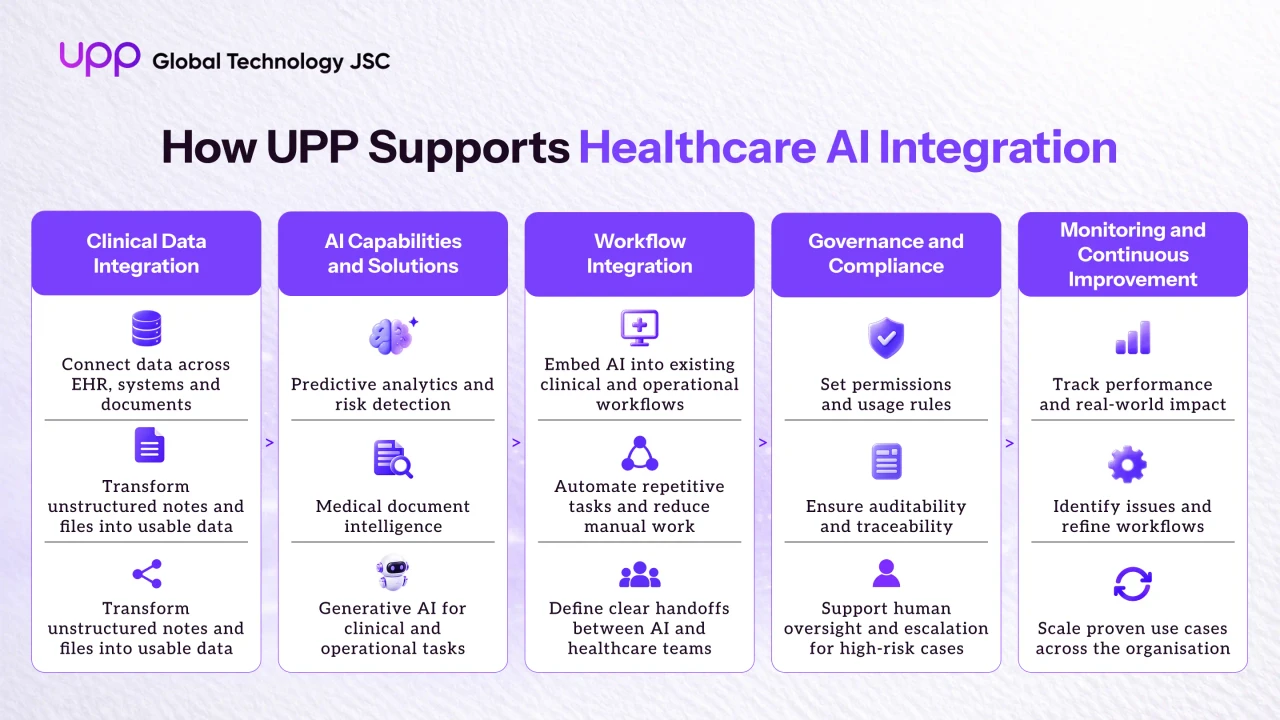
UPP Global Technology JSC helps healthcare organisations connect clinical data, AI capabilities and existing workflows into one practical operating model. The approach starts with clinical data integration and EHR interoperability, then applies predictive analytics and medical document intelligence where they can support real clinical or operational needs.
The business value comes from reducing fragmentation between data, AI and day-to-day work. Instead of adding another standalone AI tool, UPP focuses on integrating AI into existing processes so insights can move into the right workflow with appropriate review and control.
This helps healthcare organisations shorten manual handoffs, improve access to relevant information and move AI use cases closer to production. Ongoing monitoring, governance and auditability also support more reliable operation as data and workflows change over time.
>> Explore UPP’s AI Services for Healthcare
Conclusion
Healthcare AI creates limited value when data, systems and workflows remain disconnected. A connected approach brings clinical data, AI and workflow integration together with governance and monitoring from the start. This helps reduce manual handoffs, improve access to relevant information and make AI workflows easier to scale, manage and trust in production.
Tags cloud
Newsletter
DISCOVER MORE





































































LET’S TALK...
Content delivered to your inbox


ENTER YOUR EMAIL
YOU WANT TO...


Hanoi, Vietnam
Web3 Tower, No. 15, Alley 4, Duy Tan, Cau Giay, Hanoi, Vietnam