UPP News: What's new in the AI field? (Part 4)
Date
February 5th, 2024
Reading Time
5 mins
Tags cloud
What's news
Subscribe to our newsletter and stay up-to-date with the latest AI news updates.
1. Meta's free code Llama AI programming tool closes the gap with GPT-4.
Source: The Verge
Meta’s latest update to its code generation AI model, Code Llama 70B, is “the largest and best-performing model” yet. Code Llama tools were launched last August and are free for both research and commercial use. According to a post on Meta’s AI blog, Code Llama 70B can handle more queries than previous versions, which means developers can feed it more prompts while programming with higher result accuracy.
Code Llama 70B scored 53 percent in accuracy on the HumanEval benchmark, performing better than GPT-3.5’s 48.1 percent and closer to the 67 percent mark reported for GPT-4.
Built on Llama 2, Code Llama helps developers create strings of code from prompts and debug human-written work. Meta simultaneously launched two other Code Llama tools last fall, Code Llama - Python and Code Llama - Instruct, which focused on specific programming languages.
Trained on 1TB of code and code-related data, the models are open source and available under the same license as the previous versions, meaning they can be used for commercial applications – but to access them, users will need to fill out this form.
*Check out this blog from UPP: How to Deploy Llama on Your Local Machine.**
2. Shopify’s ‘Magic’ AI mage editor can make any product pics look professional.
Source: Techcrunch
Shopify’s e-commerce platform is adding more AI tools to go with its existing text generator for product descriptions and AI chatbots.
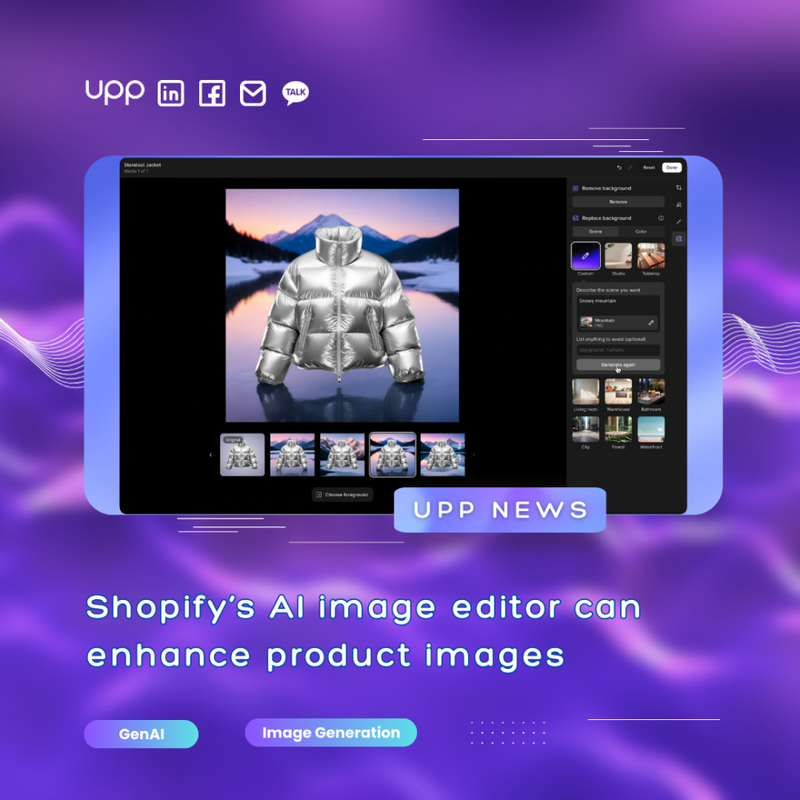
The Shopify Magic suite of generative AI tools, launched in April last year, is now introducing a media editor that incorporates generative image fill into its platform, including a conversational search functionality powered by AI. Merchants using Shopify can now use the image editor to easily change photo backgrounds without the need for Photoshop experience, aligning the visuals with their desired themes.
Many companies, including Meta, Google and Amazon, have allowed advertisers to generate backgrounds using generative AI since last year. Similarly, Shopify wants to help merchants edit their product images’ backgrounds and scenes using this technology. In the Magic Media Editor, merchants can choose a type from seven styles — Minimal, Vibrant, Natural, Urban, Regged, Refined and Surreal — or type a prompt to generate a new background.
The company says many sellers on the platform may lack access to large studios or professional photographers but still need to set their items up for success. Since there’s no additional cost to use this tool, it meets that demand. The Vice President of Products at Shopify stated, "We know not everyone has access to studios or mannequins, so we want to lower the barriers to entry for entrepreneurs to present their products in the best light."
3. The Pixel 8 is getting Google’s new AI search feature.

Source: The Verge
Google’s new AI-first approach to search is rolling out to Pixel 8 and 8 Pro phones.
Google is rolling out its “Circle to Search” feature to Pixel 8 phones today, revolutionizing how to gather information on the internet using AI. The feature, which is also available on Samsung Galaxy S24 phones, allows users to combine image searches with words in the Google app. By circling, scribbling, or highlighting elements in other applications, users can seamlessly access additional information.
The big change here is leveraging generative AI for on-the-fly searches within other apps in Android. Instead of taking an image or screenshot over to the Google app, you can long-press on the home button or the navigation bar from wherever you are to initiate the search, then highlight whatever you want to know more about and modify the search using a text prompt. A card will show you more info, and you can swipe it away when you’re done.
A noteworthy enhancement is the incorporation of generative AI for on-the-fly searches within various Android apps. Instead of taking an image or screenshot over to the Google app, users can long-press on the home button or the navigation bar from wherever they are to initiate the search, then highlight whatever they want to know more about and modify the search using a text prompt. A card will show more information, and then users can swipe it away when they are done.
The feature had already started rolling out to some Pixel 8 phones before Google’s announcement, users may have already been able to use it today.
4. Google's Lumiere: New AI model that creates realistic videos.
Source: AI Business
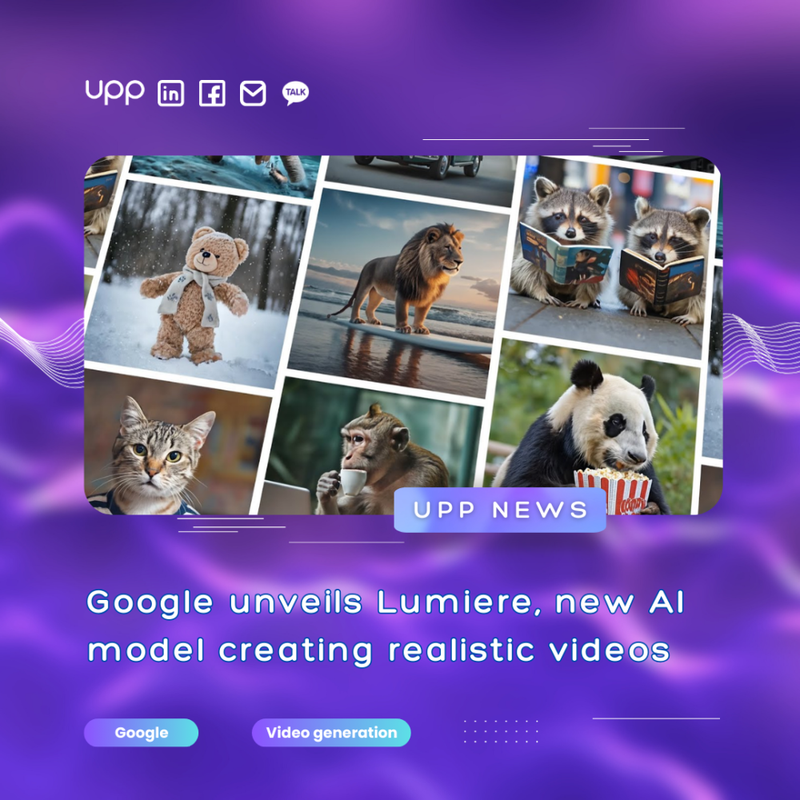
Google has unveiled Lumiere, a new cutting-edge text-to-video model capable of generating lifelike videos with realistic motion from short text prompts.
Lumiere creates videos showcasing realistic motion and can even use images and other videos to improve results. According to a paper titled "A Space-Time Diffusion Model for Video Generation", Lumiere works differently from other existing video generation models by focusing on the movement of objects in the image rather than patching together a video from key frames where the movement already happened.
The model is capable of generating videos comprised of 80 frames. In comparison, Stability's Stable Video Diffusion clocks in 14 and 25 frames. Put simply, the more frames, the smoother and more realistic the motion of the video.
In addition to text-to-video generation, Lumiere will also allow for image-to-video generation, stylized generation, which lets users make videos in a specific style, cinematography that animates only a portion of a video, and inpainting to mask out an area of the video to change the color or pattern. Researchers from Google's team contend that Lumiere produces state-of-the-art generation outputs as a result of its alternative approach, claiming the model's outputs could be used in content creation tasks and for video editing purposes.
However, Goole's Lumiere paper noted that “there is a risk of misuse for creating fake or harmful content with our technology, and we believe that it is crucial to develop and apply tools for detecting biases and malicious use cases to ensure a safe and fair use.”The model has not been made available to the public. People can explore various examples of its generations on the showcase page on Github.
5. Bard can now generate photos.

Source: The Verge
Google’s Bard chatbot is adding AI image generation, catching up on a feature that rival ChatGPT Plus has had for months.
To position Bard as a strong competitor to OpenAI's ChatGPT Plus, which operates on GPT-4 and enables image generation, Google has made significant steps. Both chatbots have proven to be effective in their text-generation capabilities. Still, Bard initially lagged due to its lack of text-to-image capabilities, giving ChatGPT Plus a bit of a competitive edge. However, users can now prompt Bard to generate photos using Google’s Imagen 2 text-to-image model with no cost, unlike ChatGPT Plus, which requires a paid subscription.
Google emphasized that Bard's image capabilities were developed with responsibility in mind. The tech giant stated that it has implemented technical and safety measures to prevent the generation of images featuring well-known individuals and to limit the creation of violent, offensive, or sexually explicit content.
Bard is also getting a handful of other expansions. While image generation is only in English for now, the chatbot has expanded to over 40 languages in more than 230 countries. The previous version only worked in English and was available in 170 countries.
Tags cloud
Newsletter
DISCOVER MORE


















































![[Recap] UPP Global Technology JSC Establishing Anniversary](/homepage/news-section/new-4.webp)






























LET’S TALK...
Content delivered to your inbox


ENTER YOUR EMAIL
YOU WANT TO...


Hanoi, Vietnam
Web3 Tower, No. 15, Alley 4, Duy Tan, Cau Giay, Hanoi, Vietnam