Rethinking Salesforce Skill Gaps in the AI Era
Date
March 26th, 2026
Reading Time
7 mins
What's news
Abstract
As organizations accelerate digital transformation, the adoption of Salesforce continues to expand across industries and functions. However, the increasing complexity of the platform has created a persistent shortage of skilled professionals, making it difficult for businesses to implement, scale, and optimize solutions efficiently.
This article examines the causes and implications of Salesforce skill gaps, and explores practical strategies to address them without disrupting ongoing operations. It also highlights how working with the right external partner can help organizations bridge capability gaps while maintaining long-term sustainability.
1. The Rising Pressure of Salesforce Skill Shortages
1.1 Expanding Scope of Salesforce Capabilities
The Salesforce ecosystem has evolved beyond traditional CRM into an AI-powered, agent driven platform. With the introduction of Salesforce Einstein GPT and Agentforce, organizations are no longer just managing customer data, they are orchestrating intelligent systems that can automate decisions, generate insights, and execute tasks autonomously.
This shift significantly increases the level of expertise required. Teams are now expected not only to configure systems, but also to design AI workflows, manage data pipelines, and govern autonomous agents.
Learn more about a Salesforce multi-cloud strategy
1.2 Operational and Strategic Consequences
Skill gaps today are no longer limited to technical configuration. Organizations now face challenges in implementing AI responsibly, ensuring data quality for AI outputs, and controlling agent behavior.
Without these capabilities, businesses risk not only inefficiencies, but also inaccurate AI-generated decisions and loss of trust in automated systems.
In addition, poorly implemented systems may result in fragmented data, inefficient workflows, and limited automation capabilities. These issues can hinder decision-making and reduce the overall effectiveness of the platform.
Over time, the inability to fully leverage Salesforce can weaken an organization’s competitive advantage, making it more difficult to achieve sustainable growth in a data-driven environment.
2. Limitations of Conventional Talent Strategies
2.1 The Challenge of Hiring Salesforce Experts
Recruiting Salesforce professionals has become increasingly difficult due to the global shortage of certified experts. Organizations often face long hiring cycles, high recruitment costs, and intense competition for top talent.
Even when suitable candidates are found, the onboarding process can take time, delaying their ability to contribute effectively to ongoing projects. This creates a gap between immediate business needs and available resources.
Furthermore, relying solely on hiring as a solution may not be sustainable in the long term, particularly for organizations that require flexible and scalable capabilities.
2.2 The Slow Pace of Internal Upskilling
Upskilling internal teams is an important long-term strategy, but it does not provide immediate results. Developing advanced Salesforce expertise requires continuous learning, practical experience, and structured training programs.
Employees who are already engaged in daily operations may struggle to dedicate sufficient time to skill development, slowing the overall progress of upskilling initiatives.
As a result, organizations often find themselves in a situation where internal capabilities are improving gradually, but not quickly enough to meet current demands.
2.3 Resource Allocation Constraints
Another common challenge lies in how existing resources are utilized. In many cases, skilled Salesforce professionals are assigned to routine tasks rather than strategic initiatives, limiting their overall impact.
This inefficient allocation not only reduces productivity but also contributes to skill stagnation, as employees are not exposed to more complex and valuable work.
Without a clear strategy for resource management, organizations may continue to face capability gaps despite having talented individuals within their teams.
2.4 The Emerging AI Capability Gap
At the core of this transformation is Salesforce Einstein GPT, a generative AI capability that enables businesses to automatically generate sales emails, customer responses, marketing content, and even code, all based on real-time CRM data. This allows organizations to move beyond static automation toward dynamic, context-aware interactions, where insights and actions are generated directly within the workflow.
However, the most significant shift lies in the introduction of Agentforce, which represents Salesforce’s move into agentic AI. Unlike traditional AI assistants that require human prompts, Agentforce enables the creation and deployment of autonomous AI agents capable of understanding intent, reasoning through complex tasks, and executing actions across systems without continuous human intervention. These agents operate based on a combination of data, reasoning, and predefined business logic, leveraging components such as the Atlas Reasoning Engine to interpret user requests, determine required data, and carry out multi-step processes independently.
Agentforce also introduces a full lifecycle environment for AI agents, allowing organizations to build, test, deploy, and monitor agents at scale using both low-code and pro-code tools, significantly reducing development time and increasing flexibility. In addition, features such as Intelligent Context enable the system to extract and structure information from unstructured and multimodal data sources, ensuring that AI-generated outputs are accurate and relevant, while built-in guardrails and the Einstein Trust Layer help mitigate risks related to hallucination, bias, and data security. This combination of generative AI and autonomous agents allows businesses to automate not only repetitive tasks but also complex decision-making processes across functions such as sales, customer service, marketing, and operations.
As a result, Salesforce is no longer simply a system of record or engagement, but a system of intelligent action, where AI agents act as digital labor working alongside humans to enhance productivity, improve customer experience, and drive real-time, data-driven decision-making across the enterprise.
3. Strategic Approaches to Closing Skill Gaps
3.1 Leveraging External Expertise for Immediate Needs
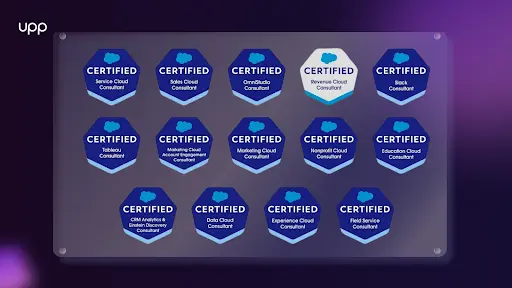
One of the most effective ways to address urgent skill shortages is to engage external experts who can be deployed quickly. This approach allows organizations to access specialized knowledge without the delays associated with hiring or training.
External professionals bring not only technical expertise but also industry experience and best practices, enabling faster problem-solving and more efficient implementation.
For example, working with a Ridge-tier partner such as UPP Global Technology JSC can provide immediate access to certified Salesforce experts, while also supporting integration with technologies like MuleSoft and data analytics to deliver more comprehensive solutions.
Read more: Unlock Seamless Integration with MuleSoft
3.2 Adopting a Hybrid Talent Model
A hybrid model that combines internal resources with external support offers a balanced approach to addressing skill gaps. Organizations can rely on external experts for complex or time-sensitive tasks, while gradually developing internal capabilities.
This approach ensures that projects can move forward without delays, while also creating opportunities for knowledge transfer and long-term growth.
By maintaining a flexible talent structure, organizations can adapt more effectively to changing business needs and technological advancements.
3.3 Aligning Skills with Business Objectives
Closing skill gaps is not only about increasing technical capabilities but also about ensuring that these capabilities align with business goals. Organizations should focus on developing skills that directly contribute to improving customer experience, operational efficiency, and data-driven decision-making.
This alignment helps maximize the value of Salesforce investments and ensures that resources are used effectively.
In the long term, a strategic approach to skill development can transform Salesforce from a technical tool into a key driver of business performance.
Conclusion
Filling Salesforce skill gaps without delays requires a shift from traditional approaches to more flexible and strategic solutions. While hiring and upskilling remain important, they must be complemented by methods that provide immediate access to expertise.
By leveraging external support, adopting hybrid talent models, and aligning capabilities with business objectives, organizations can overcome skill shortages and accelerate their digital transformation.
In a rapidly evolving environment, the ability to respond quickly to capability gaps will determine how effectively businesses can unlock the full potential of Salesforce and maintain a competitive edge.
Skip the hiring delay - Talk to a Salesforce expert now
Newsletter
DISCOVER MORE




















![[Recap] UPP Global Technology JSC Establishing Anniversary](/homepage/news-section/new-4.webp)























LET’S TALK...
Content delivered to your inbox


ENTER YOUR EMAIL
YOU WANT TO...


Hanoi, Vietnam
Web3 Tower, No. 15, Alley 4, Duy Tan, Cau Giay, Hanoi, Vietnam