UPP News: What’s New in the Salesforce Newsroom? (Part 3)
Date
March 7th, 2025
Reading Time
10 mins
Tags cloud
What's news
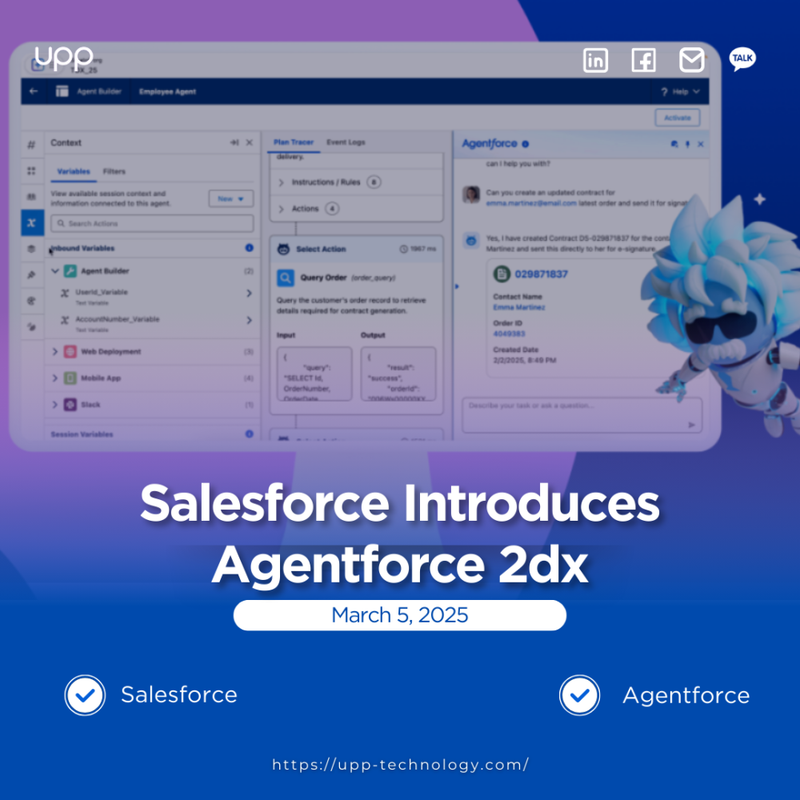
1. Salesforce Introduces Agentforce 2dx: Proactive AI for Workflows, Multimodal Experiences & Digital Labor.
Source: Salesforce
Salesforce has launched Agentforce 2dx, an AI-driven digital labor platform that enables proactive, autonomous AI agents to handle tasks without constant user input. These agents operate in the background, respond to data changes, and integrate seamlessly across interfaces, shifting from reactive automation to self-directed AI for greater efficiency and scalability.
To speed up adoption, Salesforce offers low-code and pro-code tools for developers to configure, test, and deploy AI agents quickly. The free Agentforce Developer Edition lets teams experiment with AI and explore Data Cloud for automation. These tools help businesses integrate AI into workflows with minimal effort.
Salesforce also introduced AgentExchange, a marketplace featuring pre-built AI agents and automation components from over 200 partners. This accelerates AI deployment while allowing partners to create and monetize AI solutions, supporting the growing $6 trillion digital labor market.
Companies like OpenTable, Vivint, and The Adecco Group are already seeing results, with AI agents improving customer service, automating recruitment, and enhancing efficiency. OpenTable, for instance, has cut response times by 50%, showcasing the impact of AI-driven automation.
Agentforce 2dx integrates deeply with Salesforce’s AI and automation tools, connecting with ERP systems, Slack, MuleSoft, and third-party applications. Features like Agentforce Interaction Explorer provide insights to optimize AI performance, making automation more intelligent and effective.
By bridging the gap between traditional automation and fully autonomous AI, Agentforce 2dx helps businesses streamline operations, reduce workloads, and drive innovation, positioning Salesforce as a leader in agentic AI.
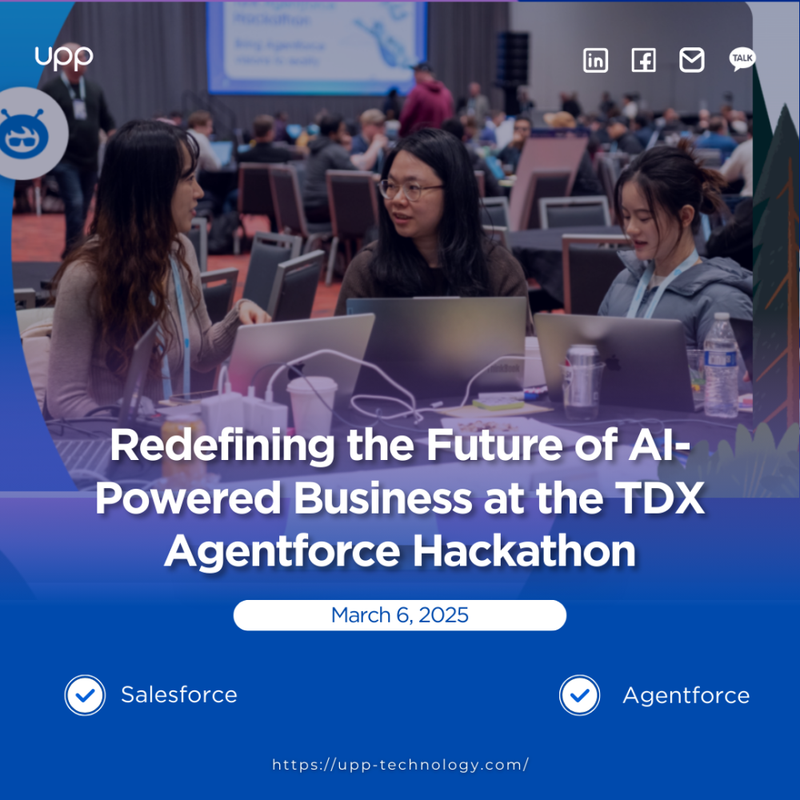
2. Redefining the Future of AI-Powered Business at the TDX Agentforce Hackathon.
Source: Salesforce
At TDX 2025, over 6,000 Agentblazers gathered in San Francisco to explore the potential of AI-driven automation. A key highlight was the Agentforce Hackathon, where developers, admins, and IT professionals built AI-powered solutions using Salesforce’s Agent Builder. Competing for a $100,000 grand prize, participants rapidly developed autonomous AI agents to solve real business challenges.
Defending champions Team 4D’S, known for their employee engagement tool PeopleForce, faced strong competition. Teams developed AI solutions for job recruiting, event networking, and expense automation. One notable innovation helped streamline retirement planning.
The winning team, Agent Halo, created an Agent Networks solution that connects insurers, repair shops, and emergency responders, enhancing efficiency and customer experience. Their project demonstrated the potential of integrating AI with Salesforce Service Cloud, Data Cloud, and Agentforce to create a seamless service ecosystem.
Other teams were also recognized in various categories, celebrating innovation, impact, and creativity in AI-driven business transformation.
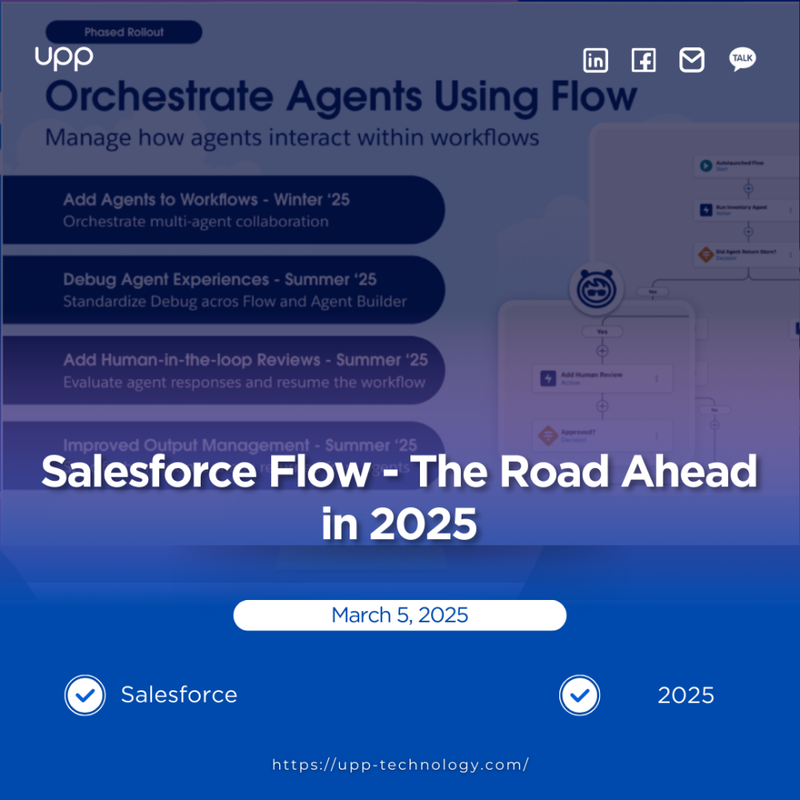
3. Salesforce Flow - The Road Ahead in 2025.
Source: Salesforce
Salesforce Flow has become central to the platform, helping users automate repetitive tasks, build applications efficiently, and maximize their Salesforce investments. The Flow product team continues to enhance its capabilities, introducing innovations aimed at improving automation, AI integration, and user experience.
A key focus this year is the integration of AI with Agentforce. Salesforce has introduced the Agent invocable action, allowing flows to interact with AI agents seamlessly. Future improvements will include a Human Review action and enhanced tools to extract structured information from agentic responses. Additionally, Salesforce is working on improving the accuracy of flow generation from prompts.
Beyond AI, several core areas of Flow are being refined. Support for the Time data type is being added, allowing users to work with Time fields more easily. Improvements to retrieving related records will simplify data queries, while a modernized email property editor will enhance usability. The Flow creation experience is also being revamped, offering a more intuitive setup process with a redesigned wizard.
The input experience is receiving significant upgrades to make working with Flow more intuitive. Users will be able to enter manual values more easily, with new input modes like a date picker for date fields. Rich text inputs, complex object selections, and collection multi-select capabilities are being added. A Formula Builder and Transform mode will allow users to write one-time-use formulas without creating separate resources. The resource picker is also being enhanced with improved search functionality, context-based prioritization, and better filtering to surface the most relevant options.
Salesforce is also focusing on enhancing the manageability of Flow actions. A new Action Hub will provide a centralized view of all actions, allowing users to track usage and manage dependencies outside of Flow Builder. Screen Flows, Salesforce’s visual application solution, will benefit from expanded styling and design options, making it easier to customize the look and feel of applications. New components like a Visual Picker, Signature input, Time component, and Matrix component are being introduced.
Enterprise manageability remains a top priority, with improvements in debugging and testing. Flow will offer a more modernized debugging interface, making complex data structures more readable. Automated testing is being expanded, integrating with Apex Test APIs for CI/CD compatibility. Version comparison tools will allow users to visually see differences between Flow versions, and persistent logging will be available, with data stored in Data Cloud for deeper analysis.
Approvals and orchestrations are also evolving, with the introduction of Flow Approvals. This new system replaces legacy approval processes, offering greater flexibility and customization, including support for delegates and recall functions. Flow Orchestrations will soon feature full-powered debugging capabilities.
In the marketing space, Flow is being integrated more deeply with Marketing Cloud, introducing Path Experimentation for A/B testing and On-canvas Insights to visualize logged data directly within the Flow canvas. The Flow and Data Cloud connection is strengthening, with new activation triggers and enhanced security features for managing data access.
Integration capabilities are expanding with the GA release of Mulesoft for Flow, offering 40 new connectors to services like Jira, Netsuite, and AI platforms like OpenAI. Future plans include deeper RPA (Robotic Process Automation) integration within Flow Builder.
Enhancements to Flow’s transformation services will allow for more advanced data processing, with developers able to build custom "invocable transformers" to manipulate collections dynamically. Developers building invocable actions in Apex will also benefit from usability improvements, including better input controls, sorting options, and visibility conditions without requiring JavaScript.
Overall, Salesforce continues to invest heavily in Flow, improving its automation capabilities, AI integrations, usability, and enterprise management features. These innovations aim to make Flow a more powerful tool for automating business processes, enhancing customer experiences, and driving productivity across the Salesforce ecosystem.
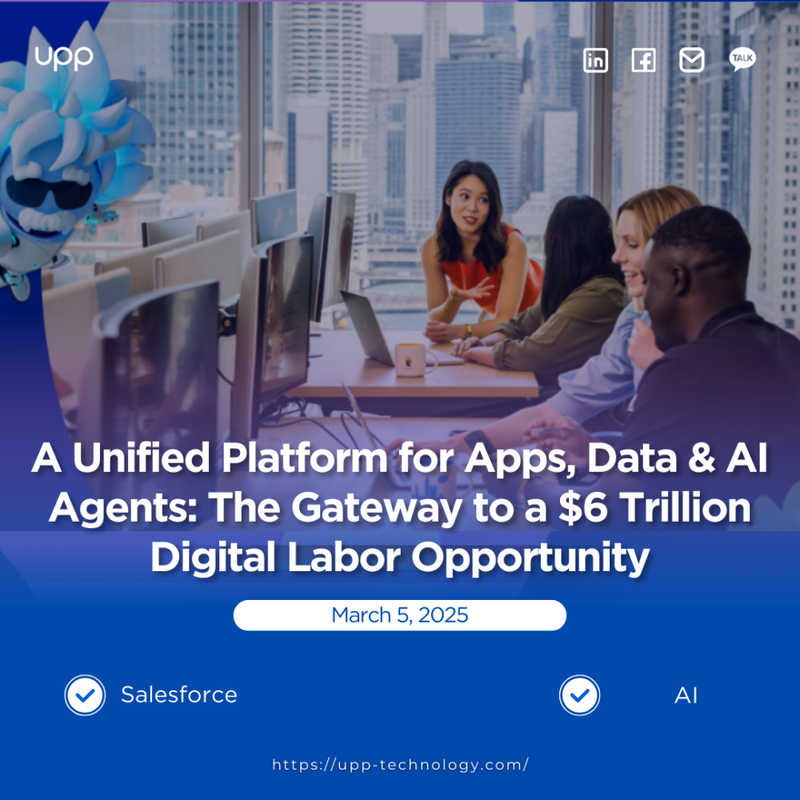
4. A Unified Platform for Apps, Data & AI Agents: The Gateway to a $6 Trillion Digital Labor Opportunity.
Source: Salesforce
Agentic AI is ushering in a major technological shift, creating a $6 trillion digital labor market. While past innovations like mobile and the internet took years to reach 100 million users, AI-powered agents are being adopted at an unprecedented rate. Salesforce’s Agentforce is at the forefront, enabling businesses to build AI agents that can reason, act, and deliver outcomes autonomously.
Unlike fragmented AI solutions, Agentforce operates on the deeply unified Salesforce Platform, integrating apps, data, AI models, and agents into a seamless system. With Data Cloud as a single source of truth, AI is embedded directly into Customer 360 applications, eliminating data silos and ensuring security, compliance, and automation at scale.
Industry leaders like Lennar, OpenTable, Pfizer, and Precina are already leveraging Agentforce to transform customer experiences, streamline operations, and drive measurable ROI. Studies show Agentforce outperforms DIY approaches, deploying agents 16 times faster with 75% greater accuracy while cutting costs by 20%.
At TDX 2025, Salesforce introduced key innovations like AgentExchange, a marketplace for prebuilt AI agent assets, and Agentforce 2dx, enhancing automation and low-code development. Additionally, a partnership with Google integrates Gemini AI for advanced multimodal capabilities.
As AI agents redefine work, Salesforce is leading the charge with a platform designed for speed, accuracy, and business impact—empowering companies to thrive in the agentic era.
Tags cloud
Newsletter
DISCOVER MORE








































![[Recap] UPP Global Technology JSC Establishing Anniversary](/homepage/news-section/new-4.webp)



























LET’S TALK...
Content delivered to your inbox


ENTER YOUR EMAIL
YOU WANT TO...


Hanoi, Vietnam
Web3 Tower, No. 15, Alley 4, Duy Tan, Cau Giay, Hanoi, Vietnam