Agentic AI & Big Data in E-commerce: Optimising Logistics and Precision Marketing
Date
April 14th, 2026
Reading Time
7 mins
Abstract
E-commerce has grown rapidly since the 1990s, becoming a core part of global trade by offering convenient access to diverse products through digital platforms.
Today, the industry is driven by technological advancements and shifting consumer behavior, with big data playing a key role in analyzing customer preferences, enabling personalized marketing digital e-commerce, optimizing pricing, and improving supply chains.
These capabilities are often centralized within an e-commerce portale, enhancing data-driven decision-making. Increasingly, end-to-end AI integration, combining data engineering, artificial intelligence, and system integration, allows businesses to seamlessly transform operations from problem identification to deployment, creating unified and efficient digital ecosystems.
AI & Big Data in E-commerce: Enhancing Logistics and Precision Marketing
The benefits of applying big data in the industry of online retailing, with a focus on logistics distribution and precision marketing in this blog. First, an investigation was conducted for examining the logistics distribution mode of e-commerce within the context of big data. Kangning Zhen, Zuopeng Zhang, and Bin Son conducted research that aimed to understand the logistics distribution strategy employed by JD.COM, a successful e-commerce platform in China, and examine how bigdata influences the effectiveness of this mode. They gather data from both primary and secondary sources, including company reports and interviews with key stakeholders. It was concluded that utilizing big data in e-commerce logistics can significantly improve efficiency and reduce costs. By leveraging data analytics and predictive algorithms, JD.COM was able to optimize delivery routes, inventory management, and customer demand forecasting. This has led to faster delivery times, reduced transportation costs, and improved customer satisfaction.
Shahriar Akter and Samuel Fosso Wamba investigated the utilization of big data analytics in the domain of online business, with a specific focus on precision marketing. The result of the research identified several key findings. Firstly, big data analytics has predominantly focused on the behavior analysis, personalization, recommendation systems, and fraud detection of customers. Secondly, the research highlighted the importance of data quality, privacy, and security issues in the context of e-commerce. Thirdly, the blog discussed the potential of using emerging technologies like machine learning and blockchain in the field of e-commerce analytics.
With the increasing complexity of AI-driven systems, there is a growing need for platforms that can support the full software development lifecycle (SDLC). Agentic AI platforms are designed to orchestrate multiple AI agents and models within a centralized environment, enabling end-to-end SDLC processes from design, development, testing, to deployment. This represents a shift from isolated AI implementations to fully integrated and managed AI ecosystems.
Read more: Big Data in E-commerce: Exploring Its Role
Applications of AI and Big Data in E-commerce Operations
Logistic distribution
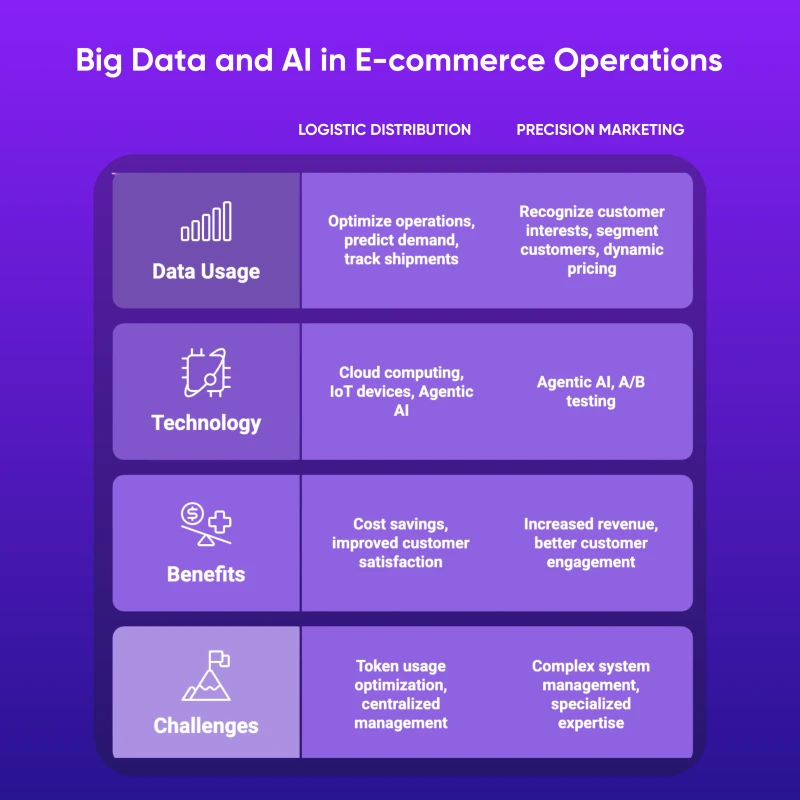
Big data plays a pivotal role in revolutionizing logistic distribution in the e-commerce industry. With the abundance of data at their disposal, e-commerce companies can optimize their logistical operations, resulting in significant cost savings and improved customer satisfaction. By leveraging big data analytics, businesses can analyze and predict consumer demand patterns, allowing them to efficiently manage their inventory and ensure sufficient stock levels. Additionally, big data enables accurate forecasting of product demand, allowing companies to plan their logistics and transportation routes accordingly. Through real-time data analysis, often visualized through tools such as big data Power BI, e-commerce platforms can monitor and track shipments, minimizing delays and providing customers with accurate delivery estimates.
Cloud computing offers significant improvements to logistic distribution processes. Integration with Internet of Things (IoT) devices and sensors enables real-time monitoring of vehicles, shipments, and inventory levels, facilitating optimized routing and reducing delays. These data flows are frequently integrated within an e-commerce portale, allowing businesses to centralize logistics, inventory, and operational insights into a single platform.
In more advanced systems, Agentic AI platforms can further enhance logistics distribution by coordinating multiple intelligent agents to automate decision-making processes. These systems can operate across the entire SDLC, ensuring that logistics solutions are continuously optimized and improved. A critical factor in such systems is token usage optimization, as token consumption becomes a core cost component in AI-driven platforms. Efficient systems that minimize token usage can achieve better cost-performance outcomes. Additionally, centralized management is required to coordinate multiple agents and models, ensuring governance, scalability, and consistency across the entire platform.
Precision marketing
E-commerce companies derive significant benefits from big data when it comes to precision marketing. Firstly, Big Data enables companies to have deeper recognition of the interest and preference of customers. By analyzing vast amounts of data collected from customer interactions, purchases, and online activities, e-commerce companies can paint a comprehensive picture of individual customers. This is particularly important in marketing digital e-commerce, where personalization and real-time engagement are key drivers of performance.
Secondly, big data enables e-commerce companies to segment their customer base more effectively. By grouping customers based on various attributes such as demographics, behavior, and purchase history, companies can identify specific segments with distinct needs and preferences.
Thirdly, big data facilitates dynamic pricing strategies for e-commerce companies. By analyzing pricing trends, competitor data, and customer behavior, companies can adjust their prices in real-time to remain competitive and maximize revenue.
Moreover, big data empowers e-commerce companies to conduct A/B testing and optimize marketing campaigns continually. Lastly, big data allows e-commerce companies to detect and prevent fraud.
When combined with Agentic AI systems, precision marketing can be further enhanced through continuous and autonomous optimization. However, managing such systems is complex and requires specialized expertise. Therefore, Agentic AI consulting services are essential to support enterprises in designing, developing, and governing these systems effectively, ensuring alignment with business objectives and operational requirements.
Read more: AI Applications in E-Commerce: Optimizing Inventory Management (Part 1)
Limitations and UPP Global Technology JSC’s Solutions
Challenges in Applying AI and Big Data in Practice
Although this blog explores the advantages of using big data in the e-commerce sector, it is important to recognize the potential limitations that could affect the practical implementation of these solutions in real-world business environments. While the blog highlights the role of big data in logistics distribution and precision marketing, many organizations still face challenges in adopting and operationalizing these technologies effectively.
In practice, applying big data and AI into enterprise systems requires not only theoretical understanding but also strong capabilities in system integration, data engineering, and end-to-end implementation. Without a unified approach, businesses may encounter issues such as fragmented data systems, inefficient workflows, and difficulties in scaling AI solutions across the organization. Therefore, when enterprises aim to adopt big data analytics in their industry, it is essential to collaborate with technology partners that can provide comprehensive, end-to-end solutions.
UPP’s End-to-End AI Approach
In this context, integrated service providers such as UPP Global Technology JSC offer a structured approach to AI adoption through a combination of AI Strategy & Governance, Enterprise Data Foundation, Agentic AI Systems, and operational frameworks including AIOps, MLOps, DataOps, and cloud cost optimization. In many enterprise environments, data visualization and decision-making are further enhanced through tools such as big data Power BI, enabling stakeholders to gain actionable insights from complex datasets.
Agentic AI Platform for End-to-End SDLC
A key component in this approach is the Agentic AI Platform, which is particularly suitable for IT outsourcing (ITO) models where speed and software quality are critical. This platform enhances the software development lifecycle by enabling faster development cycles and improving product quality. One of its main differentiators lies in its ability to support the end-to-end software development lifecycle (SDLC), ensuring that all stages from design to deployment are seamlessly connected.
Token Optimization for Cost Efficiency
Additionally, the platform emphasizes token usage optimization, which is becoming a core cost factor in modern AI systems. As AI-driven software increasingly relies on large language models, efficient token usage directly impacts operational cost and scalability. Organizations that can minimize token consumption while maintaining performance are more likely to achieve competitive advantages.
Centralized Management of AI Systems
Another important aspect is centralized management. Since end-to-end SDLC requires the coordination of multiple agents and models, a centralized platform is necessary to manage, monitor, and govern the entire system. This ensures consistency, scalability, and effective resource utilization across all stages of development and operations.
Agentic AI Consulting Services
However, building and managing such systems is not straightforward. The implementation of Agentic AI requires deep expertise in both AI and system architecture. Therefore, Agentic AI Consulting services play a critical role in supporting enterprises in designing, developing, and managing these systems effectively.
The Continued Role of Traditional AI Development
At the same time, despite the rise of Agentic AI, Traditional AI Development remains essential. AI engineers and machine learning specialists are still required to develop core models, including machine learning and deep learning systems that cannot be fully automated. In fact, as Agentic AI adoption increases, the demand for such expertise is expected to grow due to the decreasing supply of traditional AI engineers. Complex use cases, such as energy forecasting systems, require domain-specific modeling capabilities that go beyond the scope of Agentic automation.
Future Direction
Future research should therefore not only focus on the applications of big data in specific domains but also consider how integrated AI platforms, governance frameworks, and hybrid approaches between Agentic AI and traditional AI can be applied to enhance scalability, efficiency, and long-term sustainability in the e-commerce industry.
Conclusion
To sum up, the benefits of big data utilization in the e-commerce industry has been discussed and highlighted in this essay. Through the analysis of customer data, businesses have been able to enhance their logistics distribution and precision marketing strategies, leading to improved operational efficiency, cost savings, and increased customer satisfaction. These advancements play a crucial role in modern marketing digital e-commerce, where data-driven decision-making defines competitive advantage.
Big data has facilitated optimized supply chain management, dynamic pricing, targeted marketing campaigns, and personalized customer experiences.
At the same time, the integration of end-to-end AI services and Agentic AI platforms provides new opportunities for enterprises to enhance scalability, efficiency, and system integration. By leveraging centralized platforms, optimizing token usage, and combining Agentic AI with traditional AI development, organizations can build more advanced and sustainable digital systems.
Moreover, this essay has acknowledged the limitations of the research and emphasized the need for future research to address these gaps.
Newsletter
DISCOVER MORE






















































![[Recap] UPP Global Technology JSC Establishing Anniversary](/homepage/news-section/new-4.webp)

































LET’S TALK...
Content delivered to your inbox


ENTER YOUR EMAIL
YOU WANT TO...


Hanoi, Vietnam
Web3 Tower, No. 15, Alley 4, Duy Tan, Cau Giay, Hanoi, Vietnam