How Agentforce Supports Enterprise Operations
Date
May 14th, 2026
Reading Time
7 mins
Introduction
Enterprise operations today require more than basic automation. Organizations must manage growing service demands, fragmented systems, and increasing compliance expectations while maintaining operational efficiency at scale.
Salesforce Agentforce addresses these challenges by combining AI powered assistance, workflow automation, and real time CRM intelligence into a unified enterprise platform. This article explores how Agentforce supports enterprise operations through intelligent workflows, operational visibility, and scalable service management.
1. Why Enterprise Operations Need More Than Traditional Automation
Enterprise operations are becoming more complex than ever. Organizations today manage growing volumes of customer interactions, regulatory requirements, fragmented systems, and rising expectations for speed and personalization. In industries such as finance, insurance, telecom, and healthcare, operational inefficiencies can directly affect customer trust, compliance readiness, and long term business performance.
Traditional automation tools have helped enterprises reduce repetitive manual work, but rule based workflows alone are no longer enough. Modern enterprises require intelligent systems that can understand context, surface insights in real time, and support decision making across departments.
This is where Salesforce Agentforce changes the landscape.
Agentforce combines AI powered assistance, workflow automation, and real time CRM intelligence into a unified operational framework. Instead of functioning as a standalone productivity tool, it becomes part of the enterprise operating model itself, supporting agents, automating service flows, and enabling organizations to scale operations with greater speed and control.
2. What Is Salesforce Agentforce?
Salesforce Agentforce is an AI driven enterprise service platform designed to support customer operations at scale. Built on Salesforce technologies such as Einstein Copilot, Agentforce Service (Service Cloud), and Data 360 (Data Cloud). Agentforce helps organizations automate service workflows while maintaining visibility, compliance, and operational governance.
Unlike traditional automation platforms that focus only on predefined rules, Agentforce uses contextual intelligence to support dynamic operational decisions. It can analyze customer history, identify case priority, recommend next best actions, and surface relevant information directly within the service workflow.
This allows enterprises to move beyond reactive operations toward more proactive and intelligent service management.
3. How Agentforce Supports Enterprise Operations
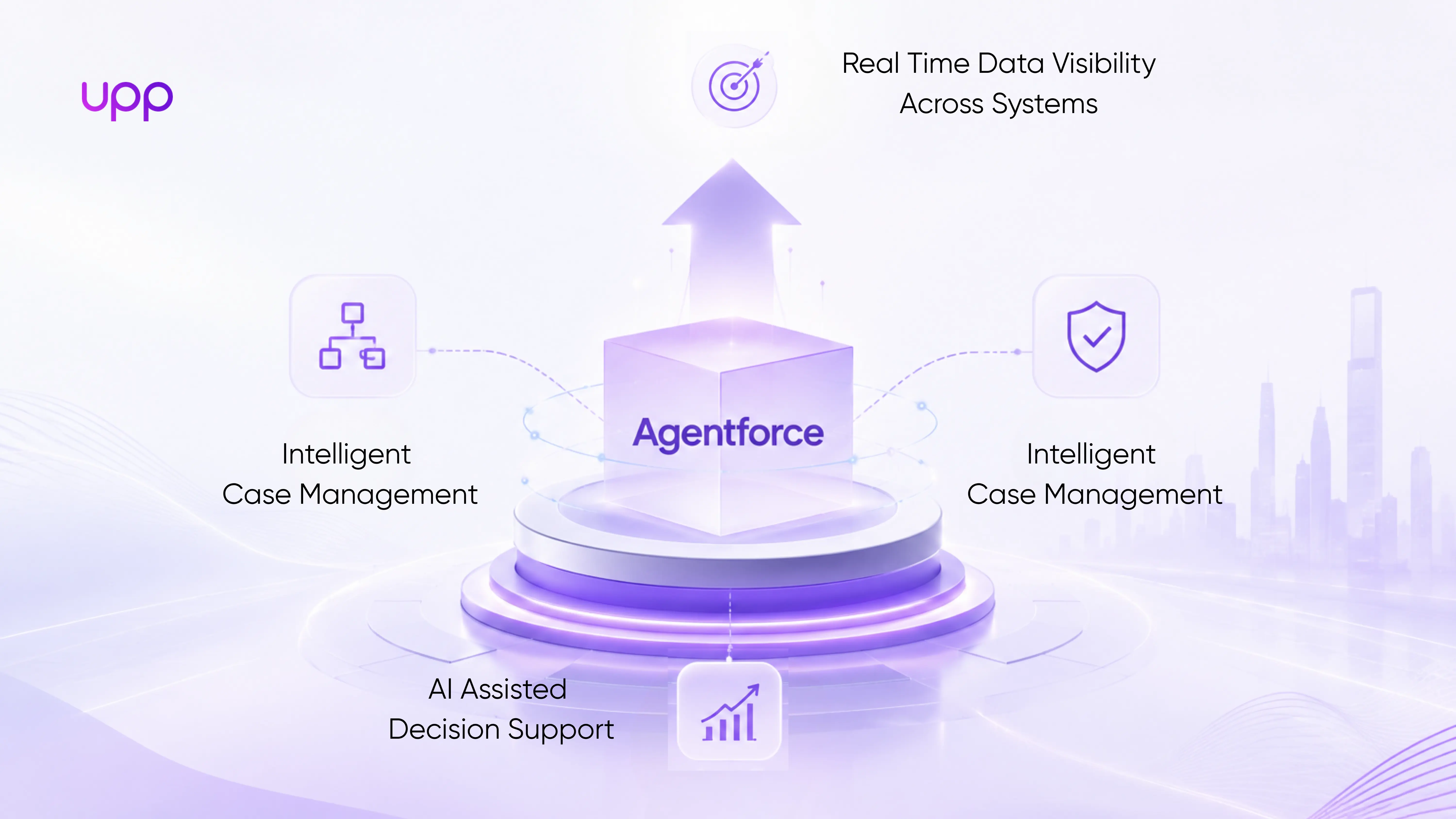
3.1. Intelligent Case Management
One of the most important ways Agentforce supports enterprise operations is through intelligent case management.
Large enterprises handle thousands of service requests every day across multiple channels. Manual triage processes often create delays, inconsistent handling, and operational bottlenecks.
Agentforce improves this process by automatically:
- Categorizing incoming requests
- Prioritizing cases based on urgency and customer profile
- Routing tickets to the appropriate teams
- Recommending next steps to service agents
This reduces operational friction while helping teams maintain faster response times and more consistent service quality.
For example, Allianz has invested heavily in AI driven customer service and workflow automation to improve claims processing and operational efficiency across its insurance operations. Platforms like Salesforce Agentforce help support these large scale enterprise workflows through intelligent case routing, automated service handling, and compliance focused operational management.
In highly regulated industries, intelligent case handling also improves traceability by ensuring that workflows follow predefined compliance rules and approval structures.
3.2. Real Time Data Visibility Across Systems
Enterprise teams often struggle with disconnected systems and fragmented customer information. In many organizations, service agents must switch between CRMs, billing platforms, compliance systems, customer databases, and operational dashboards simply to resolve a single customer issue. This fragmented workflow not only slows down response times but also increases the risk of inconsistent service handling, missing information, and operational errors.
Agentforce helps solve this challenge by centralizing operational visibility and surfacing real time data directly within the workflow environment. Through integrations with Agentforce Service (Data Cloud) and third party enterprise systems, the platform enables service teams to access critical operational information without constantly moving between applications.
This may include customer interaction history, transaction records, policy information, service usage data, compliance alerts, fraud indicators, support history, and real time account updates. By consolidating this information into a unified interface, Agentforce helps service agents gain a more complete understanding of each customer interaction and operational scenario.
For enterprise environments, this level of visibility is especially important because operational decisions often need to be made quickly while still meeting compliance and governance requirements. In financial services, for example, agents may need immediate access to transaction activity, identity verification status, and risk indicators before approving customer requests. In telecom environments, support teams may require real time network usage data, service status information, and billing records to troubleshoot technical issues efficiently.
Real time visibility also improves cross departmental collaboration. Instead of relying on manual escalations or disconnected communication between teams, operational units can work with shared information and synchronized workflows. This helps reduce duplication of effort, minimize service delays, and improve consistency across customer interactions.
In addition, centralized operational visibility supports better reporting and performance monitoring. Enterprise leaders can track workflow efficiency, service bottlenecks, SLA adherence, and operational trends more accurately through integrated dashboards and analytics capabilities.
Ultimately, Agentforce reduces the operational burden associated with fragmented systems and manual data retrieval. By providing faster access to relevant information and improving workflow transparency, the platform helps enterprises make more accurate decisions, improve customer experiences, and maintain stronger operational governance at scale.
3.3. AI Assisted Decision Support
Agentforce does not replace human teams. Instead, it augments enterprise operations with AI assisted decision support, helping organizations improve both efficiency and operational accuracy.
Using Einstein Copilot and Service GPT capabilities, Agentforce can support enterprise workflows through several intelligent functions, including:
- Suggesting responses during customer interactions
- Recommending workflow actions based on operational context
- Identifying potential operational or compliance risks
- Providing contextual knowledge recommendations in real time
- Detecting anomalies in customer behavior or service activity
These capabilities are particularly valuable in enterprise environments where operational decisions must balance speed, customer experience, and regulatory compliance at the same time.
In health tech environments, AI assisted decision support can help healthcare organizations manage patient service operations more efficiently. For example, Teladoc Health uses AI driven technologies and digital platforms to improve patient engagement, virtual care coordination, and operational responsiveness. Platforms such as Agentforce can support these workflows by helping service teams prioritize urgent patient cases, surface relevant patient interaction history, recommend next actions during support interactions, and identify operational risks that may affect patient experience or compliance processes.
In edtech environments, AI assisted workflows can also improve student support and operational efficiency. For instance, Coursera uses AI and data driven technologies to personalize learning experiences and support large scale student operations globally. With capabilities similar to Agentforce, education platforms can automatically recommend support actions, identify students at risk of disengagement, surface relevant learning history to support teams, and provide contextual guidance during student interactions. This allows organizations to deliver faster and more personalized support experiences while managing high volumes of learner requests efficiently.
By embedding intelligence directly into operational processes, Agentforce helps enterprises reduce manual decision making, improve workflow consistency, and support faster, more accurate service operations at scale.
3.4. Embedded Compliance and Governance
Compliance is one of the most critical challenges for enterprise operations, particularly in industries such as finance, insurance, telecom, healthcare, and education where organizations must manage sensitive customer data, operational risk, and strict regulatory requirements at scale.
Traditional automation systems often rely on separate governance layers to control access, monitor risks, and enforce compliance policies. This approach can create operational complexity, fragmented oversight, and slower decision making processes. Agentforce approaches compliance differently by embedding governance directly into operational workflows rather than treating it as an isolated control function.
Through integrated governance capabilities, Agentforce helps enterprises manage role based access control, policy driven workflow logic, audit ready activity tracking, region specific compliance requirements, and AI governance frameworks within a unified operational environment. This allows organizations to maintain stronger visibility and operational consistency while reducing the risks associated with disconnected governance processes.
As enterprises adopt more advanced AI capabilities and autonomous workflows, governance becomes increasingly important. Organizations must ensure that AI driven decisions remain transparent, traceable, and aligned with internal business policies as well as external regulatory standards. Agentforce supports this by enabling structured AI operations where workflows can be monitored, validated, and controlled across departments and operational systems.
For instance, in healthcare environments, organizations handling patient information must comply with strict privacy and data protection regulations while still delivering fast and responsive service experiences. Platforms like Agentforce can help healthcare providers manage secure patient interactions, maintain audit trails, and control access to sensitive records within operational workflows. In edtech environments, governance frameworks are equally important for protecting student data, managing access permissions, and ensuring compliance with regional education and privacy regulations across digital learning platforms.
This balance between automation, operational efficiency, and governance is essential for enterprises operating in high stakes environments where trust, compliance, and service reliability are closely connected.
3.5. Integration with Enterprise Ecosystems
Enterprise operations rarely exist within a single platform. Most organizations operate complex ecosystems that include legacy infrastructure, cloud applications, customer service platforms, operational support systems, and third party enterprise tools. As a result, disconnected systems often create operational silos, fragmented customer data, and inefficient workflows across departments.
Agentforce supports enterprise operations by integrating across these environments through APIs, middleware, and event driven architectures. It can connect Agentforce Service (Service Cloud) with billing platforms, synchronize customer profiles through Data 360 (Data Cloud), integrate fraud detection and compliance systems, and enable real time workflows based on operational events and customer activity. This allows enterprises to centralize operational visibility and improve coordination between systems without replacing their existing infrastructure entirely.
Instead of forcing large scale operational disruption, Agentforce helps enterprises modernize and orchestrate existing systems more intelligently while maintaining operational stability and scalability.
3.6. Operational Benefits of Agentforce
When properly implemented, Agentforce can deliver measurable operational improvements across the enterprise.
Some benefits can be mentioned are:
1. Faster Service Resolution**:** Automated triage and AI assisted workflows help reduce handling time and improve SLA performance.
2. Improved Agent Productivity**:** By surfacing relevant information automatically, Agentforce reduces manual work and helps agents focus on higher value tasks.
3. Better Customer Experience**:** Faster responses, more accurate service interactions, and proactive support contribute to stronger customer satisfaction.
4. Enhanced Operational Visibility**:** Enterprise leaders gain clearer insights into service performance, workflow bottlenecks, and AI effectiveness.
5. Scalable Operations**:** Agentforce helps organizations scale customer operations without increasing operational complexity at the same rate.
4. Why Strategic Implementation Matters
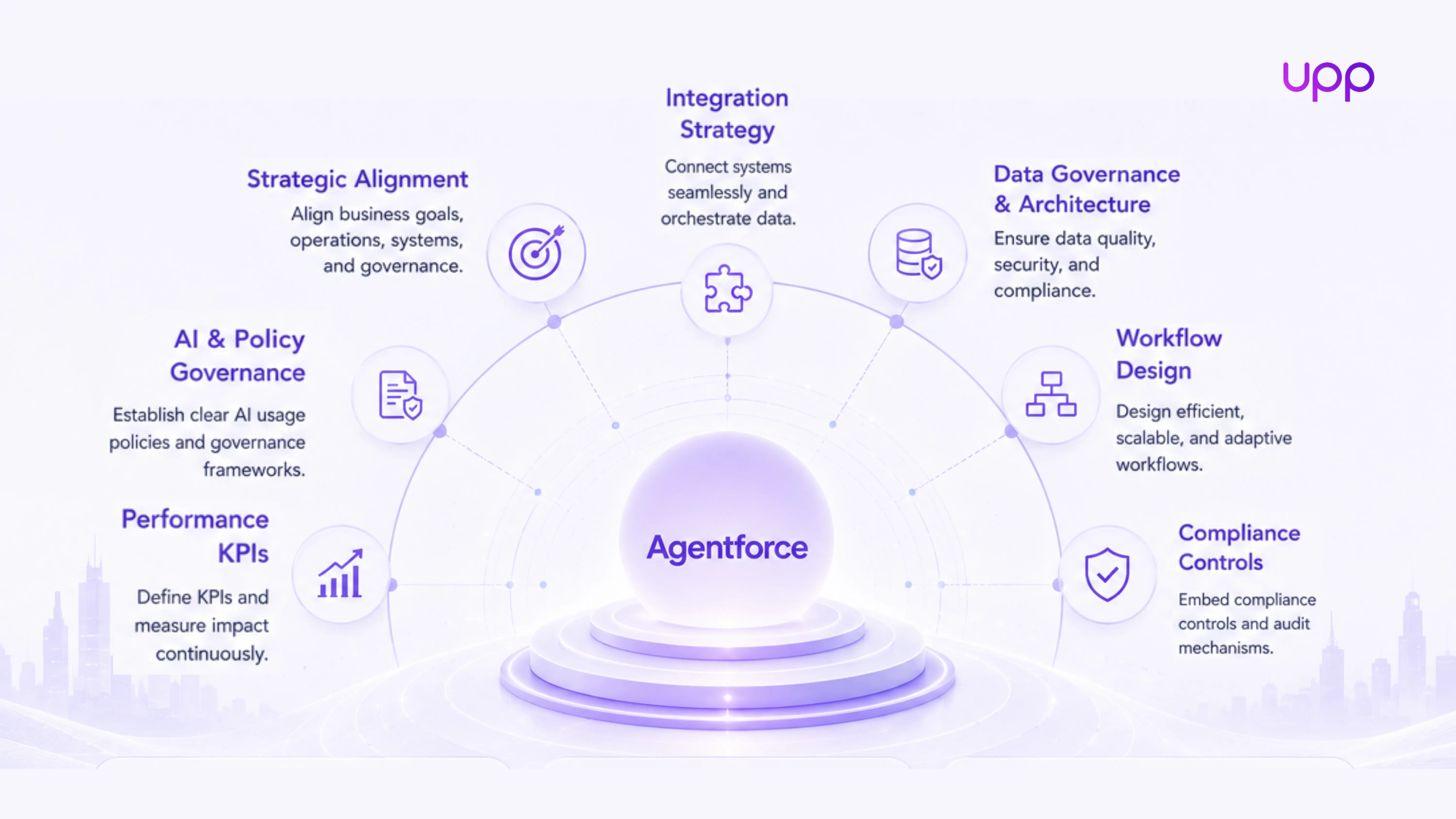
Technology alone does not guarantee operational success. Deploying Agentforce effectively requires strong alignment between business goals, operational workflows, system architecture, and governance frameworks. Organizations must carefully establish AI usage policies, integration strategies, data governance models, workflow structures, compliance controls, and measurable performance KPIs before scaling AI driven operations. Without this alignment, enterprises risk fragmented workflows, disconnected data environments, and inconsistent AI behavior across departments and systems.
A strategic implementation approach ensures that Agentforce supports long term operational objectives rather than becoming another isolated technology layer within the enterprise ecosystem.
5. The Future of Enterprise Operations with Agentforce
Enterprise operations are moving toward a model where AI, automation, and human expertise work together continuously.
Agentforce represents this shift by enabling organizations to build more intelligent, connected, and adaptive operational environments.
As enterprises face increasing pressure to improve efficiency while maintaining compliance and customer trust, platforms like Agentforce will play a growing role in operational transformation.
The organizations that succeed will not simply automate workflows. They will build intelligent operational ecosystems that combine data, AI, governance, and human decision making into a unified strategy.
Conclusion
Salesforce Agentforce is redefining how enterprise operations are managed. By combining AI assisted workflows, real time data visibility, embedded compliance, and scalable integrations, it helps organizations improve efficiency without sacrificing control.
For enterprises operating in complex and regulated environments, the value of Agentforce lies not only in automation, but in intelligent orchestration across systems, teams, and workflows.
When implemented strategically, Agentforce becomes more than a service tool. It becomes a foundation for modern enterprise operations.
Newsletter
DISCOVER MORE


































![[Recap] UPP Global Technology JSC Establishing Anniversary](/homepage/news-section/new-4.webp)
























LET’S TALK...
Content delivered to your inbox


ENTER YOUR EMAIL
YOU WANT TO...


Hanoi, Vietnam
Web3 Tower, No. 15, Alley 4, Duy Tan, Cau Giay, Hanoi, Vietnam