OpenClaw: From Chatbot to Operator Agentic System
Date
March 9th, 2026
Reading Time
7 mins
Most AI tools were designed mainly to answer questions or generate text. Chatbots and large language models made it easier for users to write emails, summarize documents, or search for information. However, a growing direction in AI development is moving beyond simple conversations, though conversational and agentic AI continue to serve different needs and coexist in practice. Today, many researchers and developers are exploring AI agents that can perform tasks and automate workflows for users.
One project that has recently attracted attention to this space is Clawdbot. Unlike traditional chatbots, it is designed to work as a personal AI assistant that can interact with a user’s system and help manage everyday digital tasks. Because it is open source and highly customizable, the project has attracted interest from developers exploring local AI automation. The AI tool shows how AI can move from being a tool that only provides answers to a system that actively supports real work.
More importantly, Clawdbot represents a shift from conversational AI toward what many developers call an "operator system" - a system that does not just respond to prompts but actively executes tasks within a digital environment on the user's behalf. Instead of simply generating responses, the system can interpret instructions, plan actions, and carry them out across a user's local environment. (Note: this use of "operator" differs from Anthropic's formal definition, where an "operator" refers to a business deploying the Claude API.). This transition from chatbot style interaction to operator style execution is a key step in the evolution of agentic AI systems.
Understanding what Clawdbot is
Clawdbot can be described as an AI agent designed to automate tasks directly on a user’s computer or private environment. Many modern AI services operate entirely through cloud platforms, where user requests are processed by remote servers. In contrast, the automation system follows a more flexible approach that allows it to run locally on a personal computer or private server. This design gives users more control over how the system works and how their data is handled. However, local execution also comes with trade-offs: it typically requires more capable hardware, involves more complex setup, and may rely on smaller, less powerful models compared to cloud hosted alternatives.
Instead of functioning as a typical chatbot, it acts more like a digital operator. Users can provide instructions through messaging interfaces or command systems, and the AI interprets these instructions before carrying out the necessary actions. The system can interact with files, applications, and other digital tools within the user's environment. For example, renaming or sorting files in a folder, triggering a local script, reading calendar data, or calling an external API. As a result, the digital automation assistant does not only generate responses but also complete tasks that normally require manual work.
This difference is architecturally and philosophically significant. When AI moves from generating text to executing actions, it introduces entirely new categories of risk, trust, and responsibility, not just a productivity upgrade.
How Clawdbot works in practice
The basic idea behind Clawdbot is straightforward to describe, even if the engineering required for reliable execution is considerably more complex. The user provides instructions, and the AI analyzes the request using a language model. After understanding the goal of the instruction, the system breaks the task into smaller steps and executes them automatically within the local environment.
For example, a user might ask the system to organize certain documents, check for updates in a specific folder, or collect information from different sources. Instead of simply suggesting what the user should do, the AI assistant attempts to complete these steps directly. In many cases, the AI can combine several actions into a single automated process.
Because the system can run continuously in the background, it does not need to wait for new instructions every time a task appears. It can monitor certain activities, manage workflows, and provide updates when necessary. This ability makes the digital automation assistant closer to a persistent assistant rather than a traditional software tool that only works when it is actively used. Users should be aware, however, that a continuously running agent consumes CPU, memory, and potentially API budget, which is a real consideration when choosing to deploy it.
As AI technology improves, this type of system may become increasingly common. This direction is reflected in active research and industry investment, from academic work on ReAct-style agent loops to commercial frameworks like LangChain, AutoGPT, and OpenAI's agent tooling, all pointing toward task-executing AI as a central part of future digital workflows.
Technical Architecture Behind Clawdbot
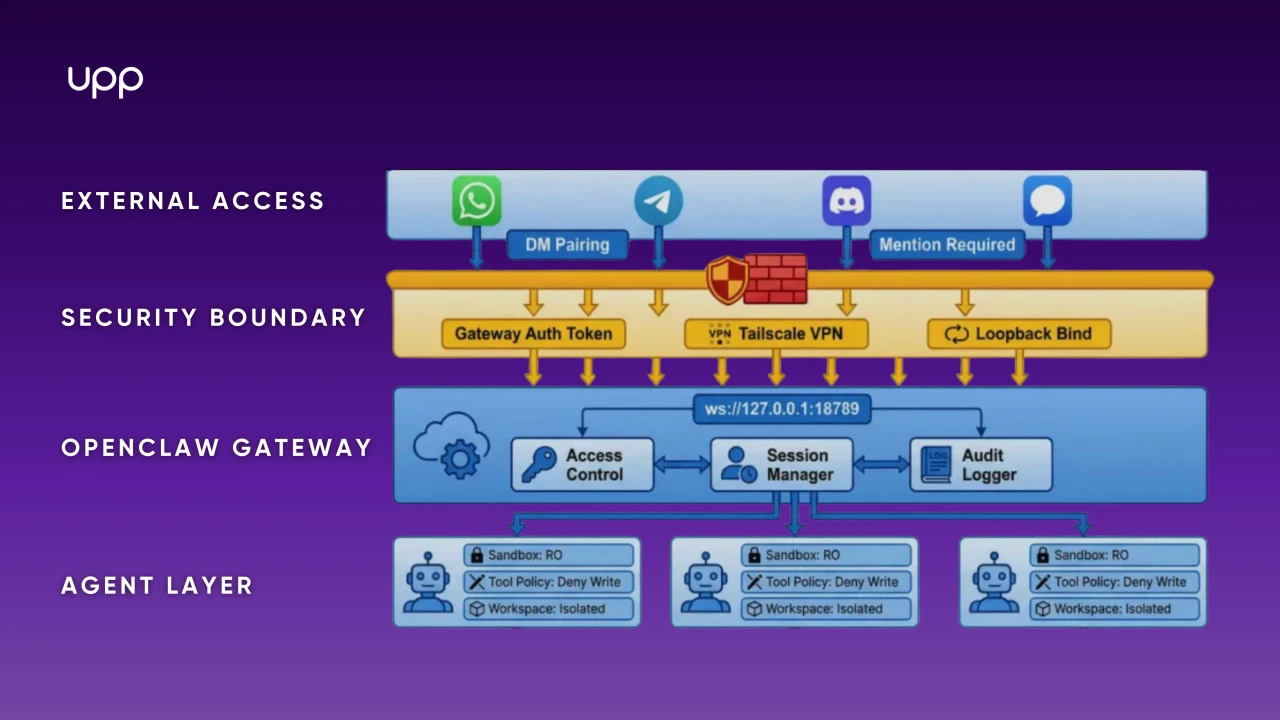
To understand why Clawdbot can function as an operator's system, it is important to look at the technical architecture that enables this behavior. Unlike traditional chat-based AI systems, it relies on several main mechanisms that allow it to perceive tasks, reason for them, and execute real actions.
At the core of the system is an agent loop that follows a continuous cycle: perceive, plan, act, and observe. In the perception stage, the AI collects information from the user’s request, the system environment, or connected tools. It then enters the planning phase, where the model analyzes the task and decides what sequence of actions should be taken. During the action phase, the system executes commands such as interacting with files, running scripts, or calling external tools. Finally, the observe stage allows the agent to review the results of its actions and adjust the next steps if necessary. This architecture closely mirrors the ReAct (Reason + Act) pattern established in AI agent research, where reasoning and acting are interleaved rather than separated.
This loop enables Clawdbot to operate in a dynamic way rather than simply responding to single prompts. Instead of completing isolated tasks, the system can adapt its behavior based on feedback from the environment and continue working until the objective is achieved, provided that clear termination conditions are defined. Without them, a runaway agent loop that cannot reach its goal is a real failure mode that developers must account for.
Another important technical component is the Model Context Protocol (MCP), an open standard developed by Anthropic. MCP provides a structured way for the AI agent to interact with external tools and services and is publicly documented for developers who want to explore it further. Through this protocol, Clawdbot can connect to different software components, interpret tool capabilities, and execute actions programmatically. This mechanism effectively turns the AI from a text generator into an operator that can control digital resources such as files, APIs, or command-line tools.
Memory management is also an essential part of the system. the intelligent system distinguishes between session based memory and persistent memory. Session-based memory keeps track of the context within a single interaction, allowing the agent to understand ongoing instructions and maintain conversation continuity. Persistent memory, on the other hand, allows the system to store longer-term knowledge across sessions.
Several structured memory files are used to support this capability. Files such as SOUL.md, AGENTS.md, and MEMORY.md help define different layers of system knowledge. SOUL.md typically describes the identity, behavior principles, and operational philosophy of the agent. AGENTS.md provides information about available agents or capabilities within the system. MEMORY.md stores accumulated knowledge or operational context that the system can reuse in future tasks. Together, these files allow the agent to maintain both operational structure and long-term awareness. This approach raises practical questions worth examining: How does the agent safely update MEMORY.md without overwriting valid entries? What happens when entries conflict? How does stale or incorrect memory affect future behavior? These are open design challenges in any file-based memory system.
Clawdbot also uses a hybrid approach to language models. Depending on the complexity of a task, the system may choose between local language models or external API-based models such as GPT or Claude. This decision is often managed through a mechanism sometimes referred to as a complexity router, which may be rule-based, heuristic-driven, or use a lightweight classifier to estimate task difficulty. For simpler tasks, the system may rely on local models that have no per-call API cost, though hardware and energy consumption are still real costs. For more complex reasoning tasks, the system may call external APIs that provide stronger intelligence but require additional cost.
This flexible architecture allows Clawdbot to balance performance, cost, and capability, though the trade-offs between local and cloud models, in terms of latency, reliability, capability gaps, and data privacy, require careful configuration and are not automatically resolved by the hybrid design.
Why Clawdbot has gained attention
One reason the intelligent system has attracted interest is its open-source nature. Because the project is publicly available, developers can study how it works, improve its functions, and adapt it to different environments. This openness encourages experimentation and innovation. That said, open-source projects can also fragment, stall without sufficient contributors, or suffer from inconsistent maintenance, outcomes that affect long-term reliability just as much as the advantages.
Another important factor is the level of control it offers to users. When AI tools operate only through cloud services, users must rely on external platforms to manage their data. With Clawdbot, the system can operate locally, meaning that files and information can remain within the user's own environment. However, when the system routes complex tasks to external APIs such as GPT or Claude, as described in the complexity router section, data may still leave the local environment. Users with strict privacy requirements should configure the system to avoid external API calls or ensure those calls comply with their data policies.
The project also highlights the growing interest in automation driven by AI agents. Many people spend a large portion of their time performing repetitive digital tasks such as organizing files, collecting information, or managing updates across multiple platforms. Systems like Clawdbot aim to reduce this workload by allowing AI to handle routine processes automatically.
Because of these advantages, the project serves as a reference point for developers building local agentic systems, illustrating one approach to how personal AI assistants might develop soon.
Possible applications of Clawdbot
The potential applications of Clawdbot depend largely on how it is configured and integrated into a user’s workflow. In personal environments, it can assist with everyday productivity tasks such as organizing documents, monitoring updates, or managing digital information. Instead of manually checking multiple applications or folders, users can rely on the AI agent to track these activities and provide useful summaries. Importantly, the value of an agentic approach here, over a simple script or scheduled task, is the system's ability to handle ambiguous or multi-step instructions without requiring the user to pre-define every action.
In technical environments, developers may use it to automate system monitoring or run scripts that manage routine processes. For example, the AI could observe system logs, notify users about unusual events, or help coordinate development tasks. These functions can reduce manual work and allow developers to focus on more complex problems.
Businesses may also explore similar AI agents to support operational processes. Automated assistants could collect internal data, generate reports, or monitor workflow progress across different teams. Although Clawdbot itself is still an emerging project, it demonstrates how AI agents could eventually become part of everyday business infrastructure. Enterprise adoption, however, will require addressing stricter security policies, compliance requirements (such as data residency and audit logging), and integration with existing toolchains, challenges that go well beyond the technical architecture alone.
Challenges and future considerations
Despite its potential, there are also some highlights several important challenges related to AI agents. Because the system has access to a user’s environment and can perform actions automatically, security and control become essential concerns. If an AI agent is given too much authority without proper safeguards, it may execute unintended actions or expose sensitive information.
For this reason, developers working with AI agents must design clear rules that define what the system can and cannot do. These challenges are not unique to Clawdbot but apply to the broader field of autonomous AI systems. (The specific mechanisms - sandboxing, permission scoping, and the least privilege model - are covered in detail in the Security section below.)
At the same time, the project offers an interesting preview of what the future of artificial intelligence might look like. Instead of interacting with AI only through short conversations, users may eventually rely on AI agents that operate continuously in the background, helping manage digital environments and automate complex workflows.
Security and Control in Operator AI Systems
While the technical capabilities of the intelligent system are impressive, they also introduce significant security challenges. Unlike traditional AI tools that only generate text, operator systems can interact directly with files, networks, and applications. This means the system may have access to sensitive data or critical infrastructure if proper controls are not implemented.
One of the most important concepts in designing such systems is defining clear security boundaries. Developers must carefully determine what parts of the system the AI agent is allowed to access and under what conditions. Techniques such as sandboxing, permission scoping, and filesystem access control are often used to restrict the operational environment of the AI. These mechanisms create controlled zones where the agent can execute tasks without risking the broader system.
Another emerging concept is the responsible permission model. Because operator AI systems can perform real actions, they require a more structured approach to permissions than traditional software. The goal is to grant the minimum viable access needed to complete a task while preventing unnecessary exposure to sensitive resources.
This idea closely aligns with the principle of least privilege (PoLP), where the system only receives the permissions required for a specific operation. Some frameworks also introduce concepts such as a Permission Traffic Light Model, where low-risk actions may be executed automatically, medium-risk actions require confirmation, and high-risk actions require explicit human approval. In addition, sandboxing the execution layer can ensure that even if the AI performs unexpected actions, the impact remains limited within a controlled environment.
Without these protections, AI agents that have access to filesystems and network connections could potentially introduce serious risks. Prompt injection attacks, where malicious content in the environment manipulates the agent into executing unintended actions, unexpected behaviors, or vulnerabilities in tool integrations might allow unauthorized access to sensitive data or system resources. Prompt injection is a particularly underappreciated threat in agentic systems, since the agent may process content from untrusted sources (web pages, documents, emails) as part of its normal operation. For this reason, security design must be considered a central part of building and deploying operator AI systems.
Lessons Learned from Clawdbot
The development of systems like Clawdbot offers several important lessons for the future of AI agents. While much attention is often placed on how these systems can automate tasks or increase productivity, an equally important question concerns the limits that must be placed on their behavior.
In practice, the most critical design decision is not how to enable the system to perform actions, but how to define the boundaries of what it should never do. Operator AI systems require carefully designed restrictions, permission structures, and human checkpoints to ensure safe operation.
As AI agents become more capable and autonomous, defining these boundaries will likely become one of the most important challenges in the field of artificial intelligence. the AI agent therefore provides more than just a technical experiment. It highlights a broader shift in how developers must think about AI systems that can act, not just respond.
A glimpse into the next stage of AI
Clawdbot represents a small but meaningful step toward a new generation of AI systems. While many AI tools today focus on generating information, projects like the intelligent automation tool demonstrate how AI can begin to interact directly with digital environments and perform useful actions.
As research in AI agents continues to advance, the key question is not whether systems like this AI agent will become more capable, but whether the safety boundaries, permission models, and human oversight mechanisms will keep pace with that capability. Clawdbot's most important contribution may be less about what it can do, and more about forcing developers to confront what agentic systems should never do.
Although the technology is still developing, it provides an early example of how artificial intelligence might evolve from a conversational tool into a system that executes tasks on behalf of users, actively reducing manual workload rather than merely advising on how to do so.
Newsletter
DISCOVER MORE





































![[Recap] UPP Global Technology JSC Establishing Anniversary](/homepage/news-section/new-4.webp)






















LET’S TALK...
Content delivered to your inbox


ENTER YOUR EMAIL
YOU WANT TO...


Hanoi, Vietnam
Web3 Tower, No. 15, Alley 4, Duy Tan, Cau Giay, Hanoi, Vietnam