AI Assistants vs AI Agents: What Problem Are You Actually Solving?
Date
August 4th, 2026
Reading Time
8 mins
Introduction
Artificial intelligence is becoming more deeply embedded in enterprise operations, but the language used to describe it is becoming less precise. AI assistants and AI agents are often discussed as interchangeable solutions, even though they are designed for different types of work and create value in different ways.
Comparing the two reveals more than a difference in features. It shows how AI can support human effort, execute business processes, interact with enterprise systems, and operate within different levels of control. For enterprise, understanding these distinctions is essential to choosing an approach that fits the problem, the workflow, and the level of autonomy the organisation is prepared to manage.
What Is an AI Assistant?
An AI assistant is a user-facing system that helps a person complete a defined task through natural-language interaction. It receives a request, uses available context to generate an answer or output, and returns control to the user.
Modern AI assistants may combine large language models, retrieval, enterprise knowledge, and application integrations. Their strength is making human work faster and more consistent.
A typical interaction follows this pattern:
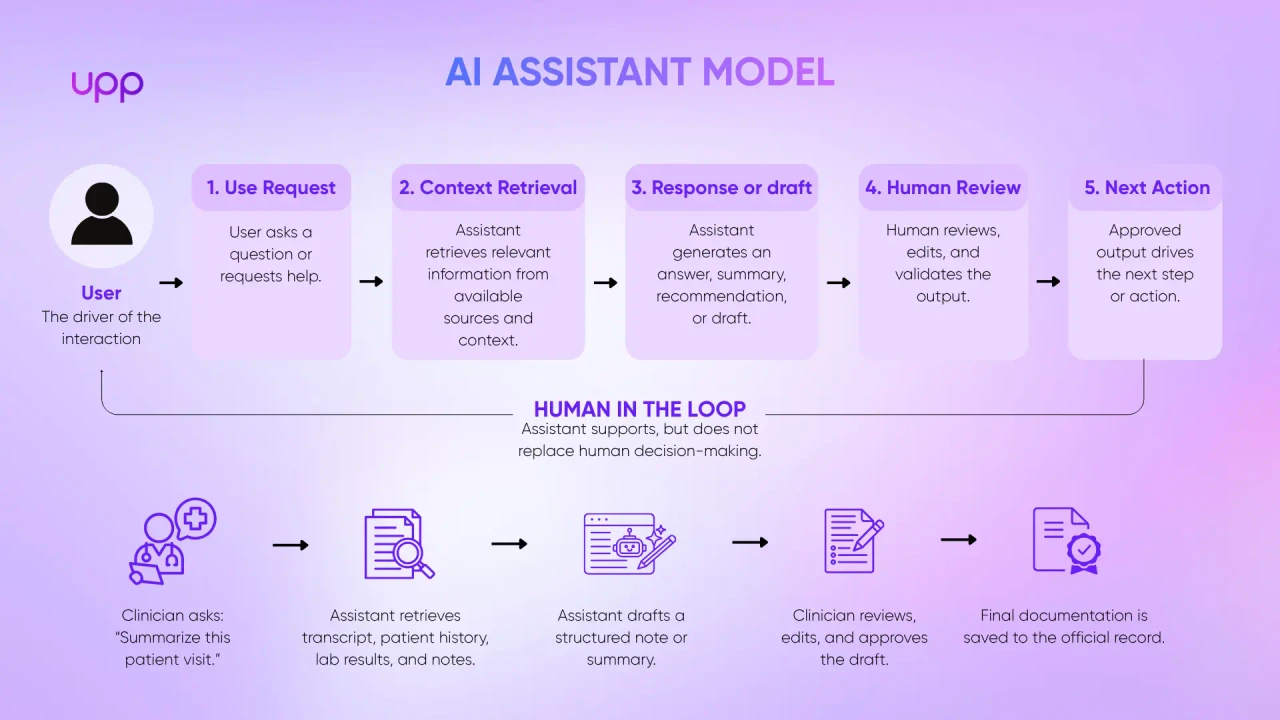
The user remains the driver. The assistant may summarize, recommend, answer, or prepare documentation, but usually waits for further instructions.
Clinical documentation is a clear example. An AI assistant can turn a transcript into a structured draft note, summarize patient history, or highlight missing fields. The clinician still verifies what enters the official record. IBM similarly distinguishes assistants as primarily reactive systems that work from user prompts and support activities such as information retrieval, recommendations, and documentation.
This task automation reduces administrative effort without transferring operational responsibility to AI. It fits work where professional judgment remains central and the outcome is a summary, recommendation, or draft.
How AI Assistants Work in Enterprise Environments
Enterprise AI assistants need more than a chatbot interface. They must be grounded in approved data and connected to the right business context.
First, the assistant interprets intent. It then retrieves information from knowledge bases, documents, databases, or systems of record. A model generates the output, while policies determine what data can be accessed and which actions require approval.
Tool use can extend the assistant’s capabilities. It may search a repository, retrieve a customer profile, calculate a value, or prepare a CRM update. Yet a person generally decides whether to accept the recommendation or commit the change.
This human-in-the-loop model suits documentation, analysis, internal support, and guided decision-making because users can review outputs before they affect downstream operations.
What Is an AI Agent?
An AI agent is a goal-oriented system designed to plan and execute actions with a defined degree of autonomy. Instead of only generating an answer, it determines how to complete an assigned task, selects and uses appropriate tools, interacts with connected systems, and adapts its actions based on the results it receives.
A typical AI agent workflow looks like this:
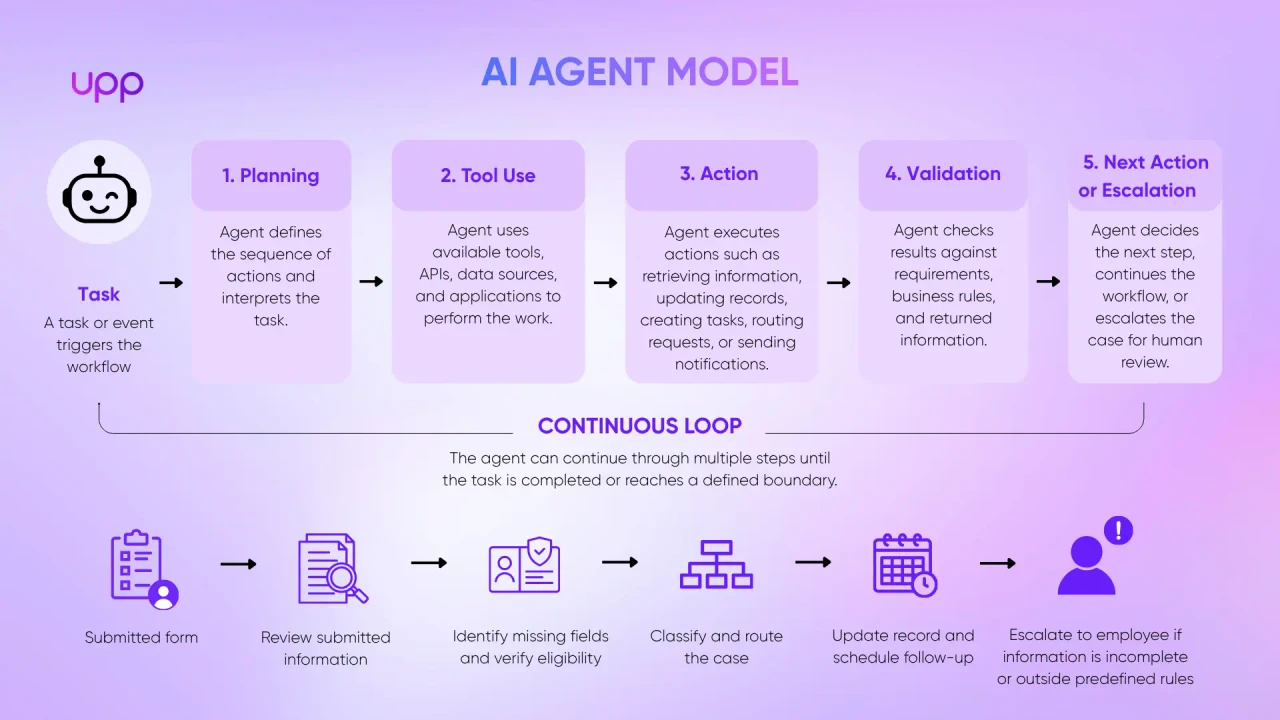
The workflow begins when the agent receives a task, such as processing a submitted form, coordinating a follow-up, updating a business record, or responding to a system request. It interprets the task, gathers the necessary context, and breaks the work into manageable steps. During planning, the agent determines the sequence of actions, identifies dependencies, and selects an appropriate approach.
Next, the agent uses available tools to execute the plan. These tools may include APIs, databases, enterprise applications, search functions, messaging services, or other agents. Tool use enables the agent to move beyond generating text and perform actions such as retrieving information, updating records, creating tasks, routing requests, or sending notifications.
After completing an action, the agent validates the result against the task requirements, business rules, and information returned by connected systems. It then determines whether the task has been completed, another step is required, the plan should be adjusted, or the case should be escalated for human review. This process may continue until the task is completed or the agent reaches a defined operational boundary.
For example, in a patient intake workflow, an AI agent may review submitted information, identify missing fields, verify eligibility, classify the request, route the case, update the relevant record, and schedule follow-up. If the information is incomplete or the case falls outside predefined rules, the agent can pause the workflow and escalate it to an authorized employee.
This is intelligent workflow automation with the value comes from connecting reasoning, decisions, and actions across an end-to-end process. Unlike an assistant that usually waits for continued user direction, an AI agent can progress through multiple steps using the tools, permissions, and guardrails available to it.
How AI Agents Work in Enterprise Environments
Enterprise AI agents begin with an assigned task, such as processing a submitted form, coordinating a follow-up, updating a business record, or handling a request from a connected system. The agent interprets the task, gathers the relevant context, plans the required steps, and selects the appropriate tools for execution.
Depending on its permissions, the agent may call APIs, retrieve information, update a CRM or another system of record, create tasks, route requests, and send notifications. After each action, it validates the result against the task requirements and business rules. Based on that validation, the agent determines whether to continue to the next step, adjust its plan, complete the task, or escalate the case for human review.
More complex enterprise workflows may require AI agent orchestration, where specialized agents handle different tasks while an orchestration layer coordinates routing, system handoffs, workflow state, dependencies, and exceptions. To support safe execution, enterprise AI agents operate within defined permissions, approval thresholds, monitoring controls, business rules, and escalation paths. Sensitive or high-impact actions may require human approval, while low-risk and reversible tasks can be completed automatically.
>> Read more: Building a Continuous Evaluation Pipeline for AI Agents
AI Assistants vs AI Agents: What is the Real Difference?
AI assistants and AI agents differ primarily in the level of responsibility assigned to the system. An assistant supports a user at a specific point in their work, while an agent progresses an assigned task through a defined workflow using tools, business rules, and validation.
The difference is not simply that AI agents are more advanced because each model is designed to address a different operational need.
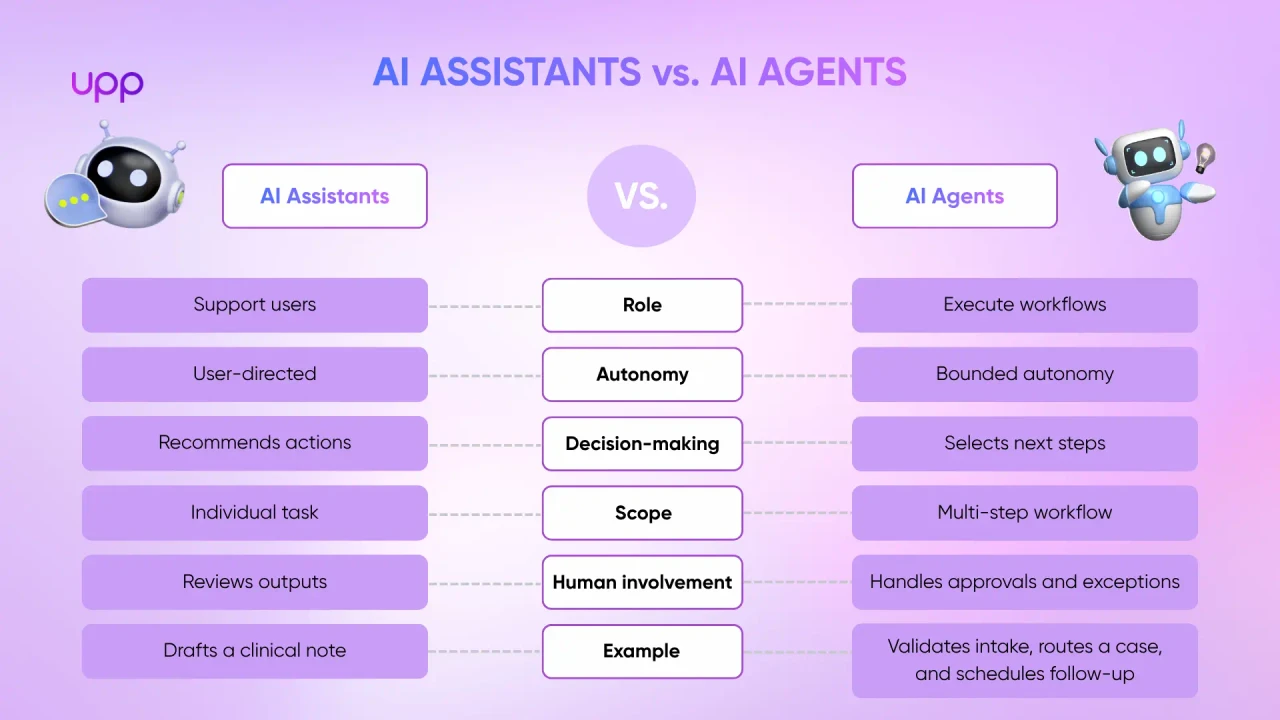
In practical terms, AI assistants improve how people complete work, while AI agents improve how work moves through a process. For example, an AI assistant may help an employee summarise a long document or prepare a customer response. An AI agent may take an assigned request, retrieve the necessary information, update the relevant systems of record, create follow-up tasks, and notify the people involved.
Neither approach is universally better. Their value depends on whether the operational friction exists within an individual task or across the wider workflow.
Choosing the Right AI Starts With Understanding the Workflow
Once the operational difference is clear, the next step is to locate the actual bottleneck.
Task assistance is appropriate when employees spend too much time searching for information, drafting content, summarising documents, or interpreting data. The employee still owns the wider process, while the AI assistant improves the speed, consistency, or quality of one activity within it.
Workflow execution becomes more relevant when delays come from repeated handoffs, manual routing, duplicate updates, status checks, or disconnected enterprise systems. These problems require more than an answer or recommendation. They require AI workflow automation that can move a task from one stage to another while following business rules and escalation paths.
Separating task-level effort from process-level coordination helps enterprises avoid two common mistakes: introducing more autonomy than the process requires or deploying an assistant that cannot address the underlying operational problem.
>> Explore UPP's Enterprise AI consulting services
How Can AI Assistants and AI Agents Work Together?
Task assistance and workflow execution are not mutually exclusive. In many enterprise environments, AI assistants and AI agents can operate as complementary layers within the same solution.
The AI assistant provides the interaction layer. It allows employees or customers to describe what they need through natural language, confirms important details, and presents the final result. The AI agent provides the execution layer. It uses approved tools and integrations to complete the required actions across connected applications.
For example, a user may ask an assistant to arrange a customer follow-up. The assistant captures the request and confirms the account, timing, and relevant instructions. An agent then retrieves the account record, creates the required task, updates the CRM, sends a notification, and returns the result.
The assistant presents the completed outcome or explains why additional input is required. Behind the interface, the agent manages the cross-system workflow. This combined architecture gives users a familiar conversational experience while enabling structured workflow execution across enterprise systems.
What Must Enterprises Design Before Enabling Autonomous Execution?
Combining assistants and agents does not mean giving AI unlimited operational control. Autonomous execution must be designed around clear boundaries.
Enterprises need to define the workflow, system permissions, business rules, approval thresholds, and exception paths before an agent is allowed to take action. Guardrails should determine what the agent can access, modify, approve, or trigger.
Human-in-the-loop controls are particularly important for sensitive, irreversible, or high-impact actions. Low-risk and reversible tasks may be completed automatically, while higher-risk decisions should require approval from an authorized employee.
Monitoring and auditability are equally important. Enterprises should be able to trace the tools used, information retrieved, records updated, validation results, and human approvals involved in each AI agent workflow.
The underlying process must also be ready for automation. Strong candidates for intelligent workflow automation usually have repeatable steps, trusted data, clear ownership, measurable outcomes, and manageable exceptions. Where these conditions are missing, organizations may need to improve the process or data foundation before introducing enterprise AI agents.
How UPP Turns AI Use Cases Into Production Workflows
Moving from an AI use case to a production-ready workflow requires more than choosing a model or adding a chatbot to an existing application.
UPP helps enterprises identify the appropriate level of AI responsibility for each operating problem. Through AI consulting, UPP evaluates workflow requirements, data readiness, integration dependencies, governance needs, and expected business outcomes before recommending an assistant, an agent, or a combined architecture.
For task-focused use cases, this may involve developing AI assistants grounded in approved enterprise knowledge and connected to relevant business applications.
For execution-focused use cases, UPP supports AI agent integration and AI agent orchestration across enterprise applications and systems of record. This includes connecting tools, coordinating workflow steps, defining human approval points, and establishing the guardrails required for secure autonomous execution.
The objective is to turn isolated AI capabilities into secure and scalable workflows that reduce manual coordination, maintain human oversight, and deliver measurable operational value.
Conclusion
The choice between AI assistants and AI agents is ultimately an enterprise design decision, not a competition between technologies. Getting it right determines whether AI becomes a useful productivity layer or a dependable part of business operations.
Enterprises should adopt the level of autonomy their processes, systems, and governance can realistically support. With the right approach, they can create immediate value today while building a practical foundation for more connected and intelligent operations over time.
FAQ
1. What is the main difference between an AI assistant and an AI agent?
An AI assistant helps a person complete a specific task, while an AI agent can plan and execute multiple actions to achieve a defined outcome across tools and systems.
2. Are AI agents always better than AI assistants?
No. AI agents offer greater autonomy, but they also require stronger integrations, guardrails, monitoring, and governance. An assistant may be better when professional judgment remains central.
3. When should a business use an AI agent?
An AI agent is suitable for repeatable multi-step processes, routing, follow-up, approvals, cross-system coordination, or frequent manual handoffs.
4. Can AI agents integrate with existing enterprise software?
Yes. AI agents can connect with existing applications through APIs, integration services, databases, or other secure connection methods. Legacy platforms may require middleware or additional integration work before they can support reliable agent execution.
5. How should enterprises measure the value of an AI agent?
Useful measures include workflow completion rate, processing time, exception rate, manual effort reduced, accuracy, and cost per workflow. These metrics should be connected to a defined operational or business outcome.
6. What data foundation do AI agents require?
AI agents need reliable and permissioned access to the information required for their assigned tasks. Clear data ownership, consistent records, security controls, and data quality are essential for dependable execution.
Tags cloud
Newsletter
DISCOVER MORE






























![[Recap] UPP Global Technology JSC Establishing Anniversary](/homepage/news-section/new-4.webp)




















LET’S TALK...
Content delivered to your inbox


ENTER YOUR EMAIL
YOU WANT TO...


Hanoi, Vietnam
Web3 Tower, No. 15, Alley 4, Duy Tan, Cau Giay, Hanoi, Vietnam