
Salesforce’s Product Rebrand: What Businesses Need to Know Now
Date
February 10th, 2026
Reading Time
7 mins
What's news
What Is Salesforce’s Product Rebranding About?
The 2025 Salesforce rebrand represents a major shift in how the company names and packages its products. Traditional “Cloud” labels are being phased out in favor of names that emphasize business outcomes, industry use cases, and AI-centric capabilities.
This change is designed to help business leaders, CRM administrators, and technology teams more easily understand what each product delivers, how it fits into their organisation, and how partner support should be structured around it.
Old vs New Salesforce Product Names (New Update)
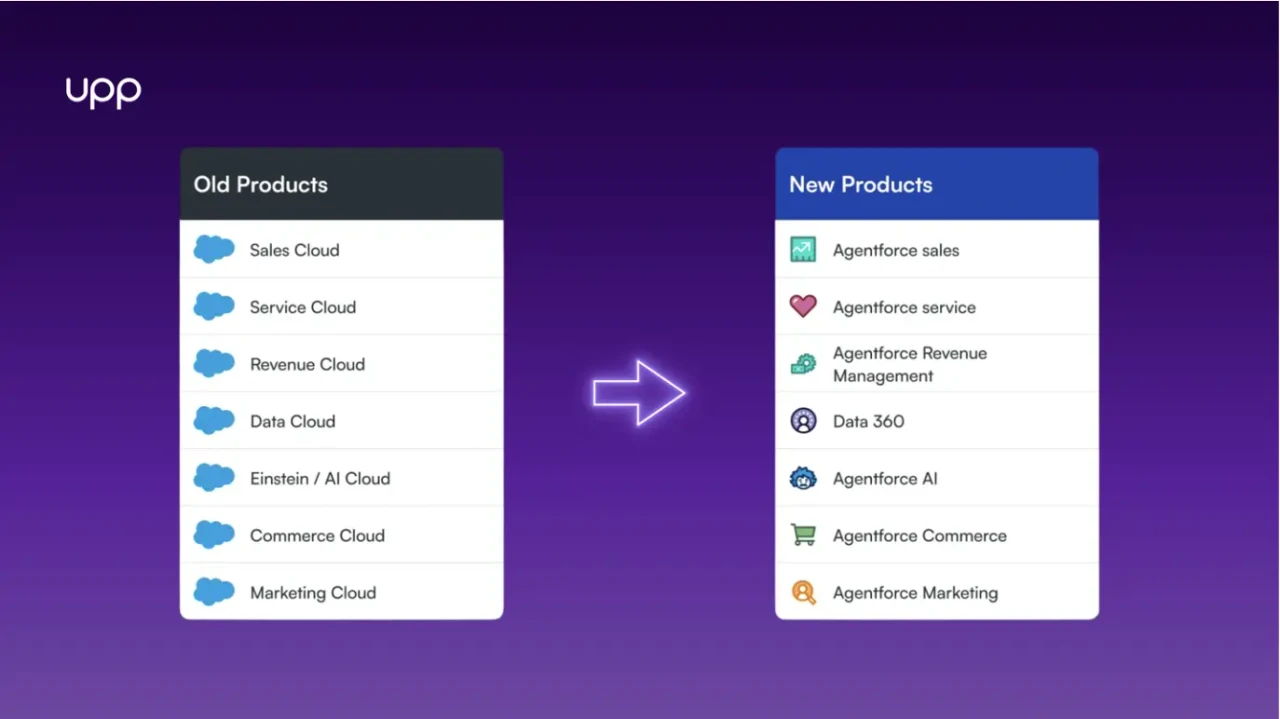
Here’s a representative table of how some main Salesforce product names are shifting. Use this as a reference when evaluating current licences, integrations, and partner alignments.
| Old Product Name | New Product Name (Rebranded) | Primary Function / Category |
|---|---|---|
| Sales Cloud | Agentforce sales | CRM for sales and revenue teams |
| Service Cloud | Agentforce service | Customer service & case management |
| Revenue Cloud | Agentforce Revenue Management | Quote-to-cash, billing, revenue opsQuote-to-cash, billing, revenue ops |
| Data Cloud | Data 360 | Unified data platform, CDP, analytics |
| Einstein / AI Cloud | Agentforce AI | Core AI engine and autonomous agent layer |
| Commerce Cloud | Agentforce Commerce | E-commerce and order management |
| Marketing Cloud | Agentforce Marketing | Marketing automation, engagement |
Note: These mappings reflect the direction of the rebranding effort. Some legacy names or transitions may still appear in documentation or partner materials.
Why Did Salesforce Rebrand Their Products?
Salesforce’s rebranding is part of their strategic vision to align product names with real business use cases and its growing AI ecosystem (including Agentforce and Data Cloud). The goal is to create a simplified, connected, and AI-driven experience across every Salesforce Cloud for customers, partners, and developers.
Reasons Behind the Rebranding:
-
Simplified Product Navigation: Make Salesforce’s product suite easier to understand by reducing confusion caused by overlapping clouds and services.
-
AI-Driven Alignment: Unify AI Cloud, Agentforce, and Data Cloud under a clear AI-first identity that reflects Salesforce’s strategic direction.
-
Unified User Experience: Ensure consistent naming, functionality, and navigation across Sales, Service, Marketing, and Commerce Clouds.
-
Business Outcome Focus: Shift from technical product groupings to outcome-based solutions that help businesses connect, automate, and grow more efficiently.
The Impact and Benefits For Your Business
By simplifying product names and organizing features within one AI-powered ecosystem, Salesforce helps organizations choose the right tools faster, understand licensing more clearly, and connect customer, marketing, and service operations across all Salesforce platforms.
1. Easier Onboarding and Product Discovery
Simplified product names help teams quickly identify what each Salesforce tool does. Instead of juggling multiple products like Sales Cloud + Einstein + AI Cloud, everything is now under Agentforce Sales (combining CRM and AI). Businesses save training time, accelerate setup, and onboard faster without confusion across departments.
2. Clear Alignment Between AI, CRM, and Automation
The rebrand unifies AI, CRM, and automation through Agentforce, Data Cloud, and Einstein Copilot. As a result, data moves more smoothly across marketing, sales, and service teams, with fewer silos. For example, insights from Agentforce can be used immediately to personalize customer email campaigns in Salesforce Marketing, without the need for extra integrations.
3. Better Licensing Transparency for Enterprise Clients
Licenses are now organized around business goals rather than product bundles. Instead of deciphering complex add-ons, clients see clear categories like Salesforce Sales or Salesforce Integration. This simplifies budgeting and purchasing. For example, AI features are now part of core products, removing the need for separate “AI Cloud” licenses.
4. Consistency in Data Experience Across Platforms
All Salesforce products, from Salesforce Analytics (formerly Tableau) to Salesforce Integration (formerly MuleSoft) now use consistent interfaces and data models. This allows teams to manage analytics, integration, and automation through one unified experience. We can see as both marketing and service dashboards can access customer insights from the same shared Data Cloud.
How to Adapt Your Salesforce Strategy Post-Rebrand
Stay ahead of Salesforce’s AI-driven shift by updating your org, training, and integrations to match the new product lineup.
-
Review Licenses & Subscriptions: Audit your current products to align contracts and functionality with Salesforce’s renamed suite.
-
Map Product Equivalents: Update internal docs and diagrams to reflect new names like Salesforce Sales and Salesforce Service.
-
Refresh Training Content: Revise onboarding and learning resources so teams understand the new AI-powered tools.
-
Check Integrations :Verify APIs and connected apps for old product references to keep systems synced.
-
Communicate Internally: Share updates across departments to ensure everyone speaks the same “Salesforce language.
A few smart updates today will help your business fully align with Salesforce’s new, AI-powered direction.
Salesforce’s New AI Vision
Salesforce centers AI with Agentforce, unifying generative AI across products.
1. Agentforce (Unified AI Platform):
Serves as a co-pilot powered by Data Cloud to provide context-aware recommendations, and offers prebuilt AI workflows that help teams deploy solutions more quickly across the organization.
2. Einstein Copilot Embedded:
-
Sales: drafts emails, forecasts pipelines.
-
Service: triages tickets, suggests resolutions.
-
Marketing: proposes campaign ideas and segment insights.
3. AI Cloud → Agentforce:
All AI capabilities (Einstein, Copilot, AI Cloud) now sit under Agentforce for centralized governance, simpler licensing, and consistent data security via Data Cloud.
4. Quick old→new roundup:
Einstein GPT → Agentforce AI | AI Cloud → Agentforce Platform | Einstein Bots → Agentforce Copilot
Benefit for ICP: Simplified AI adoption, clearer ROI, and consistent cross-departmental automation, ideal for mid-enterprise CRM teams.
Conclusion
Salesforce’s rebranding is more than a change in names, it reflects a move toward unified, AI-driven, and outcome-focused solutions. By simplifying products such as Sales Cloud into Agentforce Sales, Salesforce helps businesses see value more clearly and operate more efficiently.
To take advantage of this shift, organizations should review their CRM setup, update training materials, and realign licensing with the new structure. Done right, the rebrand becomes an opportunity to improve clarity, increase adoption, and support long-term growth.
👉Subscribe to our newsletter for the latest Salesforce updates
Newsletter
DISCOVER MORE












































![[Recap] UPP Global Technology JSC Establishing Anniversary](/homepage/news-section/new-4.webp)






























LET’S TALK...
Content delivered to your inbox


ENTER YOUR EMAIL
YOU WANT TO...


Hanoi, Vietnam
Web3 Tower, No. 15, Alley 4, Duy Tan, Cau Giay, Hanoi, Vietnam