
UPP News: What's new in the AI field? (Part 8)
Date
April 15th, 2024
Reading Time
5 mins
Subscribe to our newsletter and stay up-to-date with the latest AI news updates.
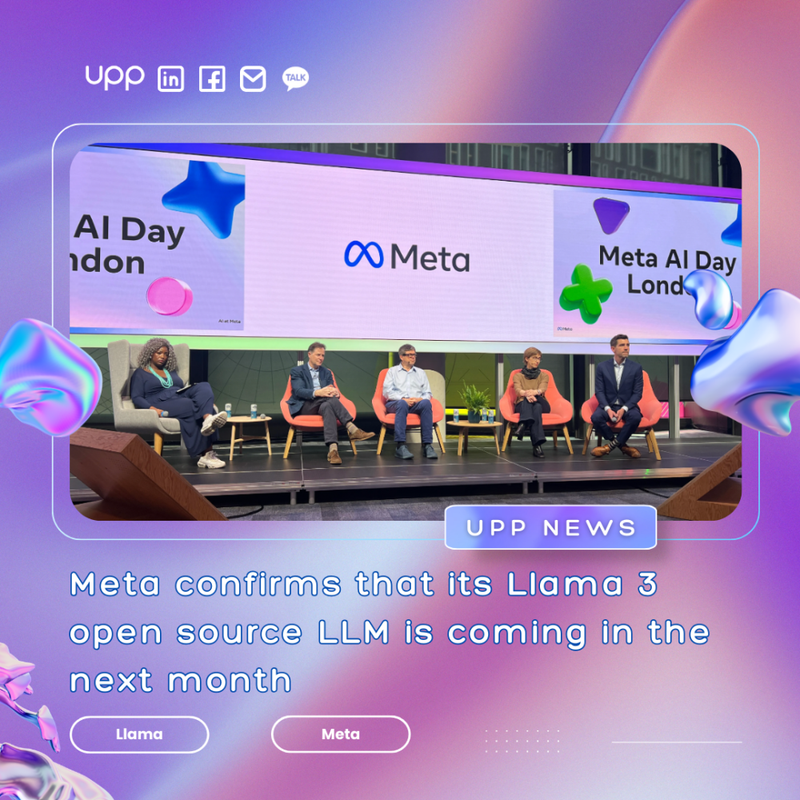
1. Meta confirms that its Llama 3 open-source LLM is coming in the next month.
Source: The Information
Meta has confirmed plans to release Llama 3, the next generation of its large language model, within the next month. This announcement follows a report by The Information on Monday indicating that Meta was nearing the launch. Nick Clegg, Meta's president of global affairs, highlighted that the release would feature several iterations of Llama 3 with varying capabilities, aiming to cater to different needs. Meta's Chief Product Officer Chris Cox emphasized that Llama 3 will power multiple products across Meta's platforms.
The decision to accelerate the release of Llama 3 underscores Meta's efforts to compete with OpenAI's ChatGPT, which gained widespread popularity over a year ago. Meta aims to address criticisms of previous versions being too limited by expanding Llama 3's scope to handle a wider range of questions, including more controversial topics. Joelle Pineau, vice president of AI Research at Meta, expressed ambitions for Llama-powered Meta AI to become the most useful assistant globally, although the company did not provide specifics on Llama 3's parameters or demonstrations of its functionality.
Meta's open-source approach with the Llama family contrasts with more proprietary models, aiming to garner favour with developers. However, the company remains cautious, as evidenced by its decision not to release Emu, its image generation tool, yet. Despite Meta's push for Llama 3, there are skeptics within the company, including Yann LeCun, Meta's chief AI scientist, who believes the future lies in joint embedding predicting architecture (JEPA) rather than generative AI, advocating for a shift in focus within the company's product division.
Read more: How to Deploy Llama on Your Local Machine.
2. Meta unveils its newest custom AI chip as it races to catch up.
Source: Techcrunch
Meta is aggressively investing in its generative AI efforts, allocating significant funds towards both AI research recruitment and hardware development, particularly in chip technology tailored for running and training AI models. The latest advancement in this pursuit is the unveiling of the "next-gen" Meta Training and Inference Accelerator (MTIA), boasting improved performance over its predecessor, MTIA v1, with a shift to a 5nm process, more processing cores, increased memory, and higher clock speed. While Meta claims up to 3x better performance, specifics on testing metrics remain vague.
Despite Meta's strides in hardware development, the company's approach and progress raise questions. While the next-gen MTIA is not currently utilized for generative AI training, Meta hints at ongoing exploration in this area. Moreover, Meta acknowledges that the chip won't replace GPUs but rather complement them, indicating a cautious approach to integration. With Meta's rivals, including Google, Amazon, and Microsoft, advancing their custom AI chips, Meta faces pressure to accelerate its hardware development to keep pace.
As Meta races to establish a foothold in the AI hardware landscape, its efforts are met with challenges and the looming shadow of competitors' advancements. While boasting a relatively swift timeline from silicon to production models for the next-gen MTIA, Meta still has significant ground to cover to achieve independence from third-party GPUs and remain competitive in the evolving AI hardware market.
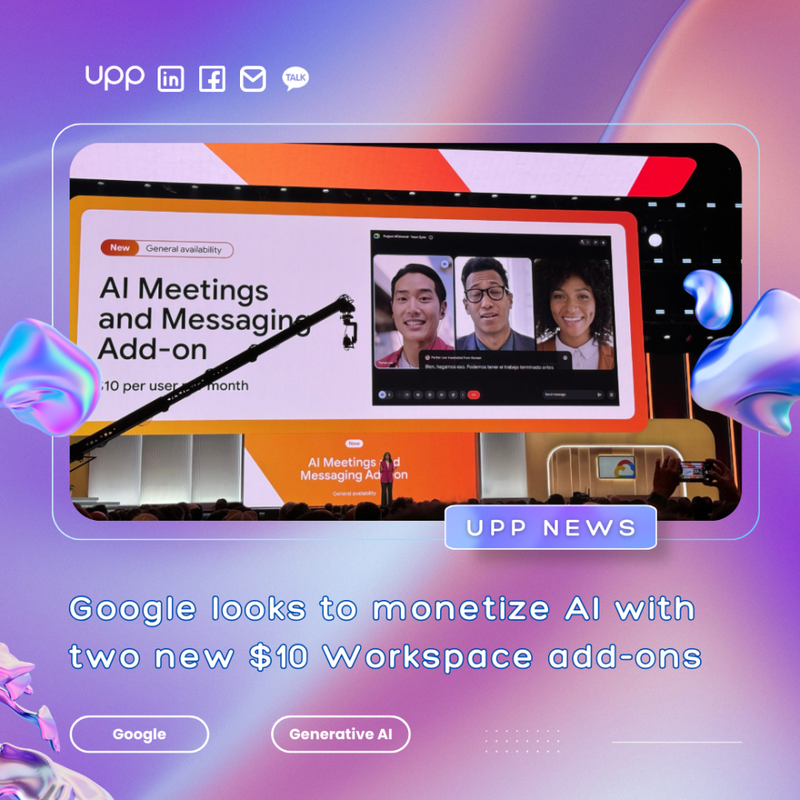
3. Google looks to monetize AI with two new $10 Workspace add-ons.
Source: Techcrunch
As companies integrate more advanced AI features into their software, they're exploring ways to monetize these capabilities. Following Microsoft's lead, Google introduced two $10/month/user add-on packages for its Google Workspace productivity suite during Google Cloud Next. The AI meetings and messaging add-on offers features like note-taking, meeting summaries, and translation into 69 languages, while the AI security package enhances content security with file classification and data loss prevention controls.
Although the cost was added, these add-ons align with similar offerings from third-party services, making them competitive options for customers seeking advanced features. Google emphasizes flexibility, allowing customers to mix and match license types and apply advanced features where needed. Additionally, Google plans to introduce further enhancements, including generative AI custom backgrounds and studio-quality meeting features, in the coming months.
Both add-ons are now available to Workspace subscribers, signalling Google's commitment to enhancing productivity and security through AI-driven solutions while offering customers flexibility in choosing the features that best suit their needs.
4. Google open source tools to support AI model development.
Source: Techcrunch
At Google's Cloud Next conference, typically focused on closed-source products, this year saw a shift with the introduction of several open-source tools aimed at supporting generative AI projects and infrastructure. MaxDiffusion, released quietly in February, offers reference implementations of diffusion models optimized for XLA devices like Google's TPUs and recent Nvidia GPUs. JetStream, a new engine for running text-generating models, claims up to 3x higher performance per dollar, catering to increasing demand for cost-efficient inference stacks.
While the 3x improvement claim lacks clarity in methodology, JetStream's optimization for popular models like Gemma 7B and Llama 2 underscores its potential impact on AI workloads in production. Additionally, Google's contributions and Nvidia GPUs, aim to maximize GPU and TPU utilization for higher energy efficiency and cost optimization. Collaborating with Hugging Face, Google introduces Optimum TPU, simplifying the deployment of generative AI models on TPU hardware.
Despite its current limitations, such as supporting only Gemma 7B and lacking support for training models on TPUs, Google promises future enhancements. These initiatives reflect Google's commitment to advancing open-source tools and easing the adoption of generative AI models, further enriching its ecosystem and developer community.
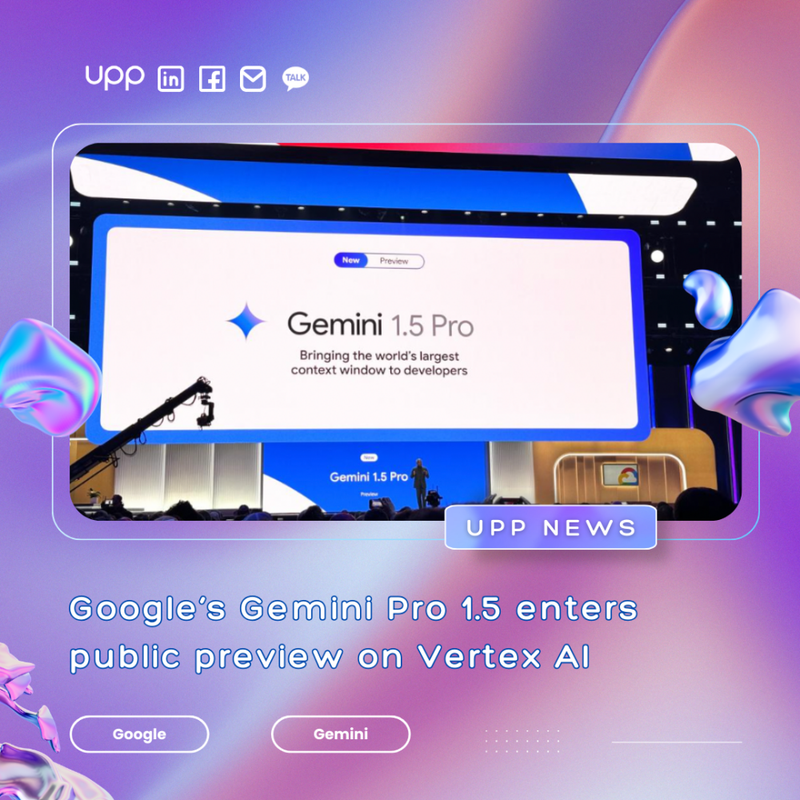
5. Google’s Gemini Pro 1.5 enters public preview on Vertex AI.
Source: Tech.co
During its Cloud Next conference, Google unveiled Gemini 1.5 Pro, its latest addition to the Gemini family of generative AI models, now available in public preview on Vertex AI. The standout feature of Gemini 1.5 Pro is its ability to process an extensive context, ranging from 128,000 tokens up to 1 million tokens, enabling it to handle complex tasks such as analyzing code libraries, reasoning across lengthy documents, and engaging in extended conversations with chatbots.
The substantial context window of Gemini 1.5 Pro allows for richer understanding and generation of content across various media types, including text, images, videos, and now audio streams. With multilingual capabilities, the model can compare content across different languages and analyze media content like TV shows, movies, and radio broadcasts. Early users such as United Wholesale Mortgage, TBS, and Replit are leveraging the model for tasks such as mortgage underwriting, automating metadata tagging, and generating and transforming code.
While Gemini 1.5 Pro's large context window offers significant capabilities, processing a million tokens requires time, with each search taking between 20 seconds to a minute to complete. Google acknowledges latency as an area of improvement and is working on optimizing the model. Additionally, Gemini 1.5 Pro will integrate into other parts of Google's corporate product ecosystem, powering new features in Code Assist to assist developers in performing large-scale changes across codebases.
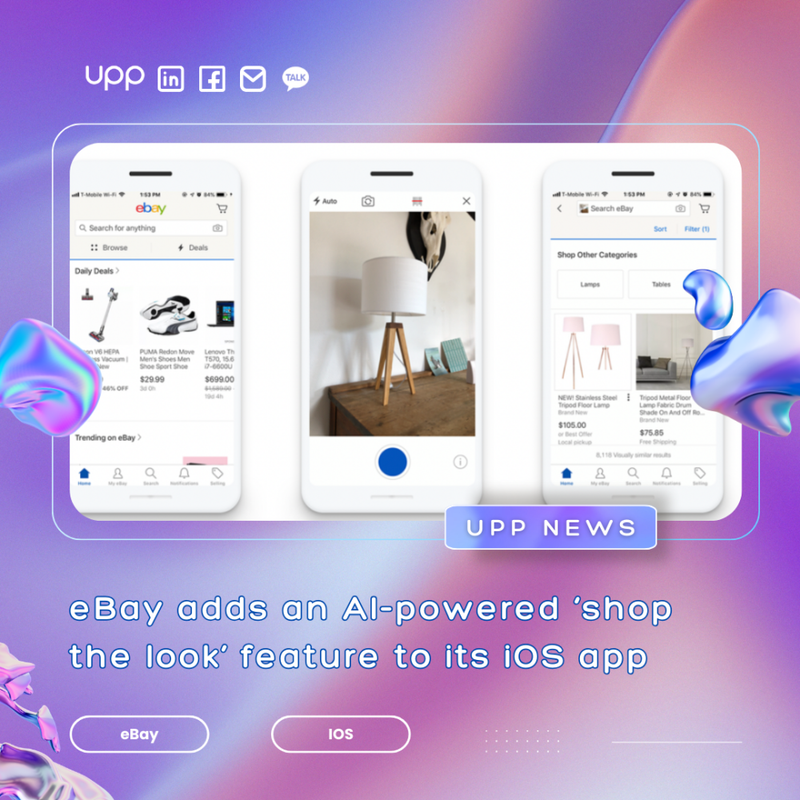
6. eBay adds an AI-powered ‘Shop the Look’ feature to its iOS app.
Source: Mashable
eBay has introduced a new generative AI-powered "Shop the Look" feature in its iOS mobile app, targeting fashion enthusiasts. This feature suggests a carousel of images and outfit ideas personalized to the customer's shopping history, aiming to showcase how other fashion items can complement their current wardrobe. Powered by eBay.ai and developed in collaboration with eBay's Responsible AI team, "Shop the Look" includes interactive hotspots that reveal similar items and outfit inspirations, incorporating preowned and luxury items matching the user's style.
To access "Shop the Look," eBay shoppers need to have viewed at least 10 fashion items in the past 180 days. The feature will be visible on the eBay homepage and the fashion landing page, providing a novel way to display eBay's extensive inventory and potentially drive more sales. eBay plans to expand the feature to other categories in the future and enhance personalization elements over time.
Although eBay is not the only platform leveraging AI in fashion shopping, its focus on fashion inspiration sets it apart from similar initiatives by Google and Amazon. Whereas Google and Amazon's AI features primarily assist customers in finding the right fit or size, eBay's "shop the look" emphasizes discovering the right style, which can be more subjective. Initially available on iOS in the U.S. and U.K., "Shop the Look" will later expand to Android devices.
7. Google Cloud Next 2024: Watch the keynote on Gemini AI, enterprise reveals right here.
Source: York IE
Google's annual Cloud Next event has commenced with a focus on the integration of AI, led by Google Cloud CEO Thomas Kurian's opening keynote at 9 a.m. PT Tuesday. This year's event promises insights into Google's efforts to facilitate the enterprise's transition into the AI era, spanning topics such as Gemini, the AI-driven chatbot, as well as strategies for securing AI products and incorporating generative AI into cloud applications.
Throughout Cloud Next 2024, Google will unveil a variety of updates and innovations, ranging from Google Vids to Gemini Code Assist to enhancements in Google Workspace. This comprehensive approach underscores Google's commitment to addressing diverse needs and interests within its developer community, ensuring a broad spectrum of tools and features to support their endeavours.
For developers eager to delve deeper into Google's offerings and announcements, the Developer Keynote began at 11:30 a.m. PT Wednesday, offering a comprehensive overview of the latest developments. Whether accessed directly or through embedded streams, attendees have access to a wealth of information and insights aimed at driving innovation and collaboration within the developer ecosystem.
8. Poe introduces a price-per-message revenue model for AI bot creators.
Source: Techcrunch
Poe, Quora's AI chatbot platform, now enables creators to set a per-message price for their bots, complementing its existing revenue-sharing program. Launched in February 2023, Poe offers users access to various AI chatbots, aiming to simplify the exploration of new AI technologies.
This move expands revenue opportunities for creators, particularly those developing "prompt bots" and server bots integrated with Poe's AI. They delayed it since its announcement last fall, Quora has now implemented the per-message fee option, allowing creators to earn money based on user interactions. Quora CEO Adam D'Angelo emphasizes the importance of covering operational costs for developers and fostering a thriving ecosystem of model developers and bot creators. The new revenue model is expected to drive the development of diverse bot genres, such as tutoring, knowledge sharing, assistants, analysis, storytelling, and image generation.
While currently available to U.S. bot creators only, global expansion is planned for the future. Additionally, Poe has introduced an enhanced analytics dashboard to provide creators with insights into bot usage and revenue, empowering them to optimize pricing strategies.
👉Want to create a #ChatGPT-powered chatbot built for your business? Try the live demo now: https://lnkd.in/g8UifHr5
Tags cloud
Newsletter
DISCOVER MORE







































![[Recap] UPP Global Technology JSC Establishing Anniversary](/homepage/news-section/new-4.webp)
































LET’S TALK...
Content delivered to your inbox


ENTER YOUR EMAIL
YOU WANT TO...


Hanoi, Vietnam
Web3 Tower, No. 15, Alley 4, Duy Tan, Cau Giay, Hanoi, Vietnam