
Smarter Context Design Starts with Understanding AI Tokens
Date
July 17th, 2026
Reading Time
10 mins
Introduction
Organizations are investing heavily in AI to automate workflows, improve decision making, and unlock greater value from enterprise data. From customer service and internal knowledge management to software development and business analytics, AI is becoming part of everyday operations rather than an experimental technology.
As adoption expands, however, many businesses discover that deploying an AI model is only the beginning. The same model can produce highly accurate responses for one team while generating inconsistent or irrelevant outputs for another. This raises an important question: what actually determines the quality of an AI response?
The answer often lies not in the model itself, but in the information it receives. Understanding how AI tokens shape context is the first step toward building Enterprise AI systems that are accurate, efficient, and scalable. Rather than treating tokens as a purely technical concept, organizations should view them as a key consideration when designing prompts, retrieving knowledge, and integrating AI into business workflows.
What Exactly Are AI Tokens?
When organizations begin building AI applications, discussions often focus on choosing the right model, writing better prompts, or expanding the context window. Those decisions certainly matter, but they all rely on a more fundamental concept: AI tokens. Without understanding how tokens work, it becomes difficult to explain why an AI model performs well in one scenario and struggles in another.
1. What Is an AI Token?
An AI token is the smallest unit of text that a language model processes. Before an AI model can understand a prompt, document, or conversation, it first converts the text into tokens through a process called tokenization. Depending on the model, a token may represent a complete word, part of a word, a number, or a punctuation mark.
Because language models process tokens instead of words, the number of words in a document does not directly reflect how much information the model receives. A single word can be split into multiple tokens, while common words or phrases may be represented by fewer tokens. This is why token count, rather than word count, determines how much information fits within a model's context window and how much computation is required to generate a response.
2. How Tokenization Works in AI Models?
Every prompt, knowledge base article, conversation history, or business document follows the same process before reaching a language model. The content is first converted into tokens, then analyzed during inference to identify relationships and generate the next sequence of tokens as a response.
For Enterprise AI, this means response quality depends not only on the capability of the model but also on the quality of the tokens it receives. Well-structured and relevant context allows the model to focus on meaningful information, while duplicated or irrelevant content can reduce its ability to produce accurate and consistent responses. Understanding this principle is the first step toward building more effective context for AI systems.
How Does an AI Model Process Tokens?
Once a prompt is submitted, an AI model follows a structured process before generating a response. Although this happens in seconds, each stage influences how accurately the model understands the request and produces relevant outputs.
The workflow typically follows this sequence:
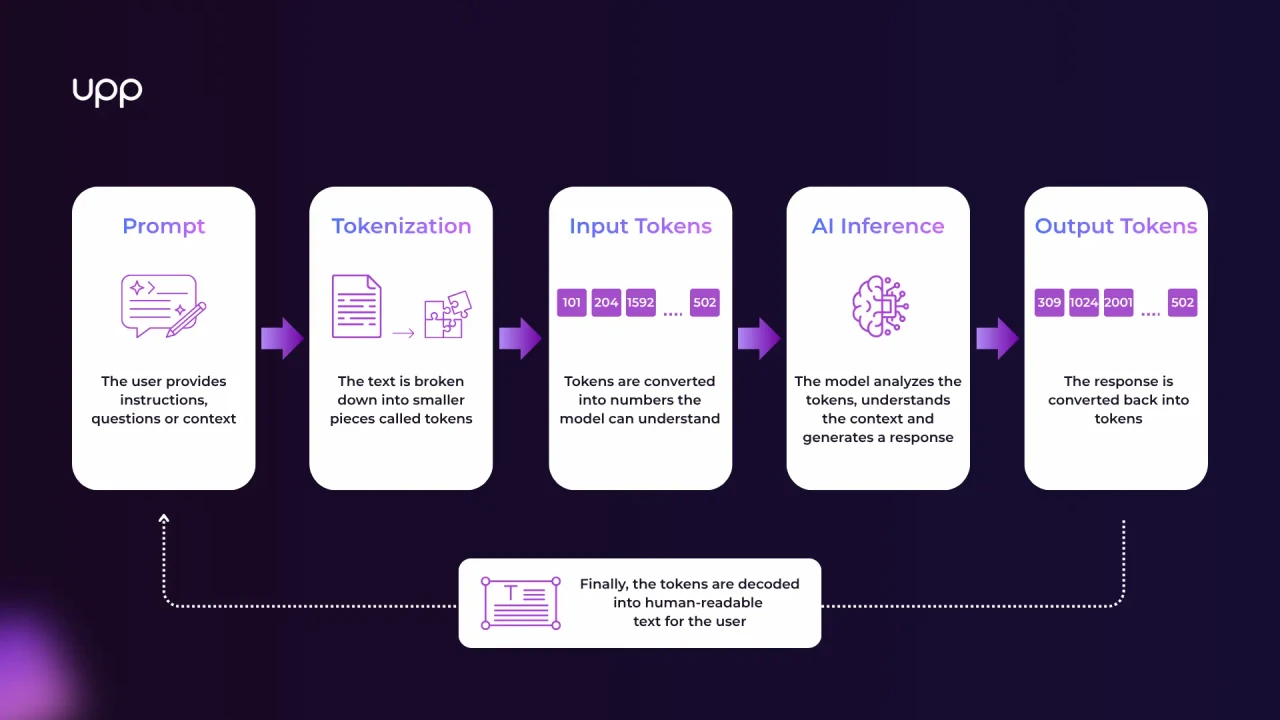
The prompt may include user instructions, conversation history, retrieved documents, or business data. During tokenization, all of this information is converted into tokens. These tokens become input tokens, which the model analyzes during AI inference to identify patterns, understand context, and predict the most appropriate response. The generated answer is then returned as output tokens.
For Enterprise AI, understanding this process helps explain why response quality is closely tied to the quality of the input. If the prompt contains outdated documents, duplicated information, or irrelevant context, the model must spend part of its processing capacity on unnecessary tokens instead of focusing on the information that matters. On the other hand, a well-structured prompt with relevant context allows the model to generate responses that are more accurate, consistent, and aligned with business objectives.
As organizations integrate AI into more business workflows, optimizing the information that enters the model often delivers greater improvements than simply changing to a larger or more advanced model. If every piece of information is processed as tokens, an important question follows: how much information can a language model consider at one time, and how does that affect the quality of its responses?
How Does the Context Window Affect AI Responses?
A context window defines the maximum number of tokens that a language model can process during a single interaction. It includes everything the model needs to consider before generating a response, such as system instructions, user prompts, retrieved knowledge, and conversation history.
A useful way to think about the context window is as the model's working memory. Only the information that fits within this limit can be used for reasoning at that moment. When the available context exceeds the context window, some information must be excluded or summarized before the model begins inference.
As newer language models continue to support larger context windows, it is easy to assume that providing more information will always produce better results. In practice, that is rarely the case. A larger context window increases the amount of information a model can process, but it does not automatically improve its ability to identify what is most relevant. If important business knowledge is buried among duplicated, outdated, or unrelated content, response quality can still decline.
For Enterprise AI, the objective is not to maximize the amount of context sent to the model. The objective is to provide the most relevant context for the specific task, allowing the model to reason more effectively while using tokens efficiently. If a larger context window does not always lead to better responses, the next challenge is determining what information the model actually needs to perform well.
Why More Context Doesn't Always Mean Better AI Performance
AI models are remarkably capable of processing large volumes of information, and it's easy to assume that feeding them more data will automatically produce better results. It's an understandable instinct, especially for organizations sitting on years of CRM records, support tickets, and internal documentation. But when it comes to AI performance, volume and value are not always the same thing.
The real factor is signal versus noise. Every token included in a prompt competes for the model's attention. Relevant tokens sharpen the response. Irrelevant tokens dilute it, and in some cases actively mislead the model by introducing patterns that don't apply to the current question.
Consider a customer support scenario. If an AI assistant is asked to resolve a billing issue and the system feeds it an entire customer interaction history, including unrelated product inquiries, old complaints, and internal notes, the model has to work harder to isolate what's relevant to the billing issue. The AI assistant can still resolve the issue, but reaching that answer takes longer and uses more processing effort than necessary, effort that smarter context design could redirect toward a faster, sharper response.
The goal is not to give AI more context. The goal is to give AI better context.
How Can Context Engineering Improve AI Performance?
Context engineering is the discipline of deliberately structuring what information reaches a model, in what form, and in what order, so that inference happens on the most relevant material available. As enterprises move from pilot projects to production-scale AI systems, this discipline becomes as important as model selection itself.
Filter Context Before Inference
Not every available document or record needs to reach the model. Filtering irrelevant information before inference reduces wasted tokens and keeps the model focused on what actually matters for the task at hand. This is especially important in high-volume environments like customer support or internal search, where unfiltered context quickly overwhelms a prompt.
Retrieve the Right Knowledge
Knowledge retrieval determines which information gets pulled into a prompt in the first place. Retrieval-Augmented Generation, commonly known as RAG, allows a system to dynamically fetch the most relevant documents or records at the moment of the query, rather than relying on static, pre-loaded context. This creates a more adaptive system, where context changes based on what the specific question actually requires.
Optimize Prompt Structure
Prompt optimization is about how instructions are framed, not just what data is included. A well-structured prompt typically separates:
-
The instruction or task
-
The objective or desired outcome
-
The expected format of the output
This structure reduces ambiguity and gives the model a clearer basis for reasoning, which improves both accuracy and consistency across repeated use.
Design AI Workflows Around Context
Context engineering extends beyond a single prompt. It shapes how AI workflows connect to enterprise systems like CRM platforms, ERP systems, and internal knowledge bases. Designing these integrations with context consistency in mind ensures that an AI system pulls accurate, current information regardless of which department or process is initiating the request.
Why Is Context Engineering Becoming a Competitive Advantage?
Prompt engineering focuses on how a single instruction is worded. Context engineering operates at a broader level, shaping what information a system has access to, how it's retrieved, and how it's maintained across an entire AI workflow. As enterprise AI matures, this broader discipline is where the real performance gains happen.
The impact shows up across several dimensions:
-
AI accuracy - cleaner, more relevant context leads to more reliable outputs
-
Token efficiency - filtering and structuring context reduces unnecessary token usage
-
Scalability - well-designed context systems handle growing data volumes without degrading performance
-
Governance - structured retrieval makes it easier to control what information AI systems can access
-
Enterprise AI architecture - context design becomes a foundational layer, not an afterthought
Organizations that succeed with Enterprise AI are not necessarily those using the largest models. They are the ones that deliver the right context at the right time, consistently, across every system that touches their AI workflows.
What Should Businesses Consider Before Scaling Enterprise AI?
Before expanding AI initiatives further, it's worth stepping back and evaluating the foundation those systems are being built on. A practical checklist for enterprise leaders:
-
Knowledge base quality - Is the underlying documentation accurate, current, and well-organized enough to be retrieved reliably?
-
Context design before prompt optimization - Has context structure been addressed first, rather than treating prompt wording as the only lever?
-
Integrated enterprise workflows - Are CRM, ERP, and knowledge systems connected in a way that supports consistent context delivery?
-
AI performance monitoring - Is there a process in place to track response quality and identify where context gaps are causing issues?
-
Token efficiency - Are workflows designed to minimize wasted tokens, both for cost control and response speed?
Answering these questions honestly will reveal more about AI readiness than any model benchmark.
>> Explore UPP's Enterprise AI consulting services
Conclusion
AI tokens are the smallest unit a language model processes, but their influence extends across every layer of enterprise AI performance, from how information is understood to how knowledge is retrieved and how responses are generated. As adoption scales, the organizations that treat context design as a core discipline, rather than a technical afterthought, will be the ones running AI systems that stay accurate and reliable under real business demands.
Investing in smarter context design now builds a foundation that supports long-term AI adoption rather than short-term experimentation. For organizations ready to move beyond pilot projects, a useful next step is assessing how well current systems are structured to deliver context, not just data, to the AI models they depend on.
Tags cloud
Newsletter
DISCOVER MORE








































































![[Recap] UPP Global Technology JSC Establishing Anniversary](/homepage/news-section/new-4.webp)









































LET’S TALK...
Content delivered to your inbox


ENTER YOUR EMAIL
YOU WANT TO...


Hanoi, Vietnam
Web3 Tower, No. 15, Alley 4, Duy Tan, Cau Giay, Hanoi, Vietnam